If you have any questions, you are always welcome to contact us. We'll get back to you as soon as possible, withing 24 hours on weekdays.
Customer service
All questions about your order, return and delivery must be sent to our customer service team by e-mail at yourstore@yourdomain.com
Sale & Press
If you are interested in selling our products, need more information about our brand or wish to make a collaboration, please contact us at press@yourdomain.com
Help
If you have any questions, you are always welcome to contact us. We'll get back to you as soon as possible, withing 24 hours on weekdays.
Customer service
All questions about your order, return and delivery must be sent to our customer service team by e-mail at yourstore@yourdomain.com
Sale & Press
If you are interested in selling our products, need more information about our brand or wish to make a collaboration, please contact us at press@yourdomain.com
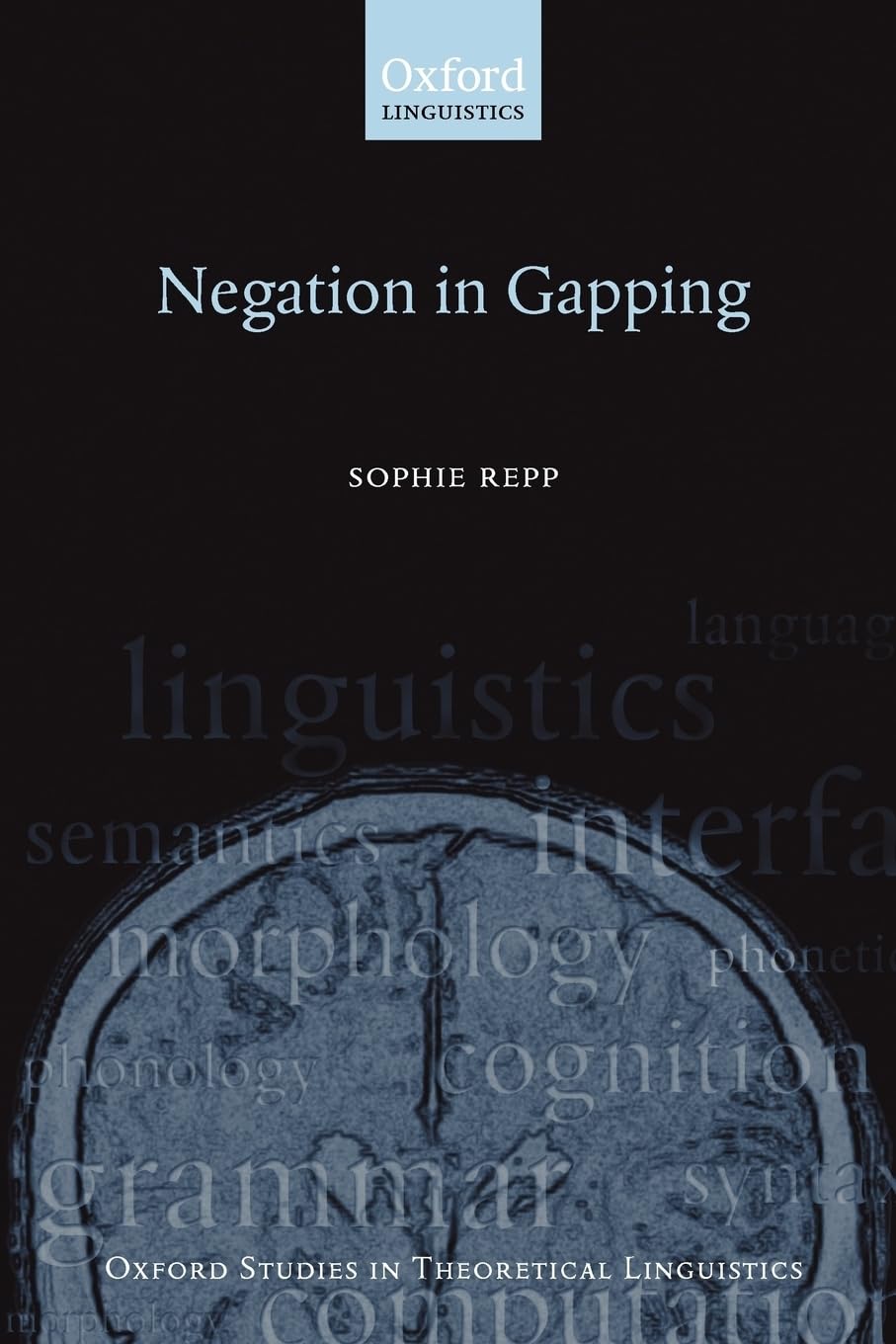
This book presents a crosslinguistic investigation of the behaviour of negation in gapping sentences. Sophie Repp focusses on German and English with reference to Dutch, Japanese, Polish, Russian, and Slovak. She shows that these languages exhibit important differences in the interaction of gapping and negation and further that no account in the literature explains why this should be. Dr Repp also argues that the precise interpretation of an elided negation depends on varying combinations of syntactic, semantic, pragmatic, and prosodic factors. Illustrating her argument by the interpretation of the negation in examples such as 'Pete hasn't got a video and John a DVD', 'Pete didn't clean the whole flat and John laze around all afternoon', and 'To Mary, Pete didn't say anything and to Sue, only that he was hungry', Dr Repp questions a basic assumption in the analysis of gapping: that the meaning of the two conjuncts must be parallel in the elided material. This leads her to a wideranging discussion of the interpretation of scope and the nature of negation. She then proposes a syntactic analysis that both takes into account the interaction of the grammatical interfaces and is at the same time compatible with more general assumptions of current generative theory. She concludes by considering the implications of her findings for linguistic theory more generally.
⚠️ WARNING (California Proposition 65):
This product may contain chemicals known to the State of California to cause cancer,
birth defects, or other reproductive harm.
For MAP (Minimum Advertised Price) violations and Intellectual Property (IP) or Trademark concerns, please contact:
support@ergodebooks.com
⚠️ California Proposition 65 Warning: Some products sold on this website may expose you to chemicals known to the State of California to cause cancer, birth defects, or other reproductive harm. For more information, visit www.P65Warnings.ca.gov.