
Title
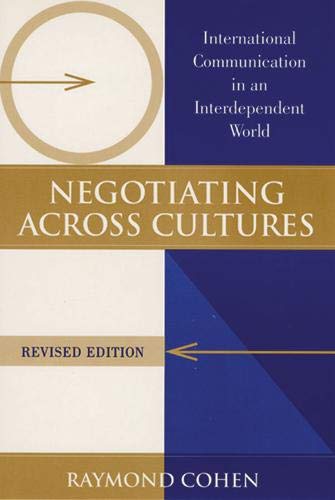
Negotiating Across Cultures: International Communication in an Interdependent World,New
Sold by Ergodebooks, an authorized reseller.
Returns accepted within 30 days | support@ergodebooks.com
Shipping Information
- Free Standard Shipping — United States only
- Processing Time: 3–5 business days
- Estimated Delivery: 6–10 business days after dispatch
- Double-boxed, fully insured & discreetly packaged
- Tracking number sent via email once dispatched
Returns & Refund
Returns accepted within 30 days of delivery.
Damaged or Defective Item
Free return shipping + replacement or full refund
Wrong Item Received
Free return shipping + replacement or full refund
Change of Mind
Return shipping at customer's expense · 25% restocking fee applies
Payment Option

For this substantially revised edition of his 1991 book, Raymond Cohen has added two new chapters, updated previous examples, and added numerous recent ones, especially concerning U.S. trade agreements. Newly added cases include the negotiations over NAFTA, China's mostfavorednation status, the nuclear nonproliferation treaty, and the Okinawa bases. All in all, about 40 percent of the text is new. Cohen explores how cultural factors have affected U.S. dealings with Japan, China, Egypt, India, and Mexico. He demonstrates that there are two quite different models of negotiation: 'low context,' a predominantly verbal and explicit style typical of individualistic societies such as the United States, and 'high context,' a style associated with nonverbal and implicit communication more typical of traditionally interdependent societies. He concludes the book with ten specific recommendations for the intercultural negotiator.
⚠️ WARNING (California Proposition 65):
This product may contain chemicals known to the State of California to cause cancer, birth defects, or other reproductive harm.
For more information, please visit www.P65Warnings.ca.gov.
- Q: What is the main focus of 'Negotiating Across Cultures'? A: The book focuses on the impact of cultural factors on international negotiations, examining how these elements shape interactions among countries.
- Q: Who is the author of 'Negotiating Across Cultures'? A: The author is Raymond Cohen, who has revised and updated his original work from 1991.
- Q: What new content is included in the revised edition? A: The revised edition includes two new chapters, updated examples, and approximately 40 percent of new text, particularly about recent trade agreements.
- Q: How many pages does the book have? A: The book contains 268 pages.
- Q: What are the key negotiation models discussed in the book? A: Cohen discusses two models: 'low context', which is verbal and explicit, and 'high context', which relies on nonverbal and implicit communication.
- Q: What is the condition of the book being sold? A: The book is listed as a 'Used Book in Good Condition'.
- Q: When was 'Negotiating Across Cultures' published? A: The book was published on January 1, 1997.
- Q: What category does this book fall under? A: It is categorized under Social Sciences.
- Q: What type of binding does the book have? A: The book is available in paperback binding.
- Q: What are some recommendations provided in the book? A: Cohen concludes with ten specific recommendations for intercultural negotiators to improve their effectiveness.