
Title
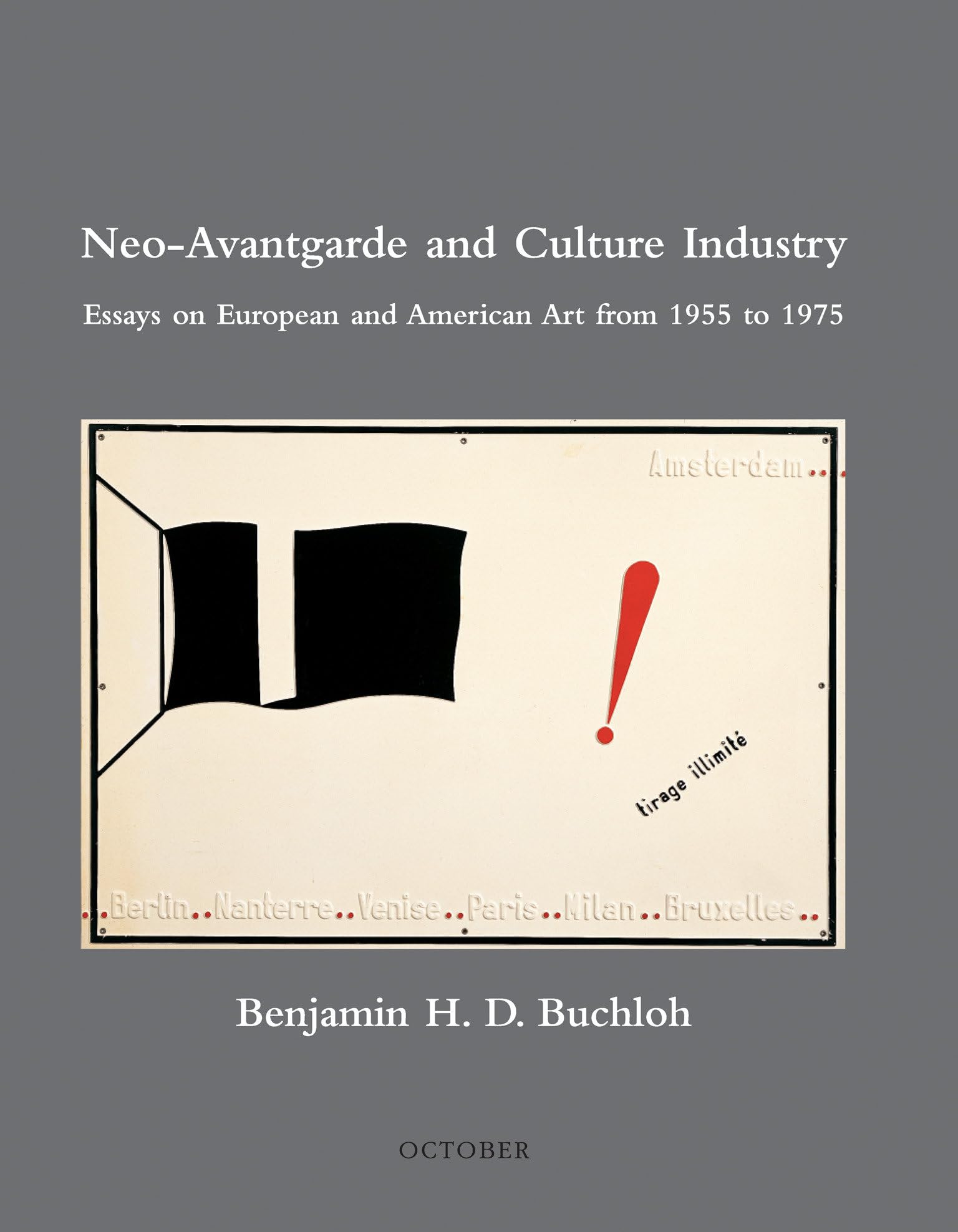
Neoavantgarde And Culture Industry: Essays On European And American Art From 1955 To 1975 (October Books),Used
Sold by Ergodebooks, an authorized reseller.
Returns accepted within 30 days | support@ergodebooks.com
Shipping Information
- Free Standard Shipping — United States only
- Processing Time: 3–5 business days
- Estimated Delivery: 6–10 business days after dispatch
- Double-boxed, fully insured & discreetly packaged
- Tracking number sent via email once dispatched
Returns & Refund
Returns accepted within 30 days of delivery.
Damaged or Defective Item
Free return shipping + replacement or full refund
Wrong Item Received
Free return shipping + replacement or full refund
Change of Mind
Return shipping at customer's expense · 25% restocking fee applies
Payment Option

Eighteen Essays Written By Buchloh Over The Last Twenty Years, Each Looking At A Single Artist Within The Framework Of Specific Theoretical And Historical Questions.Some Critics View The Postwar Avantgarde As The Empty Recycling Of Forms And Strategies From The First Two Decades Of The Twentieth Century. Others View It, More Positively, As A New Articulation Of The Specific Conditions Of Cultural Production In The Postwar Period. Benjamin Buchloh, One Of The Most Insightful Art Critics And Theoreticians Of Recent Decades, Argues For A Dialectical Approach To These Positions.This Collection Contains Eighteen Essays Written By Buchloh Over The Last Twenty Years. Each Looks At A Single Artist Within The Framework Of Specific Theoretical And Historical Questions. The Art Movements Covered Include Nouveau Realisme In France (Arman, Yves Klein, Jacques De La Villegle) Art In Postwar Germany (Joseph Beuys, Sigmar Polke, Gerhard Richter), American Fluxus And Pop Art (Robert Watts And Andy Warhol), Minimalism And Postminimal Art (Michael Asher And Richard Serra), And European And American Conceptual Art (Daniel Buren, Dan Graham). Buchloh Addresses Some Artists In Terms Of Their Oppositional Approaches To Language And Painting, For Example, Nancy Spero And Lawrence Weiner. About Others, He Asks More General Questions Concerning The Development Of Models Of Institutional Critique (Hans Haacke) And The Theorization Of The Museum (Marcel Broodthaers); Or He Addresses The Formation Of Historical Memory In Postconceptual Art (James Coleman). One Of The Book'S Strengths Is Its Systematic, Interconnected Account Of The Key Issues Of American And European Artistic Practice During Two Decades Of Postwar Art. Another Is Buchloh'S Method, Which Integrates Formalist And Sociohistorical Approaches Specific To Each Subject.
⚠️ WARNING (California Proposition 65):
This product may contain chemicals known to the State of California to cause cancer, birth defects, or other reproductive harm.
For more information, please visit www.P65Warnings.ca.gov.
- Q: How many pages does the book contain? A: This book contains six hundred thirty-two pages. It provides a comprehensive look at various art movements and artists.
- Q: What are the dimensions of the book? A: The book measures seven point zero six inches in length, one point one eight inches in width, and nine point zero six inches in height.
- Q: What type of binding does the book have? A: The book is published in paperback binding. This makes it lightweight and portable for reading.
- Q: Who is the author of the book? A: The author of the book is Benjamin H. D. Buchloh. He is a well-known art critic and theoretician.
- Q: What is the main subject of the book? A: The book focuses on European and American art from nineteen fifty-five to nineteen seventy-five. It includes essays on various artists and art movements.
- Q: How do I read this book? A: You can read this book by simply picking it up and starting from the first essay. Each essay can be read independently.
- Q: Is this book suitable for art students? A: Yes, this book is suitable for art students. It provides in-depth analysis and critical perspectives on significant artists and movements.
- Q: Can I find specific artists discussed in the book? A: Yes, the book discusses artists like Arman, Yves Klein, and Andy Warhol. Each essay focuses on a single artist.
- Q: How should I store this book? A: You should store this book in a dry place, upright on a shelf. This will help prevent damage to the binding and pages.
- Q: Is this book safe for kids? A: No, this book is not specifically designed for kids. It contains advanced art critiques and themes that may not be suitable.
- Q: What if the book arrives damaged? A: If the book arrives damaged, you should contact the seller for a return or replacement. Most sellers have a return policy for damaged items.
- Q: Does the book include illustrations? A: Yes, the book includes illustrations relevant to the essays. These visuals support the analysis of the discussed artworks.
- Q: Is there a glossary or index in the book? A: Yes, there is an index in the book. This helps readers find specific topics or artists easily.
- Q: What makes this book unique? A: This book is unique due to its dialectical approach to art criticism. It connects various theoretical and historical questions.
- Q: Can I gift this book to someone interested in art? A: Yes, this book makes a great gift for anyone interested in art history or criticism. It offers valuable insights.
- Q: What is the publication year of the book? A: The book was published in two thousand.