If you have any questions, you are always welcome to contact us. We'll get back to you as soon as possible, withing 24 hours on weekdays.
Customer service
All questions about your order, return and delivery must be sent to our customer service team by e-mail at yourstore@yourdomain.com
Sale & Press
If you are interested in selling our products, need more information about our brand or wish to make a collaboration, please contact us at press@yourdomain.com
Help
If you have any questions, you are always welcome to contact us. We'll get back to you as soon as possible, withing 24 hours on weekdays.
Customer service
All questions about your order, return and delivery must be sent to our customer service team by e-mail at yourstore@yourdomain.com
Sale & Press
If you are interested in selling our products, need more information about our brand or wish to make a collaboration, please contact us at press@yourdomain.com
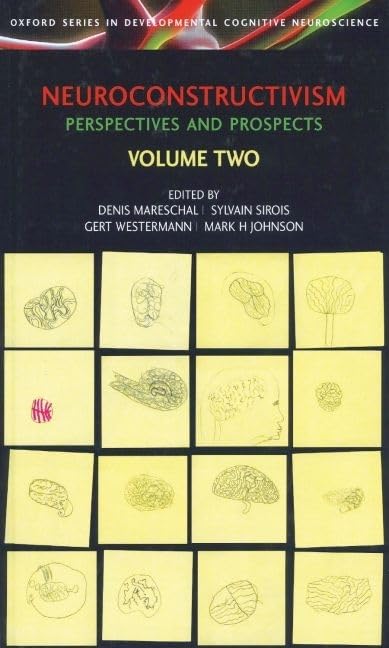
What are the processes, from conception to adulthood, that enable a single cell to grow into a sentient adult? They are so complex that any attempt to understand development necessitates a multidisciplinary approach, integrating data from cognitive studies, computational modeling, and neuroimagingan approach until now seldom taken when considering child development. Neuroconstructivism is a major twovolume work that seeks to redress this balance, presenting an integrative new framework for considering development. In Volume One, the authors review uptodate findings from neurobiology, brain imaging, child development, as well computer and robotic modeling to consider why children's thinking develops the way it does, and propose a new synthesis of development that is based on five key principles found to operate at many different levels of description. Their Neuroconstructivist framework also shows how developmental disorders, such as dyslexia, can arise from typical developmental processes operating under atypical constraints. Of central importance to Neuroconstructivism is the idea that computer and robotic models are vital tools for investigating the processes and mechanisms involved in learning and development. Volume Two illustrates the principles of Neuroconstructivist development through contributions from nine different labs across the world. This volume complements Volume One by providing concrete examples of how the Neuroconstructivist principles can be grounded in a diverse range of domains, and thereby shape the research agenda in each.
⚠️ WARNING (California Proposition 65):
This product may contain chemicals known to the State of California to cause cancer,
birth defects, or other reproductive harm.
For MAP (Minimum Advertised Price) violations and Intellectual Property (IP) or Trademark concerns, please contact:
support@ergodebooks.com
⚠️ California Proposition 65 Warning: Some products sold on this website may expose you to chemicals known to the State of California to cause cancer, birth defects, or other reproductive harm. For more information, visit www.P65Warnings.ca.gov.