If you have any questions, you are always welcome to contact us. We'll get back to you as soon as possible, withing 24 hours on weekdays.
Customer service
All questions about your order, return and delivery must be sent to our customer service team by e-mail at yourstore@yourdomain.com
Sale & Press
If you are interested in selling our products, need more information about our brand or wish to make a collaboration, please contact us at press@yourdomain.com
Help
If you have any questions, you are always welcome to contact us. We'll get back to you as soon as possible, withing 24 hours on weekdays.
Customer service
All questions about your order, return and delivery must be sent to our customer service team by e-mail at yourstore@yourdomain.com
Sale & Press
If you are interested in selling our products, need more information about our brand or wish to make a collaboration, please contact us at press@yourdomain.com
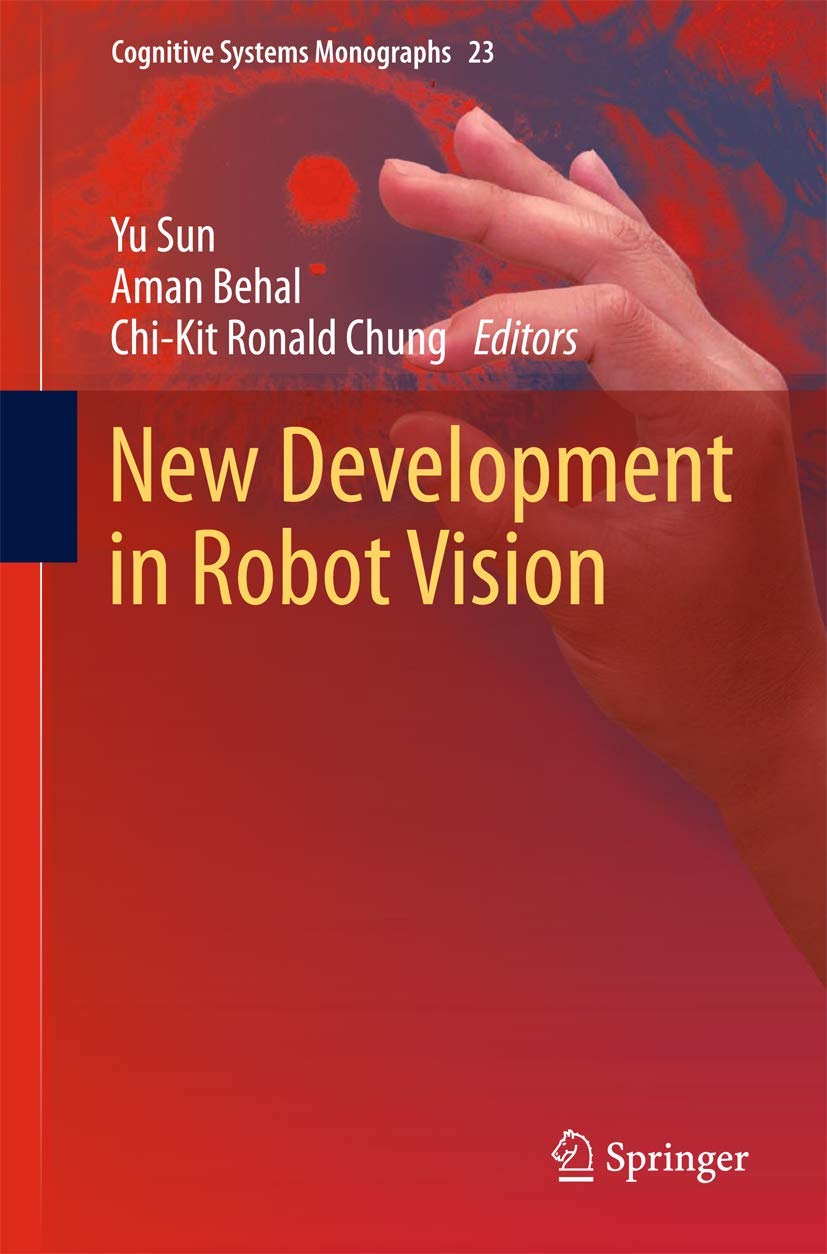
The field of robotic vision has advanced dramatically recently with the development of new range sensors. Tremendous progress has been made resulting in significant impact on areas such as robotic navigation, scene/environment understanding, and visual learning. This edited book provides a solid and diversified reference source for some of the most recent important advancements in the field of robotic vision. The book starts with articles that describe new techniques to understand scenes from 2D/3D data such as estimation of planar structures, recognition of multiple objects in the scene using different kinds of features as well as their spatial and semantic relationships, generation of 3D object models, approach to recognize partially occluded objects, etc. Novel techniques are introduced to improve 3D perception accuracy with other sensors such as a gyroscope, positioning accuracy with a visual servoing based alignment strategy for microassembly, and increasing object recognition reliability using related manipulation motion models. For autonomous robot navigation, different visionbased localization and tracking strategies and algorithms are discussed. New approaches using probabilistic analysis for robot navigation, online learning of visionbased robot control, and 3D motion estimation via intensity differences from a monocular camera are described. This collection will be beneficial to graduate students, researchers, and professionals working in the area of robotic vision.
⚠️ WARNING (California Proposition 65):
This product may contain chemicals known to the State of California to cause cancer,
birth defects, or other reproductive harm.
For MAP (Minimum Advertised Price) violations and Intellectual Property (IP) or Trademark concerns, please contact:
support@ergodebooks.com
⚠️ California Proposition 65 Warning: Some products sold on this website may expose you to chemicals known to the State of California to cause cancer, birth defects, or other reproductive harm. For more information, visit www.P65Warnings.ca.gov.