
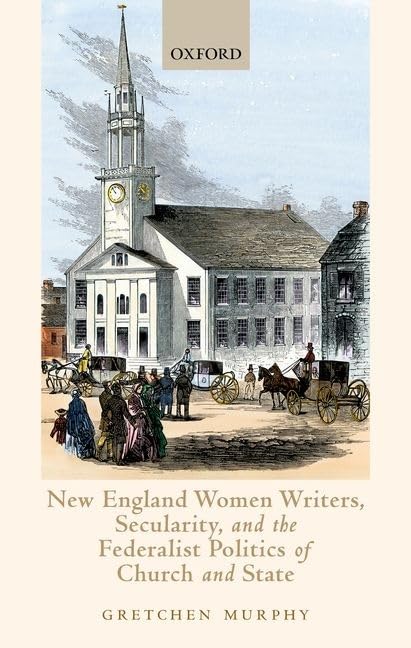
Title
New England Women Writers, Secularity, and the Federalist Politics of Church and State,Used
Sold by Ergodebooks, an authorized reseller.
Returns accepted within 30 days | support@ergodebooks.com
Shipping Information
- Free Standard Shipping — United States only
- Processing Time: 3–5 business days
- Estimated Delivery: 6–10 business days after dispatch
- Double-boxed, fully insured & discreetly packaged
- Tracking number sent via email once dispatched
Returns & Refund
Returns accepted within 30 days of delivery.
Damaged or Defective Item
Free return shipping + replacement or full refund
Wrong Item Received
Free return shipping + replacement or full refund
Change of Mind
Return shipping at customer's expense · 25% restocking fee applies
Payment Option

Drawing on literature, correspondence, sermons, legal writing, and newspaper publishing, this book offers a new account women's political participation and the process of religious disestablishment. Scholars have long known that eighteenth and nineteenthcentury American women wrote pious, sentimental stories, but this book uses biographical and archival methods to understand their religious concerns as entry points into the era's debates about democratic conditions of possibility and the role of religion in a republic. Beginning with the early republic's constitutional and electoral contests about the end of religious establishment and extending through the nineteenth century, Murphy argues that Federalist women and Federalist daughters of the next generation adapted that party's ideas and fears by promoting privatized Christianity with public purpose. Harriet Beecher Stowe, Catharine Sedgwick, Lydia Sigourney, Judith Sargent Murray, and Sally Sayward Wood authorised themselves as Federalism's literary curators, and in doing so they imagined new configurations of religion and revolution, faith and rationality, public and private. They did so using literary form, writing in gothic, sentimental, and regionalist genres to update the Federalist concatenation of religion, morality, and government in response to changing conditions of secularity and religious privatization in the new republic. Murphy shows that their project both complicates received narratives of separation of church and state and illuminates the problem of democracy and belief in postsecular America.
⚠️ WARNING (California Proposition 65):
This product may contain chemicals known to the State of California to cause cancer, birth defects, or other reproductive harm.
For more information, please visit www.P65Warnings.ca.gov.