If you have any questions, you are always welcome to contact us. We'll get back to you as soon as possible, withing 24 hours on weekdays.
Customer service
All questions about your order, return and delivery must be sent to our customer service team by e-mail at yourstore@yourdomain.com
Sale & Press
If you are interested in selling our products, need more information about our brand or wish to make a collaboration, please contact us at press@yourdomain.com
Help
If you have any questions, you are always welcome to contact us. We'll get back to you as soon as possible, withing 24 hours on weekdays.
Customer service
All questions about your order, return and delivery must be sent to our customer service team by e-mail at yourstore@yourdomain.com
Sale & Press
If you are interested in selling our products, need more information about our brand or wish to make a collaboration, please contact us at press@yourdomain.com
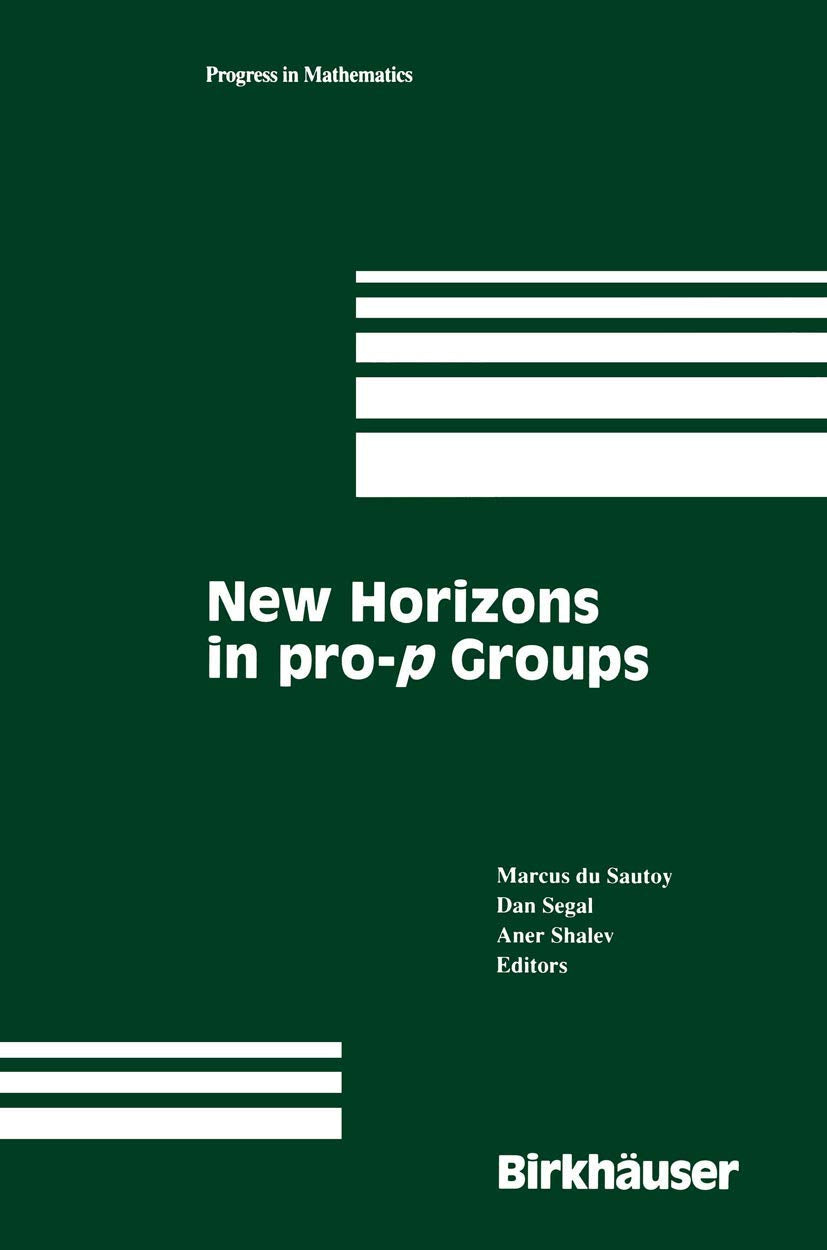
A prop group is the inverse limit of some system of finite pgroups, that is, of groups of primepower order where the prime conventionally denoted p is fixed. Thus from one point of view, to study a prop group is the same as studying an infinite family of finite groups; but a prop group is also a compact topological group, and the compactness works its usual magic to bring 'infinite' problems down to manageable proportions. The padic integers appeared about a century ago, but the systematic study of prop groups in general is a fairly recent development. Although much has been dis covered, many avenues remain to be explored; the purpose of this book is to present a coherent account of the considerable achievements of the last several years, and to point the way forward. Thus our aim is both to stimulate research and to provide the comprehensive background on which that research must be based. The chapters cover a wide range. In order to ensure the most authoritative account, we have arranged for each chapter to be written by a leading contributor (or contributors) to the topic in question. Prop groups appear in several different, though sometimes overlapping, contexts.
⚠️ WARNING (California Proposition 65):
This product may contain chemicals known to the State of California to cause cancer,
birth defects, or other reproductive harm.
For MAP (Minimum Advertised Price) violations and Intellectual Property (IP) or Trademark concerns, please contact:
support@ergodebooks.com
⚠️ California Proposition 65 Warning: Some products sold on this website may expose you to chemicals known to the State of California to cause cancer, birth defects, or other reproductive harm. For more information, visit www.P65Warnings.ca.gov.