
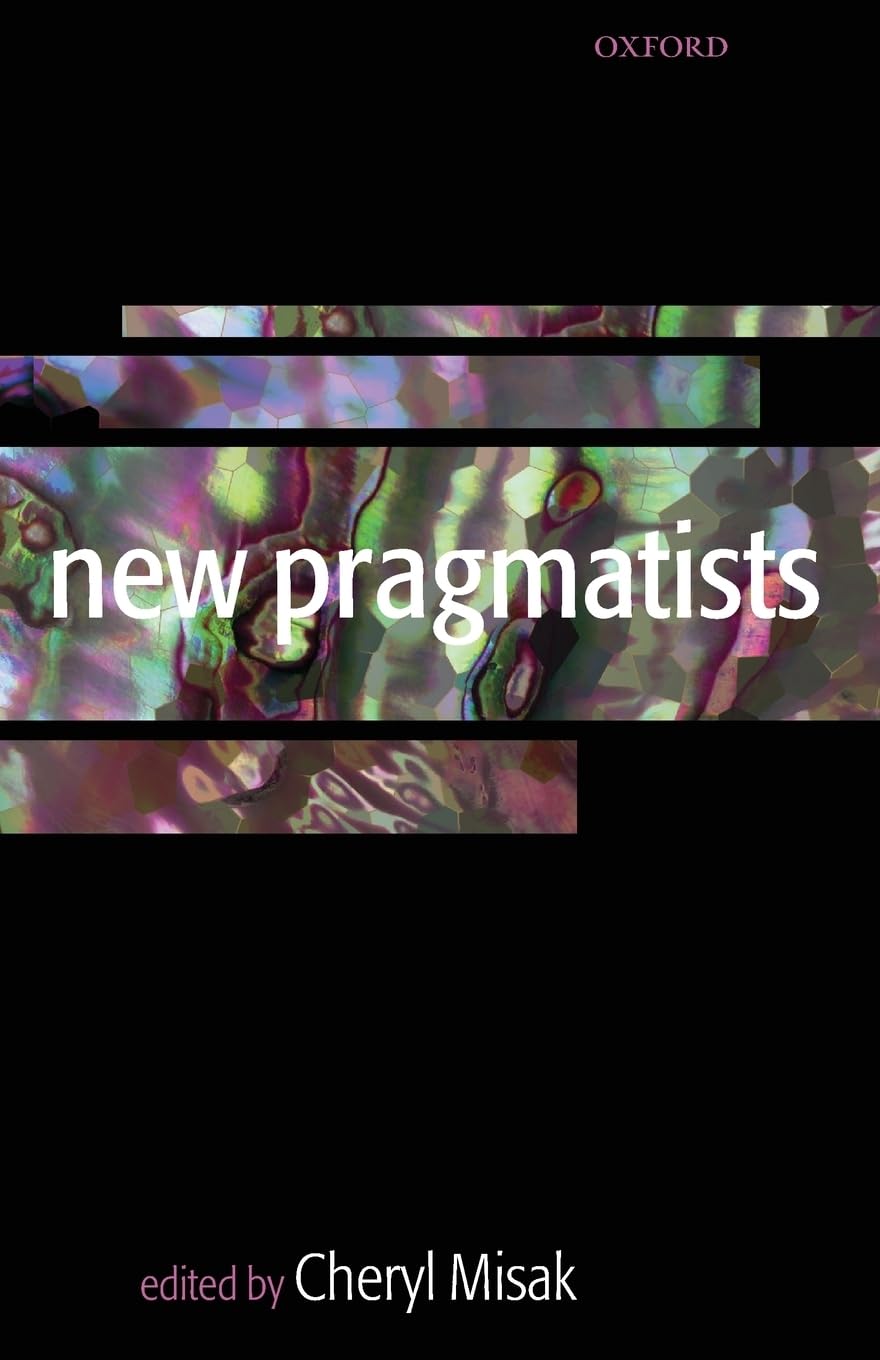
Title
New Pragmatists,Used
Sold by Ergodebooks, an authorized reseller.
Returns accepted within 30 days | support@ergodebooks.com
Shipping Information
- Free Standard Shipping — United States only
- Processing Time: 3–5 business days
- Estimated Delivery: 6–10 business days after dispatch
- Double-boxed, fully insured & discreetly packaged
- Tracking number sent via email once dispatched
Returns & Refund
Returns accepted within 30 days of delivery.
Damaged or Defective Item
Free return shipping + replacement or full refund
Wrong Item Received
Free return shipping + replacement or full refund
Change of Mind
Return shipping at customer's expense · 25% restocking fee applies
Payment Option

Pragmatism is the view that our philosophical concepts must be connected to our practices philosophy must stay connected to first order inquiry, to real examples, to reallife expertise. The classical pragmatists, Charles Sanders Peirce, William James, and John Dewey, put forward views of truth, rationality, and morality that they took to be connected to, and good for, our practices of inquiry and deliberation. When Richard Rorty, the bestknown contemporary pragmatist, looks at our practices, he finds that we don't aim at truth or objectivity, but only at solidarity, or agreement within a community, or what our peers will let us get away with saying. There is, however, a revisionist movement amongst contemporary philosophers who are interested in pragmatism. When these new pragmatists examine our practices, they find that the trail of the human serpent is over everything, as James said, but this does not toss us into the sea of postmodern arbitrariness, where truth varies from person to person and culture to culture. The fact that our standards of objectivity come into being and evolve over time does not detract from their objectivity. As Peirce and Dewey stressed, we are always immersed in a context of inquiry, where the decision to be made is a decision about what to believe from here, not what to believe were we able to start from scratch from certain infallible foundations. But we do not go forward arbitrarily. That is, these new pragmatists provide accounts of inquiry that are both recognizably pragmatic in orientation and hospitable to the cognitive aspiration to get one's subject matter right. The best of Peirce, James, and Dewey has thus resurfaced in deep, interesting, and fruitful ways, explored in this volume by David Bakhurst, Arthur Fine, Ian Hacking, David Macarthur, Danielle Macbeth, Cheryl Misak, Terry Pinkard, Huw Price, and Jeffrey Stout.
⚠️ WARNING (California Proposition 65):
This product may contain chemicals known to the State of California to cause cancer, birth defects, or other reproductive harm.
For more information, please visit www.P65Warnings.ca.gov.