
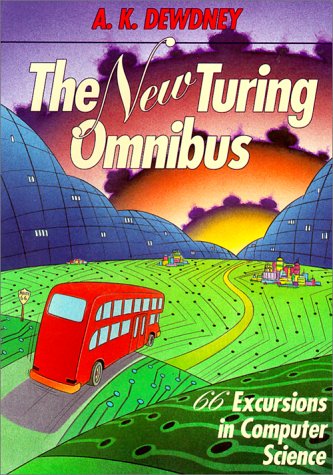
Title
New Turing Omnibus (New Turning Omnibus : 66 Excursions In Computer Science)
Sold by Ergodebooks, an authorized reseller.
Returns accepted within 30 days | support@ergodebooks.com
Shipping Information
- Free Standard Shipping — United States only
- Processing Time: 3–5 business days
- Estimated Delivery: 6–10 business days after dispatch
- Double-boxed, fully insured & discreetly packaged
- Tracking number sent via email once dispatched
Returns & Refund
Returns accepted within 30 days of delivery.
Damaged or Defective Item
Free return shipping + replacement or full refund
Wrong Item Received
Free return shipping + replacement or full refund
Change of Mind
Return shipping at customer's expense · 25% restocking fee applies
Payment Option

No Other Volume Provides As Broad, As Thorough, Or As Accessible An Introduction To The Realm Of Computers As A. K. Dewdney'S The Turing Omnibus.Updated And Expanded, The Turing Omnibus Offers 66 Concise, Brilliantly Written Articles On The Major Points Of Interest In Computer Science Theory, Technology, And Applications. New For This Tour: Updated Information On Algorithms, Detecting Primes, Noncomputable Functions, And Selfreplicating Computersplus Completely New Sections On The Mandelbrot Set, Genetic Algorithms, The Newtonraphson Method, Neural Networks That Learn, Dos Systems For Personal Computers, And Computer Viruses.Contents:1 Algorithms 2 Finite Automata 3 Systems Of Logic 4 Simulation 5 Godel'S Theorem 6 Game Trees 7 The Chomsky Hierarchy 8 Random Numbers 9 Mathematical Research 10 Program Correctness 11 Search Trees 12 Errorcorecting Codes 13 Boolean Logic 14 Regular Languages 15 Time And Space Complexity 16 Genetic Algorithms 17 The Random Access Machine 18 Spline Curves 19 Computer Vision 20 Karnaugh Maps 21 The Newtonraphson Method 22 Minimum Spanning Trees 23 Generative Grammars 24 Recursion 25 Fast Multiplication 26 Nondeterminism 27 Perceptrons 28 Encoders And Multiplexers 29 Cat Scanning 30 The Partition Problem 31 Turing Machines 32 The Fast Fourier Transform 33 Analog Computing 34 Satisfiability 35 Sequential Sorting 36 Neural Networks That Learn 37 Public Key Cryptography 38 Sequential Cirucits 39 Noncomputerable Functions 40 Heaps And Merges 41 Npcompleteness 42 Number Systems For Computing 43 Storage By Hashing 44 Cellular Automata 45 Cook'S Theorem 46 Selfreplicating Computers 47 Storing Images 48 The Scram 49 Shannon'S Theory 50 Detecting Primes 51 Universal Turing Machines 52 Text Compression 53 Disk Operating Systems 54 Npcomplete Problems 55 Iteration And Recursion 56 Vlsi Computers 57 Linear Programming 58 Predicate Calculus 59 The Halting Problem 60 Computer Viruses 61 Searching Strings 62 Parallel Computing 63 The Word Problem 64 Logic Programming 65 Relational Data Bases 66 Church'S Thesis
⚠️ WARNING (California Proposition 65):
This product may contain chemicals known to the State of California to cause cancer, birth defects, or other reproductive harm.
For more information, please visit www.P65Warnings.ca.gov.
- Q: How many pages does the New Turing Omnibus have? A: The New Turing Omnibus has four hundred eighty pages. This extensive coverage provides a broad introduction to computer science.
- Q: What is the binding type of the New Turing Omnibus? A: The book is available in paperback binding. This makes it more flexible and easier to handle.
- Q: What are the dimensions of the New Turing Omnibus? A: The dimensions are approximately zero point ninety-eight inches in thickness, six point five inches in width, and nine point twenty-five inches in height. These measurements make it a convenient size for reading.
- Q: Who is the author of the New Turing Omnibus? A: The author is A.K. Dewdney. He presents complex topics in an accessible manner for readers.
- Q: What topics are covered in the New Turing Omnibus? A: The book covers foundational theories, technology, and applications in computer science. Key topics include algorithms, neural networks, and computer viruses.
- Q: Is the New Turing Omnibus suitable for beginners? A: Yes, it is suitable for beginners. The book provides concise articles that introduce major concepts in computer science.
- Q: Can I use the New Turing Omnibus as a textbook? A: Yes, it can be used as a supplementary textbook. Its structured articles cover essential topics in computer science.
- Q: What reading level is appropriate for the New Turing Omnibus? A: It is appropriate for high school and college students. The writing is clear and engaging, making it accessible.
- Q: How should I store the New Turing Omnibus? A: Store it in a cool, dry place away from direct sunlight. This helps preserve the quality of the paperback.
- Q: Can I clean the New Turing Omnibus? A: Yes, you can gently wipe the cover with a damp cloth. Avoid using harsh chemicals to maintain its condition.
- Q: What if the New Turing Omnibus arrives damaged? A: You can contact customer support for a replacement. Most sellers have a return policy for damaged items.
- Q: Does the New Turing Omnibus include updated information? A: Yes, it includes updated information and new sections in this edition. Topics like genetic algorithms and the Mandelbrot set are newly added.
- Q: Is the New Turing Omnibus a comprehensive resource? A: Yes, it is a comprehensive resource for computer science enthusiasts. The collection of articles covers a wide range of relevant topics.
- Q: What is the publication year of the New Turing Omnibus? A: The latest edition was published in two thousand. This edition has been updated and expanded from previous versions.
- Q: Is the New Turing Omnibus appropriate for adults? A: Yes, it is appropriate for adult readers interested in computer science. The content is engaging and informative for all ages.