
Title
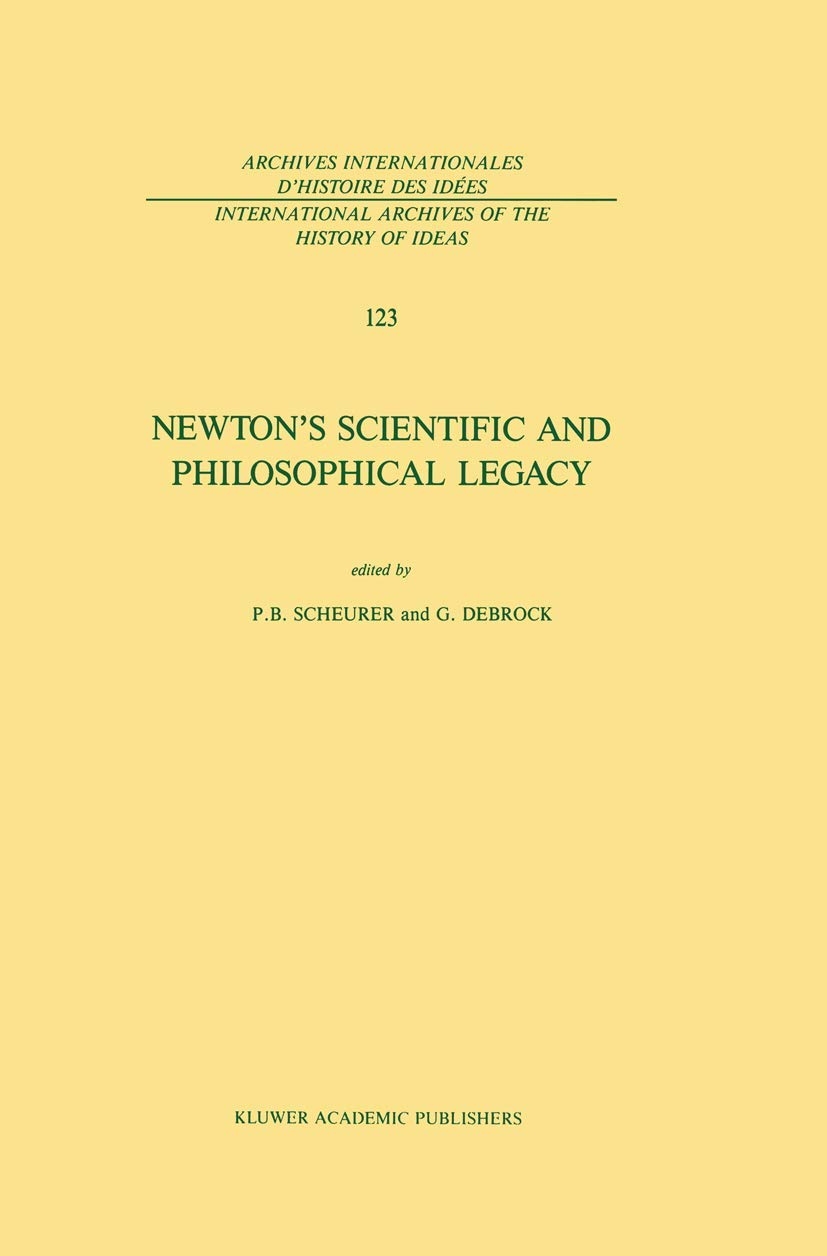
Newtons Scientific and Philosophical Legacy (International Archives of the History of Ideas Archives internationales d'histoire ,Used
Sold by Ergodebooks, an authorized reseller.
Returns accepted within 30 days | support@ergodebooks.com
Shipping Information
- Free Standard Shipping — United States only
- Processing Time: 3–5 business days
- Estimated Delivery: 6–10 business days after dispatch
- Double-boxed, fully insured & discreetly packaged
- Tracking number sent via email once dispatched
Returns & Refund
Returns accepted within 30 days of delivery.
Damaged or Defective Item
Free return shipping + replacement or full refund
Wrong Item Received
Free return shipping + replacement or full refund
Change of Mind
Return shipping at customer's expense · 25% restocking fee applies
Payment Option

This volume contains the Proceedings of the International Colloqui um "Newton's Scientific and Philosophical Legacy", that was held at the Catholic University of Nijmegen (The Netherlands) from June 9th to 12th 1987 to celebrate the Tercentenary of the publication of Newton's Philo sophiae Naturalis Principia Mathematica (1667). Although 1987 was a busy year for Newton scholars, we were happy that five of most prom inent among them were able to come to Nijmegen and speak on the vari ous aspects of Newton's thought. They are the Professors I. Bernard Cohen (Harvard), Gale Christianson (Indiana State), B. J. Dobbs (Northwestern), Richard H. Popkin (UCLA) and Mordechai Feingold (Boston University). No doubt, recent scholarship has put Newton's genius in a quite different perspective from the one that had come to make up what may be called Newtonian mythology. Although his achievements in the areas of mechanics, mathematics, and optics remain indisputed, Newton's scientific efforts were apparently entirely subordi nate to his religious beliefs. This volume has been divided into four parts, preceded by a Pream ble in which Prof. Christianson offers a vivid portrait of Newton as a per son. The first part deals with the science of Newton as he himself under stood that term. The second part considers the influence of Newton's work on later scientific developments. The third part deals primarily with the question of the methodological influence of Newton, and the last part with his more philosophical legacy. Two editorial remarks are due.
⚠️ WARNING (California Proposition 65):
This product may contain chemicals known to the State of California to cause cancer, birth defects, or other reproductive harm.
For more information, please visit www.P65Warnings.ca.gov.