
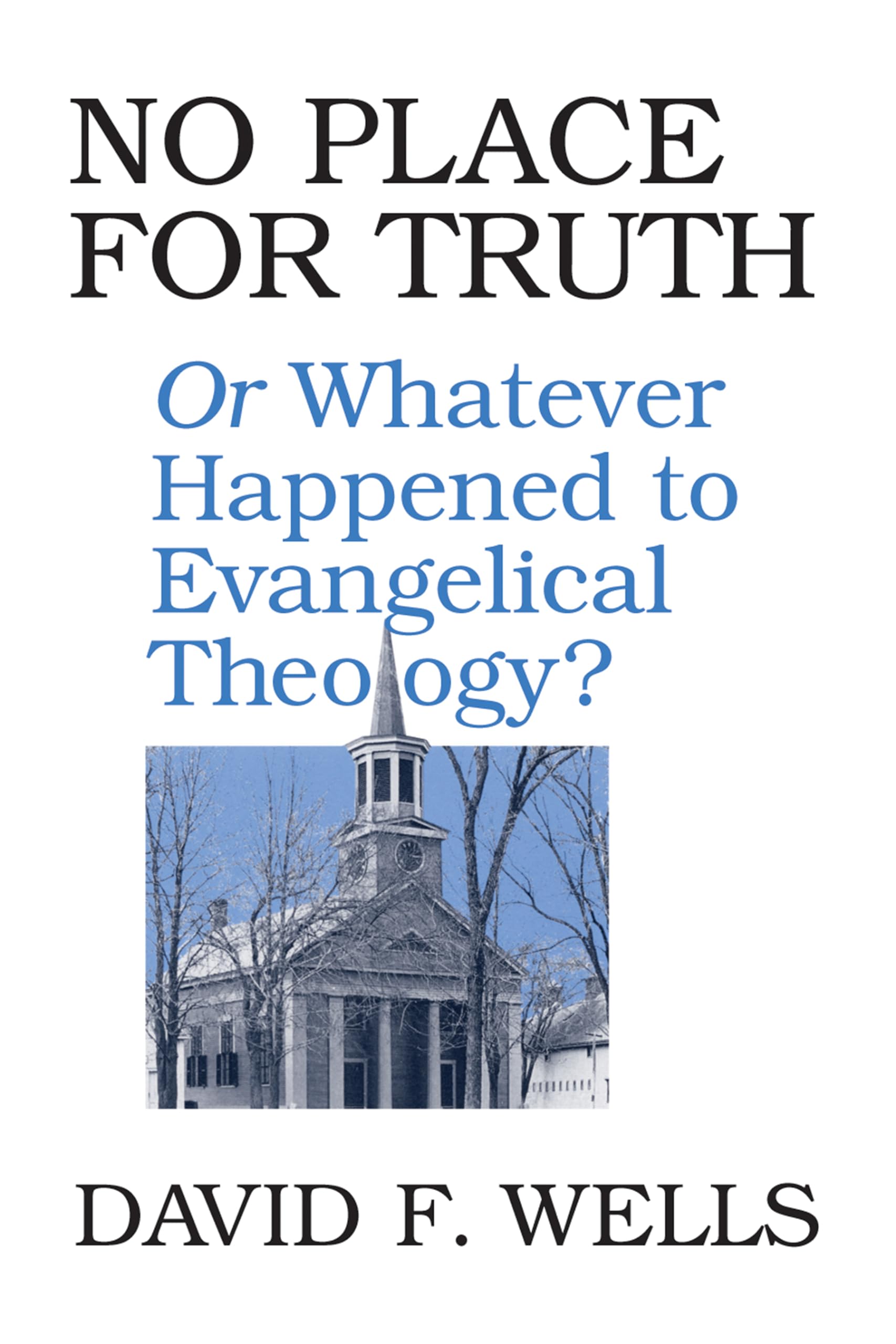
Title
No Place for Truth: or Whatever Happened to Evangelical Theology?,Used
Sold by Ergodebooks, an authorized reseller.
Returns accepted within 30 days | support@ergodebooks.com
Shipping Information
- Free Standard Shipping — United States only
- Processing Time: 3–5 business days
- Estimated Delivery: 6–10 business days after dispatch
- Double-boxed, fully insured & discreetly packaged
- Tracking number sent via email once dispatched
Returns & Refund
Returns accepted within 30 days of delivery.
Damaged or Defective Item
Free return shipping + replacement or full refund
Wrong Item Received
Free return shipping + replacement or full refund
Change of Mind
Return shipping at customer's expense · 25% restocking fee applies
Payment Option

Has something indeed happened to evangelical theology and to evangelical churches? According to David Wells, the evidence indicates that evangelical pastors have abandoned their traditional role as ministers of the Word to become therapists and 'managers of the small enterprises we call churches.' Along with their parishioners, they have abandoned genuine Christianity and biblical truth in favor of the sort of innerdirected experiential religion that now pervades Western society.Specifically, Wells explores the wholesale disappearance of theology in the church, the academy, and modern culture. Western culture as a whole, argues Wells, has been transformed by modernity, and the church has simply gone with the flow. The new environment in which we live, with its huge cities, triumphant capitalism, invasive technology, and pervasive amusements, has vanquished and homogenized the entire world. While the modern world has produced astonishing abundance, it has also taken a toll on the human spirit, emptying it of enduring meaning and morality.Seeking respite from the acids of modernity, people today have increasingly turned to religions and therapies centered on the self. And, whether consciously or not, evangelicals have taken the same path, refashioning their faith into a religion of the self. They have been coopted by modernity, have sold their soul for a mess of pottage. According to Wells, they have lost the truth that God stands outside all human experience, that he still summons sinners to repentance and belief regardless of their selfimage, and that he calls his church to stand fast in his truth against the blandishments of a godless world.The first of three volumes meant to encourage renewal in evangelical theology (the other two to be written by Cornelius Plantinga Jr. and Mark Noll), No Place for Truth is a contemporary jeremiad, a clarion call to all evangelicals to note well what a pass they have come to in capitulating to modernity, what a risk they are running by abandoning historic orthodoxy. It is provocative reading for scholars, ministers, seminary students, and all theologically concerned individuals.
⚠️ WARNING (California Proposition 65):
This product may contain chemicals known to the State of California to cause cancer, birth defects, or other reproductive harm.
For more information, please visit www.P65Warnings.ca.gov.
- Q: What is the main theme of 'No Place for Truth'? A: The main theme of 'No Place for Truth' by David Wells is the critique of evangelical theology and the shift away from traditional biblical truth towards a self-centered, experiential religion influenced by modernity.
- Q: Who is the author of 'No Place for Truth'? A: The author of 'No Place for Truth' is David F. Wells, a prominent theologian known for his critical analysis of the evangelical movement.
- Q: What kind of readers would benefit from this book? A: This book is beneficial for scholars, ministers, seminary students, and anyone interested in theology and the challenges facing evangelical faith today.
- Q: How many pages does 'No Place for Truth' have? A: The book 'No Place for Truth' consists of 330 pages.
- Q: What is the publication date of the book? A: The book was published on December 20, 1994.
- Q: Is 'No Place for Truth' a single volume or part of a series? A: It is the first of three volumes intended to encourage renewal in evangelical theology, with the other two volumes to be written by Cornelius Plantinga Jr. and Mark Noll.
- Q: What type of binding does this book have? A: The book is available in paperback binding.
- Q: What are the key issues addressed in the book? A: Key issues include the abandonment of traditional roles by evangelical pastors, the loss of genuine Christianity, and the impact of modernity on faith and theology.
- Q: Is the book suitable for someone new to theological studies? A: While the book engages in complex theological discussions, it can be suitable for those new to the field, especially if they have an interest in contemporary evangelical issues.
- Q: Does 'No Place for Truth' provide solutions for the issues it raises? A: Yes, the book serves as a clarion call for evangelicals to return to historic orthodoxy and emphasizes the importance of standing firm in biblical truth.