If you have any questions, you are always welcome to contact us. We'll get back to you as soon as possible, withing 24 hours on weekdays.
Customer service
All questions about your order, return and delivery must be sent to our customer service team by e-mail at yourstore@yourdomain.com
Sale & Press
If you are interested in selling our products, need more information about our brand or wish to make a collaboration, please contact us at press@yourdomain.com
Help
If you have any questions, you are always welcome to contact us. We'll get back to you as soon as possible, withing 24 hours on weekdays.
Customer service
All questions about your order, return and delivery must be sent to our customer service team by e-mail at yourstore@yourdomain.com
Sale & Press
If you are interested in selling our products, need more information about our brand or wish to make a collaboration, please contact us at press@yourdomain.com
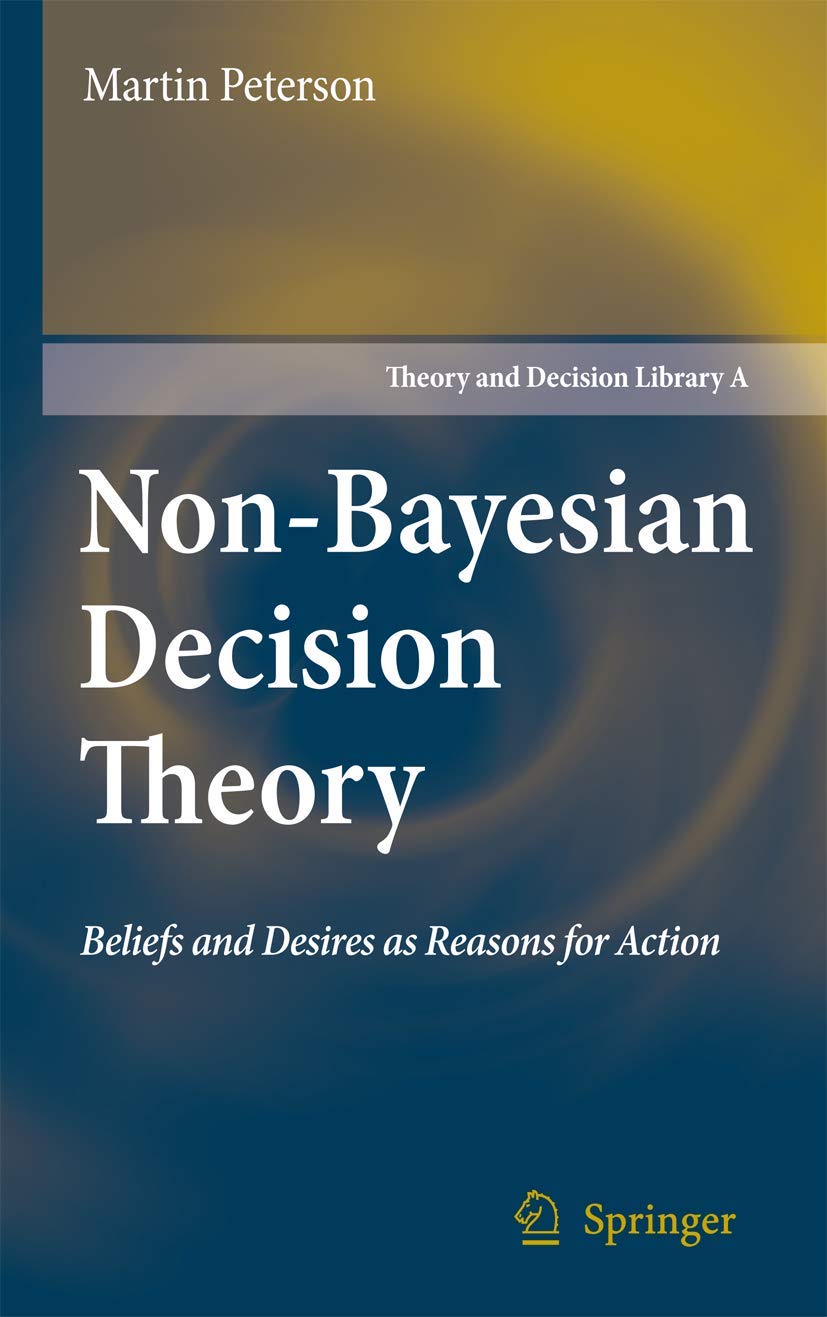
For quite some time, philosophers, economists, and statisticians have endorsed a view on rational choice known as Bayesianism. The work on this book has grown out of a feeling that the Bayesian view has come to dominate the academic com nitytosuchanextentthatalternative,nonBayesianpositionsareseldomextensively researched. Needless to say, I think this is a pity. NonBayesian positions deserve to be examined with much greater care, and the present work is an attempt to defend what I believe to be a coherent and reasonably detailed nonBayesian account of decision theory. The main thesis I defend can be summarised as follows. Rational agents m imise subjective expected utility, but contrary to what is claimed by Bayesians, ut ity and subjective probability should not be de?ned in terms of preferences over uncertain prospects. On the contrary, rational decision makers need only consider preferences over certain outcomes. It will be shown that utility and probability fu tions derived in a nonBayesian manner can be used for generating preferences over uncertain prospects, that support the principle of maximising subjective expected utility. To some extent, this nonBayesian view gives an account of what modern cision theory could have been like, had decision theorists not entered the Bayesian path discovered by Ramsey, de Finetti, Savage, and others. I will not discuss all previous nonBayesian positions presented in the literature.
⚠️ WARNING (California Proposition 65):
This product may contain chemicals known to the State of California to cause cancer,
birth defects, or other reproductive harm.
For MAP (Minimum Advertised Price) violations and Intellectual Property (IP) or Trademark concerns, please contact:
support@ergodebooks.com
⚠️ California Proposition 65 Warning: Some products sold on this website may expose you to chemicals known to the State of California to cause cancer, birth defects, or other reproductive harm. For more information, visit www.P65Warnings.ca.gov.