If you have any questions, you are always welcome to contact us. We'll get back to you as soon as possible, withing 24 hours on weekdays.
Customer service
All questions about your order, return and delivery must be sent to our customer service team by e-mail at yourstore@yourdomain.com
Sale & Press
If you are interested in selling our products, need more information about our brand or wish to make a collaboration, please contact us at press@yourdomain.com
Help
If you have any questions, you are always welcome to contact us. We'll get back to you as soon as possible, withing 24 hours on weekdays.
Customer service
All questions about your order, return and delivery must be sent to our customer service team by e-mail at yourstore@yourdomain.com
Sale & Press
If you are interested in selling our products, need more information about our brand or wish to make a collaboration, please contact us at press@yourdomain.com
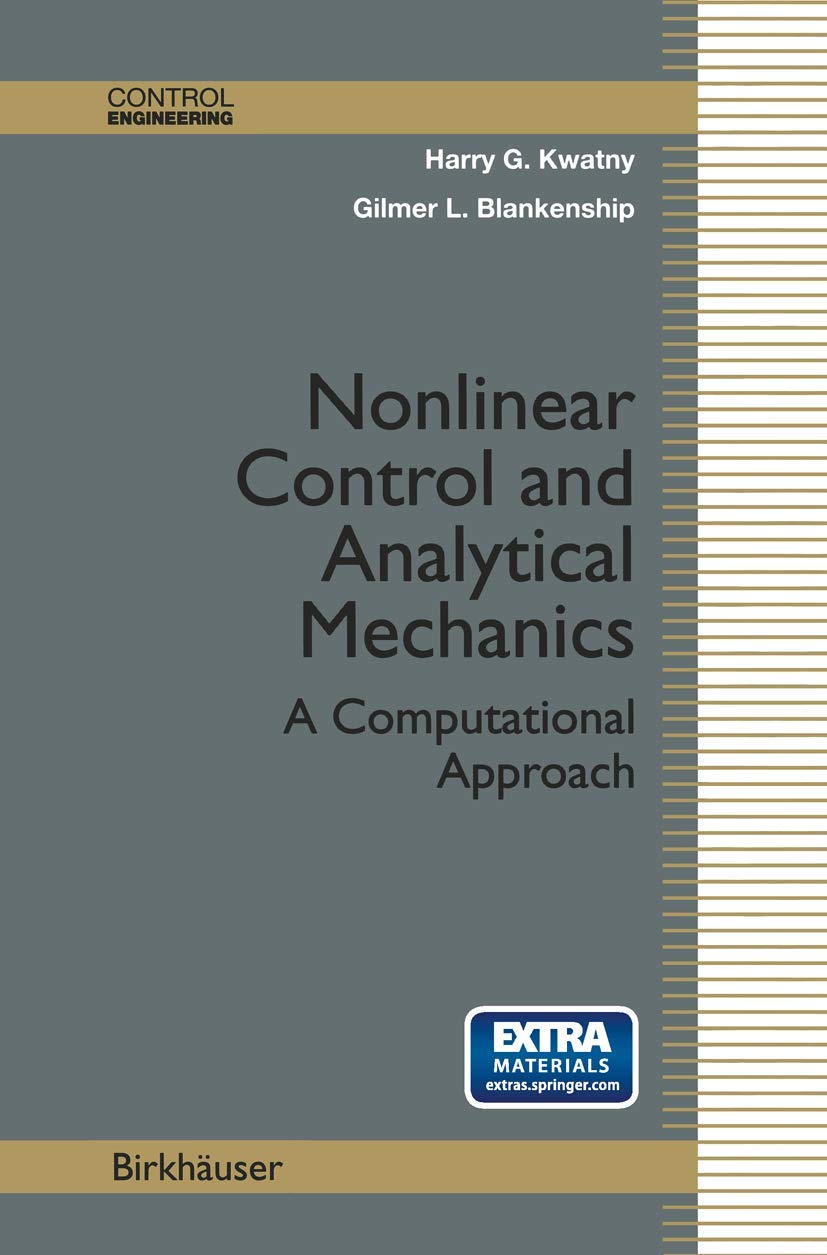
During the past decade we have had to confront a series of control design prob lems involving, primarily, multibody electromechanical systems in which nonlinearity plays an essential role. Fortunately, the geometric theory of non linear control system analysis progressed substantially during the 1980s and 90s, providing crucial conceptual tools that addressed many of our needs. However, as any control systems engineer can attest, issues of modeling, computation, and implementation quickly become the dominant concerns in practice. The prob lems of interest to us present unique challenges because of the need to build and manipulate complex mathematical models for both the plant and controller. As a result, along with colleagues and students, we set out to develop computer algebra tools to facilitate model building, nonlinear control system design, and code generation, the latter for both numerical simulation and real time con an outgrowth of that continuing effort. As trol implementation. This book is a result, the unique features of the book includes an integrated treatment of nonlinear control and analytical mechanics and a set of symbolic computing software tools for modeling and control system design. By simultaneously considering both mechanics and control we achieve a fuller appreciation of the underlying geometric ideas and constructions that are common to both. Control theory has had a fruitful association with analytical mechanics from its birth in the late 19th century.
⚠️ WARNING (California Proposition 65):
This product may contain chemicals known to the State of California to cause cancer,
birth defects, or other reproductive harm.
For MAP (Minimum Advertised Price) violations and Intellectual Property (IP) or Trademark concerns, please contact:
support@ergodebooks.com
⚠️ California Proposition 65 Warning: Some products sold on this website may expose you to chemicals known to the State of California to cause cancer, birth defects, or other reproductive harm. For more information, visit www.P65Warnings.ca.gov.