
Title
Nonlinear Dynamics of Interacting Populations (World Scientific Nonlinear Science Series a),Used
Sold by Ergodebooks, an authorized reseller.
Returns accepted within 30 days | support@ergodebooks.com
Shipping Information
- Free Standard Shipping — United States only
- Processing Time: 3–5 business days
- Estimated Delivery: 6–10 business days after dispatch
- Double-boxed, fully insured & discreetly packaged
- Tracking number sent via email once dispatched
Returns & Refund
Returns accepted within 30 days of delivery.
Damaged or Defective Item
Free return shipping + replacement or full refund
Wrong Item Received
Free return shipping + replacement or full refund
Change of Mind
Return shipping at customer's expense · 25% restocking fee applies
Payment Option

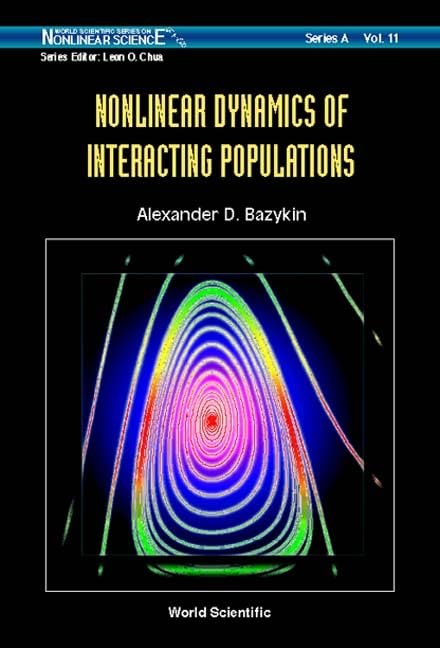
This book contains a systematic study of ecological communities of two or three interacting populations. Starting from the LotkaVolterra system, various regulating factors are considered, such as rates of birth and death, predation and competition. The different factors can have a stabilizing or a destabilizing effect on the community, and their interplay leads to increasingly complicated behavior. Studying and understanding this path to greater dynamical complexity of ecological systems constitutes the backbone of this book. On the mathematical side, the tool of choice is the qualitative theory of dynamical systems most importantly bifurcation theory, which describes the dependence of a system on the parameters. This approach allows one to find general patterns of behavior that are expected to be observed in ecological models. Of special interest is the reaction of a given model to disturbances of its present state, as well as to changes in the external conditions. This leads to the general idea of 'dangerous boundaries' in the state and parameter space of an ecological system. The study of these boundaries allows one to analyze and predict qualitative and often sudden changes of the dynamics a muchneeded tool, given the increasing antropogenic load on the biosphere.As a spinoff from this approach, the book can be used as a guided tour of bifurcation theory from the viewpoint of application. The interested reader will find a wealth of intriguing examples of how known bifurcations occur in applications. The book can in fact be seen as bridging the gap between mathematical biology and bifurcation theory.
⚠️ WARNING (California Proposition 65):
This product may contain chemicals known to the State of California to cause cancer, birth defects, or other reproductive harm.
For more information, please visit www.P65Warnings.ca.gov.