If you have any questions, you are always welcome to contact us. We'll get back to you as soon as possible, withing 24 hours on weekdays.
Customer service
All questions about your order, return and delivery must be sent to our customer service team by e-mail at yourstore@yourdomain.com
Sale & Press
If you are interested in selling our products, need more information about our brand or wish to make a collaboration, please contact us at press@yourdomain.com
Help
If you have any questions, you are always welcome to contact us. We'll get back to you as soon as possible, withing 24 hours on weekdays.
Customer service
All questions about your order, return and delivery must be sent to our customer service team by e-mail at yourstore@yourdomain.com
Sale & Press
If you are interested in selling our products, need more information about our brand or wish to make a collaboration, please contact us at press@yourdomain.com
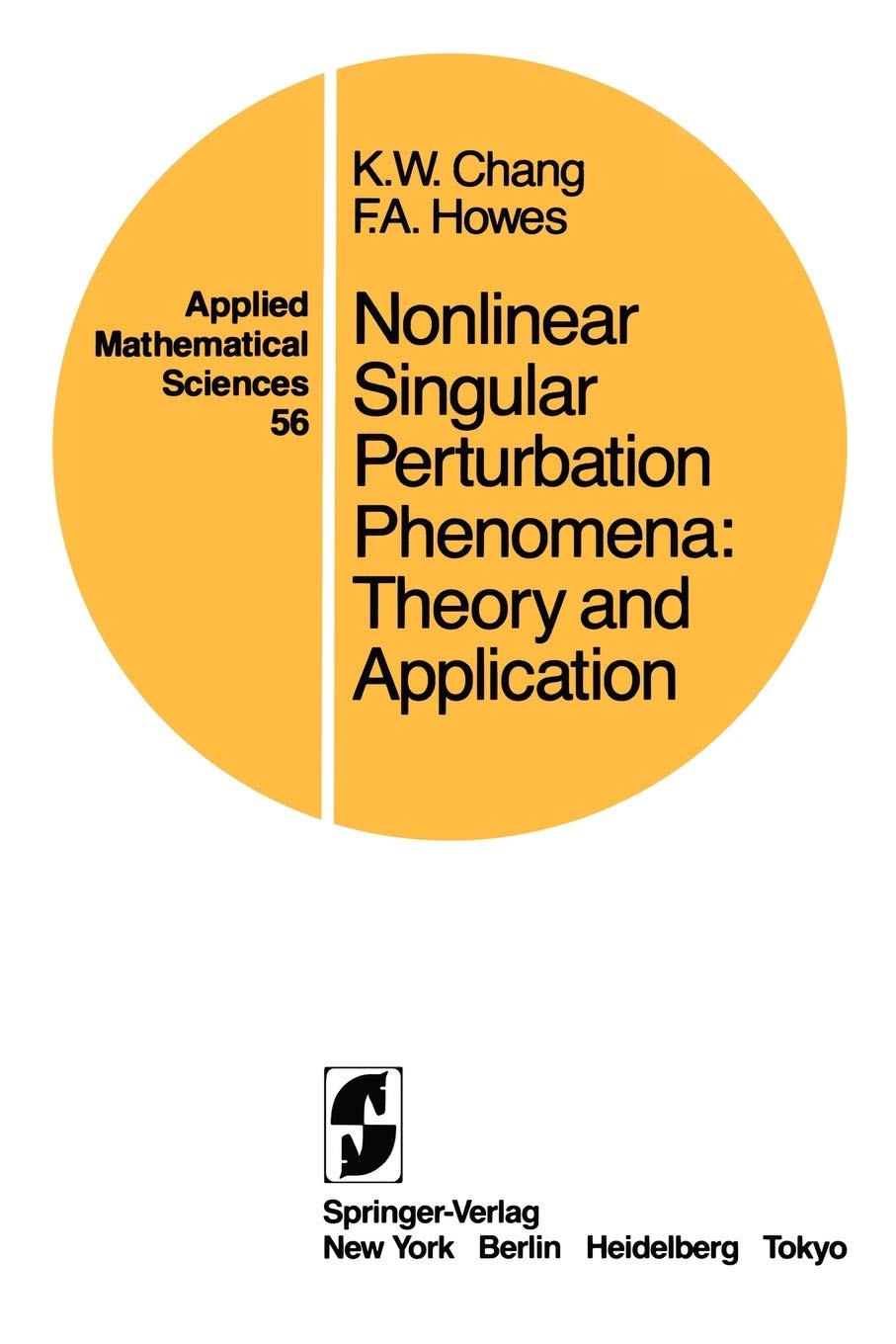
Our purpose in writing this monograph is twofold. On the one hand, we want to collect in one place many of the recent results on the exist ence and asymptotic behavior of solutions of certain classes of singularly perturbed nonlinear boundary value problems. On the other, we hope to raise along the way a number of questions for further study, mostly ques tions we ourselves are unable to answer. The presentation involves a study of both scalar and vector boundary value problems for ordinary dif ferential equations, by means of the consistent use of differential in equality techniques. Our results for scalar boundary value problems obeying some type of maximum principle are fairly complete; however, we have been unable to treat, under any circumstances, problems involving 'resonant' behavior. The linear theory for such problems is incredibly complicated already, and at the present time there appears to be little hope for any kind of general nonlinear theory. Our results for vector boundary value problems, even those admitting higher dimensional maximum principles in the form of invariant regions, are also far from complete. We offer them with some trepidation, in the hope that they may stimulate further work in this challenging and important area of differential equa tions. The research summarized here has been made possible by the support over the years of the National Science Foundation and the National Science and Engineering Research Council.
⚠️ WARNING (California Proposition 65):
This product may contain chemicals known to the State of California to cause cancer,
birth defects, or other reproductive harm.
For MAP (Minimum Advertised Price) violations and Intellectual Property (IP) or Trademark concerns, please contact:
support@ergodebooks.com
⚠️ California Proposition 65 Warning: Some products sold on this website may expose you to chemicals known to the State of California to cause cancer, birth defects, or other reproductive harm. For more information, visit www.P65Warnings.ca.gov.