
Title
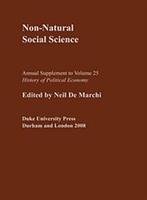
Nonnatural Social Science: Reflecting On The Enterprise Of 'More Heat Than Light' (Volume 25) (History Of Political Economy Ann,Used
Sold by Ergodebooks, an authorized reseller.
Returns accepted within 30 days | support@ergodebooks.com
Shipping Information
- Free Standard Shipping — United States only
- Processing Time: 3–5 business days
- Estimated Delivery: 6–10 business days after dispatch
- Double-boxed, fully insured & discreetly packaged
- Tracking number sent via email once dispatched
Returns & Refund
Returns accepted within 30 days of delivery.
Damaged or Defective Item
Free return shipping + replacement or full refund
Wrong Item Received
Free return shipping + replacement or full refund
Change of Mind
Return shipping at customer's expense · 25% restocking fee applies
Payment Option

Published in 1989, Philip Mirowskis More Heat Than Light: Economics as Social Physics, Physics as Natures Economics offered a challenge to historians of economics that could not be ignored. Neoclassical economics, he said, adopted certain analytical tools of midnineteenthcentury physics, simply substituting utility for energy, and in so doing, chose a naturalworld model which denied that economic knowledge might be essentially social and cultural. The essays in this collection represent the first collective effort to respond to Mirowskis challenge by examining and assessing the Mirowski enterprise.In addition to questioning the veracity of the connection between physics and economics, the contributors consider the farreaching implications of Mirowskis thesis for the history of economics. Mirowski shows that economic texts must be viewed in their relation to texts outside the field of economics and offers an alternative reading of economic texts as social and cultural inscriptions. As historians of economics respond to Mirowskis challenge, the style and direction of their work will be changed. Utlimately, a careful assessment of More Heat Than Light may introduce historians of economics to recognize that the discipline of economics may not be the most appropriate category from which to proceed.Contributors. Jack Birner, Marcel Boumans, A. W. Coats, Avi J. Cohen, I. Bernard Cohen, Neil de Marchi, Steve Fuller, Clifford G. Gaddy, Wade Hands, Albert Jolink, Arjo Klamer, Robert Leonard, Philip Mirowski, Theodore M. Porter, Margaret Schabas, E. Roy Weintraub
⚠️ WARNING (California Proposition 65):
This product may contain chemicals known to the State of California to cause cancer, birth defects, or other reproductive harm.
For more information, please visit www.P65Warnings.ca.gov.