If you have any questions, you are always welcome to contact us. We'll get back to you as soon as possible, withing 24 hours on weekdays.
Customer service
All questions about your order, return and delivery must be sent to our customer service team by e-mail at yourstore@yourdomain.com
Sale & Press
If you are interested in selling our products, need more information about our brand or wish to make a collaboration, please contact us at press@yourdomain.com
Help
If you have any questions, you are always welcome to contact us. We'll get back to you as soon as possible, withing 24 hours on weekdays.
Customer service
All questions about your order, return and delivery must be sent to our customer service team by e-mail at yourstore@yourdomain.com
Sale & Press
If you are interested in selling our products, need more information about our brand or wish to make a collaboration, please contact us at press@yourdomain.com
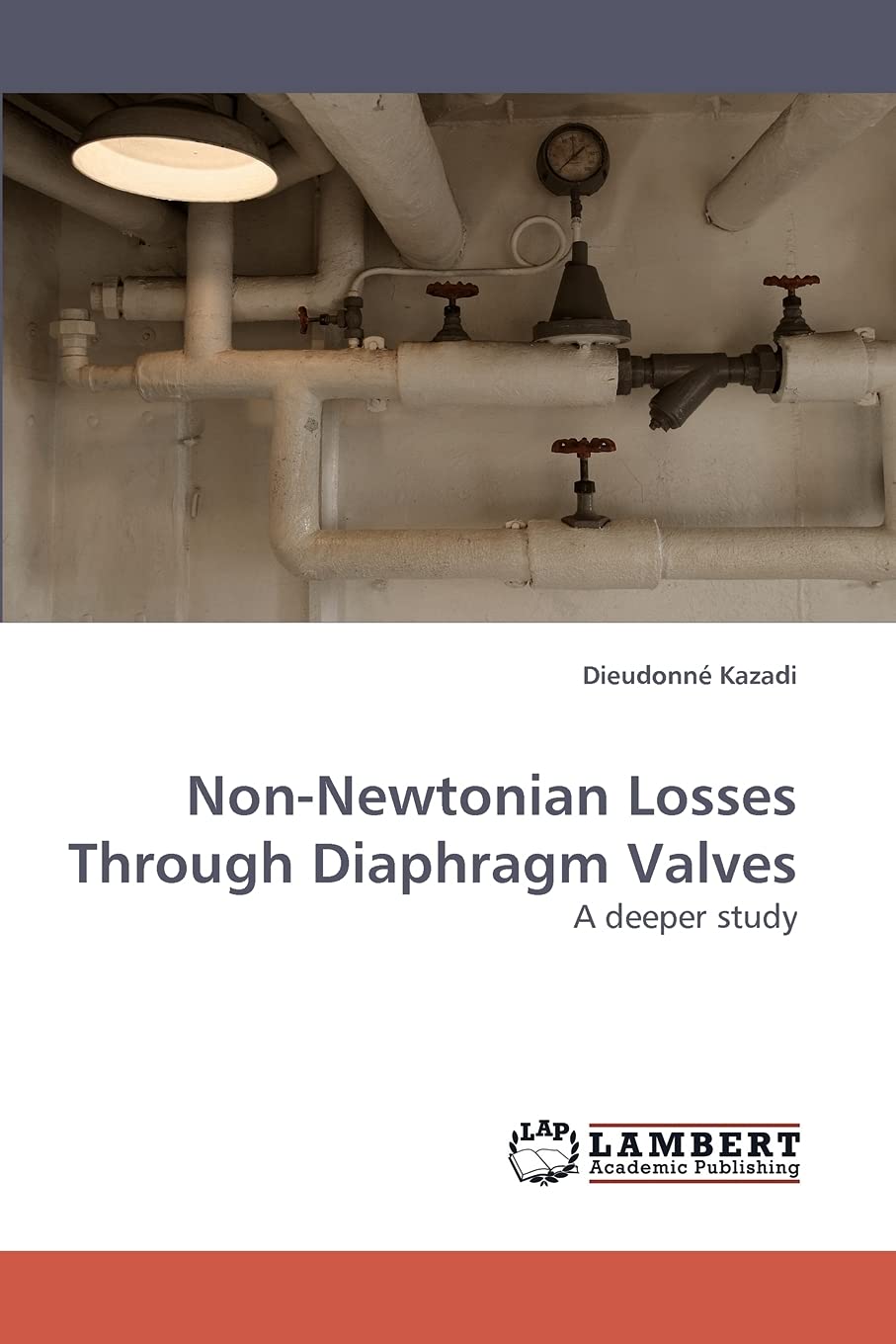
The prediction of head losses in a pipe system is very important because head losses affect the performance of fluid machinery such as pumps. In a pipe system, two kinds of losses are observed: major losses and minor losses. In Newtonian and nonNewtonian flow, major losses are those that are due to friction in straight pipes and minor losses are those that are due to pipe fittings. Minor losses must be accurately predicted in a pipe system because they are not negligible and can sometimes outweigh major losses. There is presently little data for the prediction of nonNewtonian head losses in pipe fittings in the literature and little consensus amongst researchers. In the case of diaphragm valves, usually, only one loss coefficient value is given in turbulent flow or in laminar flow with no reference to a specific size of the valve, assuming geometrical similarity that would lead to dynamic similarity. However, no one has done a systematic study of various sizes of diaphragm valves from the same manufacturer to establish if this is true. This could be the main reason for discrepancies found in the literature This work addresses this issue.
⚠️ WARNING (California Proposition 65):
This product may contain chemicals known to the State of California to cause cancer,
birth defects, or other reproductive harm.
For MAP (Minimum Advertised Price) violations and Intellectual Property (IP) or Trademark concerns, please contact:
support@ergodebooks.com
⚠️ California Proposition 65 Warning: Some products sold on this website may expose you to chemicals known to the State of California to cause cancer, birth defects, or other reproductive harm. For more information, visit www.P65Warnings.ca.gov.