
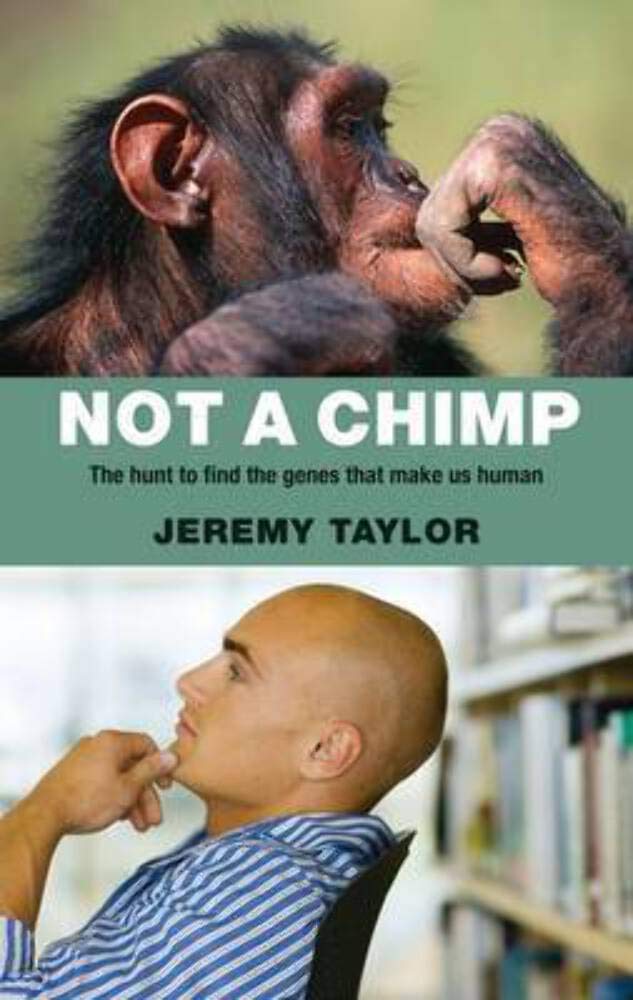
Title
Not a Chimp: The Hunt to Find the Genes that Make Us Human,Used
Sold by Ergodebooks, an authorized reseller.
Returns accepted within 30 days | support@ergodebooks.com
Shipping Information
- Free Standard Shipping — United States only
- Processing Time: 3–5 business days
- Estimated Delivery: 6–10 business days after dispatch
- Double-boxed, fully insured & discreetly packaged
- Tracking number sent via email once dispatched
Returns & Refund
Returns accepted within 30 days of delivery.
Damaged or Defective Item
Free return shipping + replacement or full refund
Wrong Item Received
Free return shipping + replacement or full refund
Change of Mind
Return shipping at customer's expense · 25% restocking fee applies
Payment Option

It is one of the bestknown pieces of scientific triviathat human DNA and chimpanzee DNA differ by a mere 1.6%. But are we then just chimps with a few genetic tweaks? Are our language and our technology just an extension of the grunts and antcollecting sticks of chimps?In Not a Chimp, Jeremy Taylor describes one of the great scientific quests of our timesthe effort to discover precisely what makes humans different from other primates, especially our closest evolutionary relative, the chimpanzee. Drawing on stateoftheart science, Taylor convincingly debunks the assertion that our two species are nearly identical genetically. He sketches the picture now emerging from cuttingedge research in genetics, animal behavior, and other fields to show that the socalled 1.6% difference is effectively much larger, leading to a profound divergence between the two species. Indeed, he explains that the evolution of the human genome has accelerated since the split of chimps and humans from a common ancestor more than six million years ago. In fact, at least 7% of human genesalmost one gene in tenhave accumulated changes within the last 50,000 years. Some of the genes that have changed orchestrate entire sets of other genes, and recent studies show that it is this complex interactionrather than the action of individual genesthat underlies speech processes, brain development, and a host of other mechanisms that make humans unique.We humans are far different, genetically speaking, than chimps. More than that, we have been the architects of our own evolution through the same processes that have produced our farm animals and crop plants. We are the apes that domesticated themselves."Should be mandatory reading for journalists who often reinforce the general publics misconception that chimps are practically human."New Scientist
⚠️ WARNING (California Proposition 65):
This product may contain chemicals known to the State of California to cause cancer, birth defects, or other reproductive harm.
For more information, please visit www.P65Warnings.ca.gov.
- Q: How many pages does the book have? A: This book has three hundred sixty-eight pages. It provides an in-depth exploration of human genetics compared to chimpanzees.
- Q: What is the binding type of this book? A: The book is hardcover. This makes it durable and suitable for long-term use.
- Q: What are the dimensions of the book? A: The book measures eight point five eight inches in length, one point five inches in width, and nine inches in height. These dimensions make it a standard-sized hardcover.
- Q: Who is the author of this book? A: The author of this book is Jeremy Taylor. He discusses human evolution and genetics in detail.
- Q: What topics does the book cover? A: The book covers the genetic differences between humans and chimpanzees. It delves into evolution, genetics, and human uniqueness.
- Q: Is this book suitable for children? A: No, this book is not specifically designed for children. It is more suited for adults or older teens interested in genetics and evolution.
- Q: How do I read this book? A: You can read this book like any standard hardcover book. Open it and begin from the first page.
- Q: What is the reading level of this book? A: The reading level is intended for adults or advanced readers. It includes complex scientific concepts.
- Q: Are there any illustrations in the book? A: No, there are no specific details about illustrations in the book's description. It focuses on text-based content.
- Q: How should I store this book? A: Store this book in a cool, dry place. Keeping it upright on a shelf will help maintain its condition.
- Q: Can this book be opened flat? A: No, as a hardcover book, it does not open completely flat. This is typical for hardcover bindings.
- Q: What if the book arrives damaged? A: If the book arrives damaged, you should contact the seller for a return or replacement. Most sellers provide support for damaged items.
- Q: Is this book returnable? A: Yes, most bookstores and online retailers have return policies. Check the specific policy where you purchase the book.
- Q: What if I have questions about the content? A: You can look for discussion forums or book clubs online. Engaging with others can help clarify any questions.
- Q: How does this book compare to similar titles? A: This book is more focused on genetic differences compared to other titles that may cover broader topics in evolution.
- Q: Is there a specific audience for this book? A: Yes, the book is ideal for those interested in genetics, anthropology, and evolutionary biology. It's geared towards a scholarly audience.