If you have any questions, you are always welcome to contact us. We'll get back to you as soon as possible, withing 24 hours on weekdays.
Customer service
All questions about your order, return and delivery must be sent to our customer service team by e-mail at yourstore@yourdomain.com
Sale & Press
If you are interested in selling our products, need more information about our brand or wish to make a collaboration, please contact us at press@yourdomain.com
Help
If you have any questions, you are always welcome to contact us. We'll get back to you as soon as possible, withing 24 hours on weekdays.
Customer service
All questions about your order, return and delivery must be sent to our customer service team by e-mail at yourstore@yourdomain.com
Sale & Press
If you are interested in selling our products, need more information about our brand or wish to make a collaboration, please contact us at press@yourdomain.com
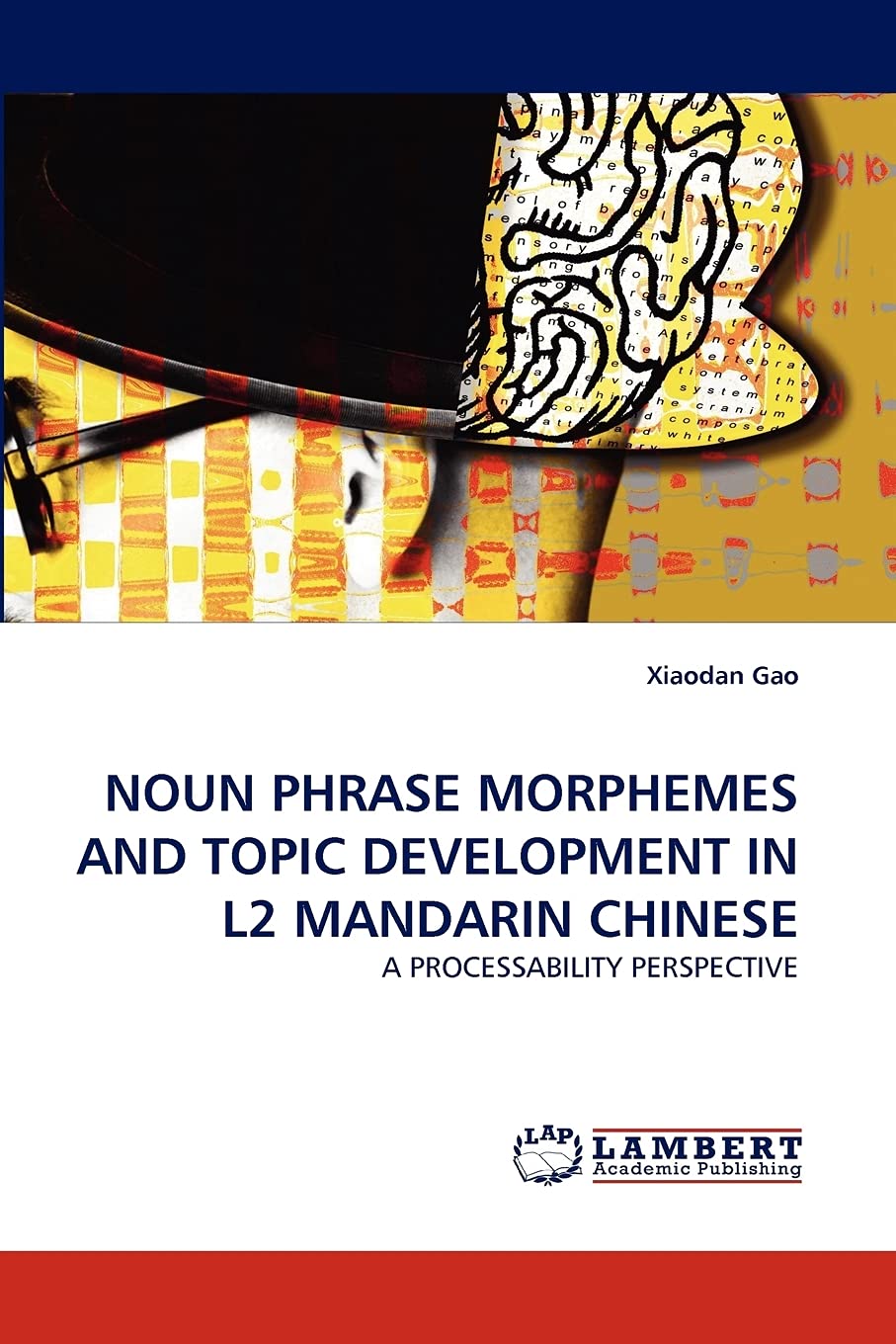
Processability Theory (PT), a second language development theory, proposes a hierarchy of processing procedures that purportedly constrain interlanguage development. Although PT has been applied to a range of languages, little work has been done on Mandarin Chinese. The research in this book examines the development of noun phrase (NP) morphology and topic structures in interlanguage Chinese within the PT framework. The research proposes a fivestage hierarchy of NP and topic development in L2 Mandarin Chinese. Data was collected in New Zealand and China from learners with L1 English, Japanese and German. Analysis revealed conformity with the predicted developmental stages and consistency regardless of L1. This research provides further support for the predictive and explanatory power of the processing procedures proposed by PT and the role these procedures play in second language development. This book provides a point of reference for PT researchers. Researchers in second language acquisition, or more specifically those researching Mandarin Chinese as a second or foreign language, as well as students in Applied Linguistics will also find this book useful.
⚠️ WARNING (California Proposition 65):
This product may contain chemicals known to the State of California to cause cancer,
birth defects, or other reproductive harm.
For MAP (Minimum Advertised Price) violations and Intellectual Property (IP) or Trademark concerns, please contact:
support@ergodebooks.com
⚠️ California Proposition 65 Warning: Some products sold on this website may expose you to chemicals known to the State of California to cause cancer, birth defects, or other reproductive harm. For more information, visit www.P65Warnings.ca.gov.