
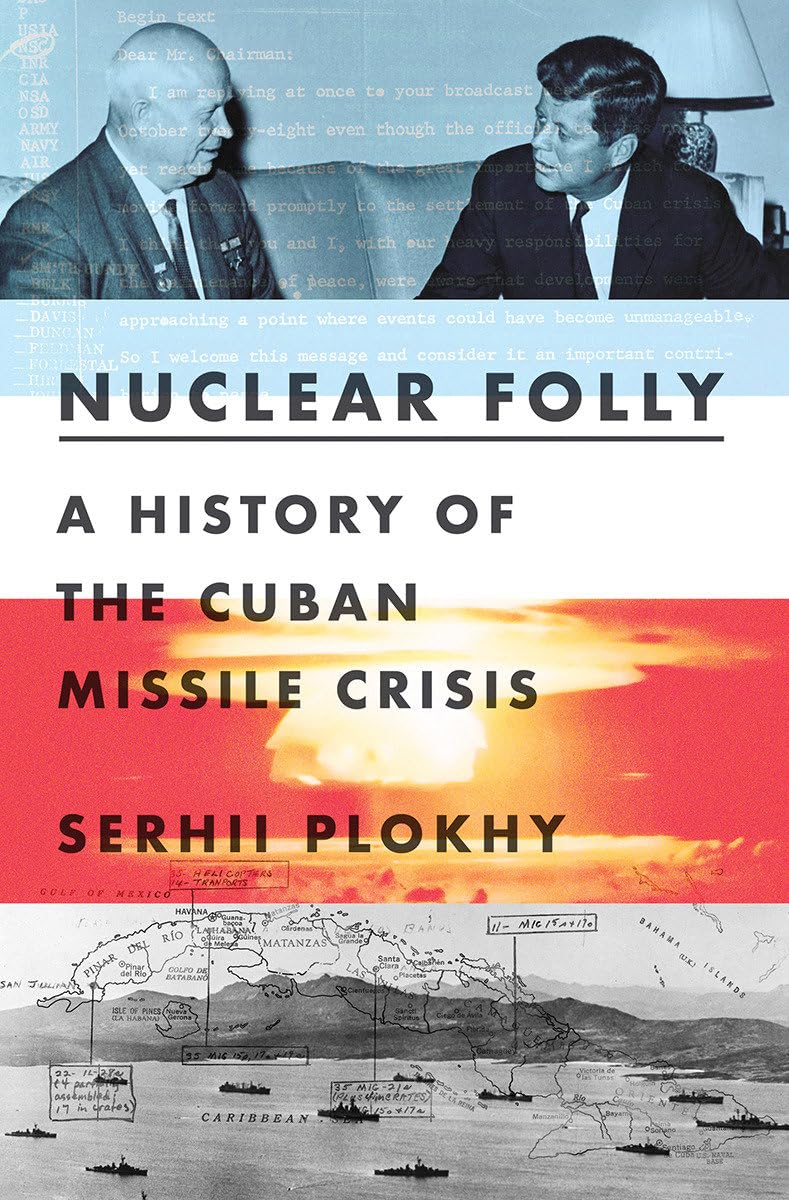
Title
Nuclear Folly: A History Of The Cuban Missile Crisis
Sold by Ergodebooks, an authorized reseller.
Returns accepted within 30 days | support@ergodebooks.com
Shipping Information
- Free Standard Shipping — United States only
- Processing Time: 3–5 business days
- Estimated Delivery: 6–10 business days after dispatch
- Double-boxed, fully insured & discreetly packaged
- Tracking number sent via email once dispatched
Returns & Refund
Returns accepted within 30 days of delivery.
Damaged or Defective Item
Free return shipping + replacement or full refund
Wrong Item Received
Free return shipping + replacement or full refund
Change of Mind
Return shipping at customer's expense · 25% restocking fee applies
Payment Option

A Harrowing Account Of The Cuban Missile Crisis And How The Us And Ussr Came To The Brink Of Nuclear Apocalypse.Nearly Thirty Years After The End Of The Cold War, Todays World Leaders Are Abandoning Disarmament Treaties, Building Up Their Nuclear Arsenals, And Exchanging Threats Of Nuclear Strikes. To Survive This New Atomic Age, We Must Relearn The Lessons Of The Most Dangerous Moment Of The Cold War: The Cuban Missile Crisis.Serhii Plokhys Nuclear Folly Offers An International Perspective On The Crisis, Tracing The Tortuous Decisionmaking That Produced And Then Resolved It, Which Involved John Kennedy And His Advisers, Nikita Khrushchev And Fidel Castro, And Their Commanders On The Ground. In Breathtaking Detail, Plokhy Vividly Recounts The Young Jfk Being Played By The Canny Khrushchev; The Hotheaded Castro Willing To Defy The Ussr And Threatening To Align Himself With China; The Soviet Troops On The Ground Clearing Jungle Foliage In The Tropical Heat, And Desperately Trying To Conceal Nuclear Installations On Cuba, Which Were Nonetheless Easily Spotted By U2 Spy Planes; And The Hairraising Near Misses At Sea That Nearly Caused A Soviet Nucleararmed Submarine To Fire Its Weapons.More Often Than Not, The Americans And Soviets Misread Each Other, Operated Under False Information, And Came Perilously Close To Nuclear Catastrophe. Despite These Errors, Nuclear War Was Ultimately Avoided For One Central Reason: Fear, And The Realization That Any Escalation On Either The Soviets Or The Americans Part Would Lead To Mutual Destruction.Drawing On A Range Of Soviet Archival Sources, Including Previously Classified Kgb Documents, As Well As White House Tapes, Plokhy Masterfully Illustrates The Drama And Anxiety Of Those Tense Days, And Provides A Way For Us To Grapple With The Problems Posed In Our Present Day. 8 Pages Of Photographs; 2 Maps
⚠️ WARNING (California Proposition 65):
This product may contain chemicals known to the State of California to cause cancer, birth defects, or other reproductive harm.
For more information, please visit www.P65Warnings.ca.gov.
- Q: How many pages are in 'Nuclear Folly: A History of the Cuban Missile Crisis'? A: This book contains four hundred sixty-four pages. It offers an in-depth exploration of the Cuban missile crisis.
- Q: What is the binding type of this book? A: The book is hardcover. This durable binding provides a sturdy option for long-term use.
- Q: What are the dimensions of 'Nuclear Folly'? A: The dimensions of the book are six and a half inches in length, one point six one inches in width, and nine point six one inches in height.
- Q: Who is the author of 'Nuclear Folly'? A: The author is Serhii Plokhy. He provides a meticulous account of the events surrounding the Cuban missile crisis.
- Q: What subjects does 'Nuclear Folly' cover? A: The book covers the Cuban missile crisis, focusing on the political dynamics between the US, USSR, and Cuba.
- Q: Is 'Nuclear Folly' suitable for young readers? A: The book is not specifically designed for children. It delves into complex historical and political themes that may require maturity to fully understand.
- Q: What themes are explored in 'Nuclear Folly'? A: Themes include nuclear strategy, international relations, and the psychological tensions of the Cold War. These elements provide a rich context for the crisis.
- Q: Can you summarize the main focus of 'Nuclear Folly'? A: The main focus is the Cuban missile crisis and its implications for modern nuclear diplomacy. It emphasizes the lessons learned from this historical event.
- Q: What kind of resources does the author use in the book? A: The author draws on a variety of Soviet archival sources, including previously classified KGB documents and White House tapes.
- Q: Are there any visual aids in 'Nuclear Folly'? A: Yes, the book includes eight pages of photographs and two maps. These visuals enhance the reader's understanding of the events.
- Q: How should I care for my hardcover copy of 'Nuclear Folly'? A: To care for your hardcover book, keep it in a cool, dry place and avoid exposing it to direct sunlight. This preserves the cover and pages.
- Q: Is there a warranty or return policy for 'Nuclear Folly'? A: Return policies may vary by retailer. Typically, you can return the book within a specific period if it is undamaged.
- Q: What if 'Nuclear Folly' arrives damaged? A: If the book arrives damaged, contact the retailer's customer service for assistance with returns or exchanges.
- Q: How is 'Nuclear Folly' different from other books on the Cuban missile crisis? A: This book offers a unique international perspective and utilizes new archival research, providing insights not found in other works.
- Q: What audience is 'Nuclear Folly' intended for? A: The book is intended for readers interested in history, politics, and international relations, particularly those who want to understand nuclear strategy.