
Title
Nucleic Acids: Curvature And Deformation: Recent Advances And New Paradigms (Acs Symposium Series),Used
Sold by Ergodebooks, an authorized reseller.
Returns accepted within 30 days | support@ergodebooks.com
Shipping Information
- Free Standard Shipping — United States only
- Processing Time: 3–5 business days
- Estimated Delivery: 6–10 business days after dispatch
- Double-boxed, fully insured & discreetly packaged
- Tracking number sent via email once dispatched
Returns & Refund
Returns accepted within 30 days of delivery.
Damaged or Defective Item
Free return shipping + replacement or full refund
Wrong Item Received
Free return shipping + replacement or full refund
Change of Mind
Return shipping at customer's expense · 25% restocking fee applies
Payment Option

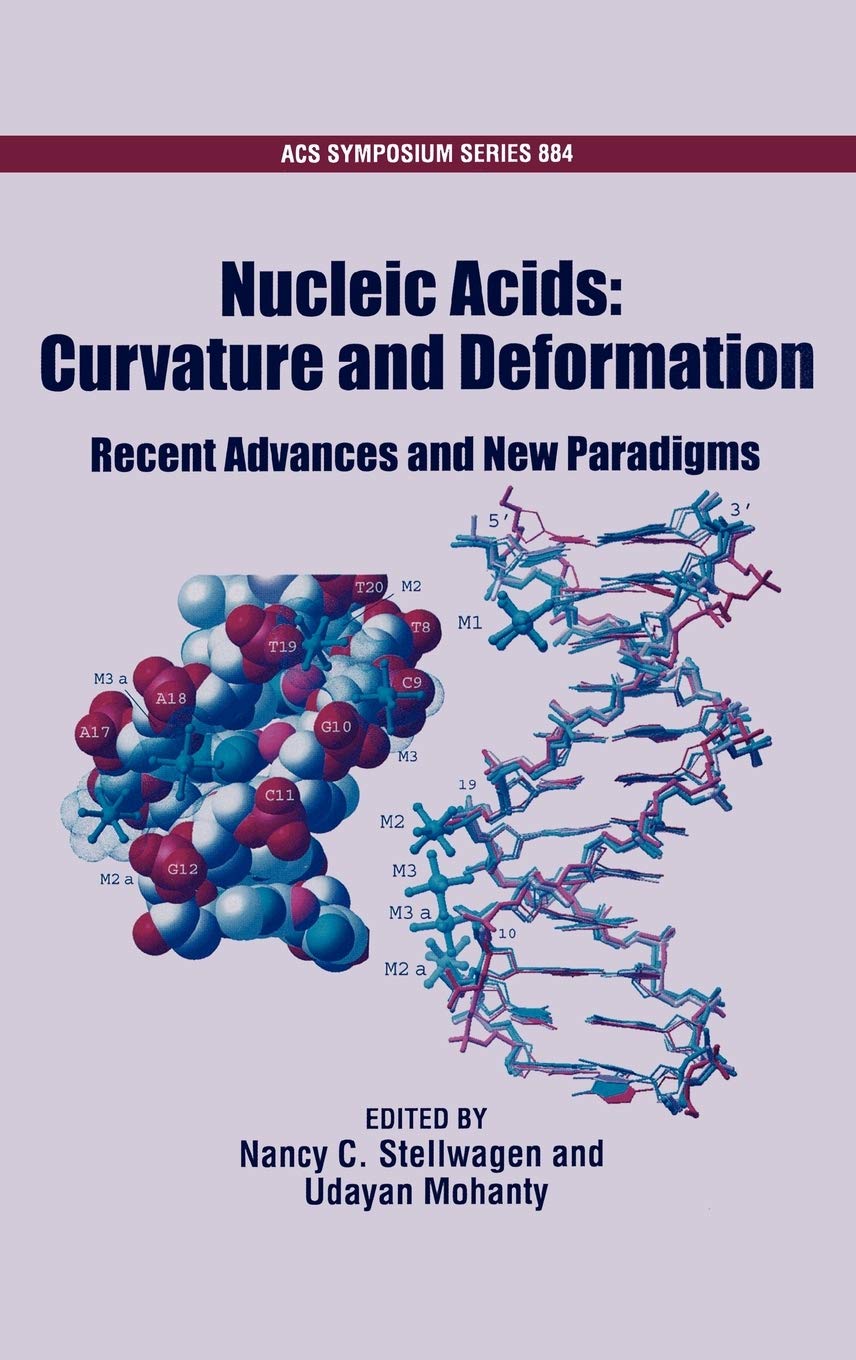
Curvature and Deformation of Nucleic Acids: Recent Advances, New Paradigms presents an uptodate review on the curvature and deformation of nucleic acids. Chapter 1 sets the various chapters in context, as well as describing several controversial topics. Chapter 2 gives a comprehensivereview of the literature on DNA bending and describes the current status of molecular dynamics simulations of DNA and proteinDNA complexes. Chapter 3 describes the structural basis for Atract DNA helix bending, based on recent NMR structures and other biophysical measurements. Chapter 4 describesthe localization of Mg++ ions in the crystal structure of a Bform DNA dodecamer and discusses the relevance of these bound ions to sequencedependent bending. Chapter 5 discusses the electrostatic energy penalties that result from phosphate crowding in curved DNA oligomers. Chapter 6 presents aquantitative model that predicts the magnitude of the bend caused by asymmetric charge neutralization of DNA phosphate residues. Chapter 7 reviews the structural and dynamic properties of fourway DNA junctions in the presence of metal ions, and it describes the exchange between alternative stackingconformers in solution. Chapter 8 documents the fact that a conserved pseudouridine residue in an RNA duplex containing a precursor messenger branch site makes an important contribution to the structure of the molecule. Chapter 9 describes structural perturbations that are observed indiseaserelated mutants of human mitochondrial transfer RNAs. Chapter 10 reviews the thermodynamics of the folding and unfolding of DNA oligomers distorted by the binding of small ligands. Chapter 11 describes a method of constructing DNA fragments for cyclization studies that uses single strandgaps as flexible hinges that allow the correct torsional orientation of the helix ends. Chapter 12 reviews a statistical mechanical model that predicts the stability of reconstituted nucleosomes based on sequencedependent DNA curvature and flexibility.
⚠️ WARNING (California Proposition 65):
This product may contain chemicals known to the State of California to cause cancer, birth defects, or other reproductive harm.
For more information, please visit www.P65Warnings.ca.gov.