
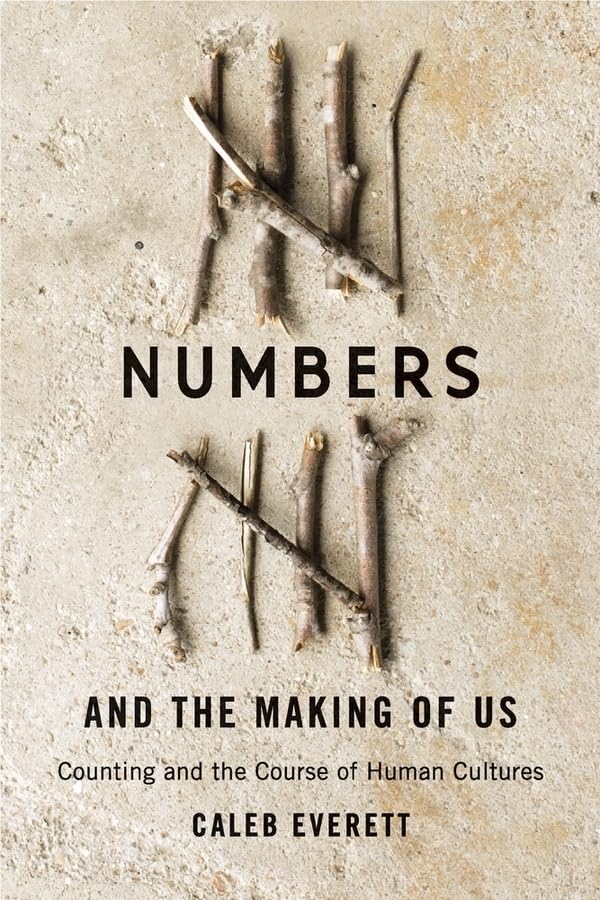
Title
Numbers And The Making Of Us: Counting And The Course Of Human Cultures,Used
Sold by Ergodebooks, an authorized reseller.
Returns accepted within 30 days | support@ergodebooks.com
Shipping Information
- Free Standard Shipping — United States only
- Processing Time: 3–5 business days
- Estimated Delivery: 6–10 business days after dispatch
- Double-boxed, fully insured & discreetly packaged
- Tracking number sent via email once dispatched
Returns & Refund
Returns accepted within 30 days of delivery.
Damaged or Defective Item
Free return shipping + replacement or full refund
Wrong Item Received
Free return shipping + replacement or full refund
Change of Mind
Return shipping at customer's expense · 25% restocking fee applies
Payment Option

Carved Into Our Past, Woven Into Our Present, Numbers Shape Our Perceptions Of The World And Of Ourselves Much More Than We Commonly Think. Numbers And The Making Of Us Is A Sweeping Account Of How Numbers Radically Enhanced Our Species Cognitive Capabilities And Sparked A Revolution In Human Culture. Caleb Everett Brings New Insights In Psychology, Anthropology, Primatology, Linguistics, And Other Disciplines To Bear In Explaining The Myriad Human Behaviors And Modes Of Thought Numbers Have Made Possible, From Enabling Us To Conceptualize Time In New Ways To Facilitating The Development Of Writing, Agriculture, And Other Advances Of Civilization.Number Concepts Are A Human Inventiona Tool, Much Like The Wheel, Developed And Refined Over Millennia. Numbers Allow Us To Grasp Quantities Precisely, But They Are Not Innate. Recent Research Confirms That Most Specific Quantities Are Not Perceived In The Absence Of A Number System. In Fact, Without The Use Of Numbers, We Cannot Precisely Grasp Quantities Greater Than Three; Our Minds Can Only Estimate Beyond This Surprisingly Minuscule Limit.Everett Examines The Various Types Of Numbers That Have Developed In Different Societies, Showing How Most Number Systems Derived From Anatomical Factors Such As The Number Of Fingers On Each Hand. He Details Fascinating Work With Indigenous Amazonians Who Demonstrate That, Unlike Language, Numbers Are Not A Universal Human Endowment. Yet Without Numbers, The World As We Know It Would Not Exist.
⚠️ WARNING (California Proposition 65):
This product may contain chemicals known to the State of California to cause cancer, birth defects, or other reproductive harm.
For more information, please visit www.P65Warnings.ca.gov.
- Q: What is the binding type of this book? A: This book has a hardcover binding. Hardcover books are known for their durability and premium feel.
- Q: How many pages does this book contain? A: This book contains three hundred twelve pages. The length allows for a thorough exploration of the topic.
- Q: What are the book's dimensions? A: The book measures five point seven five inches in length, one inch in width, and eight point seven five inches in height. These dimensions make it a manageable size for reading.
- Q: Who is the author of this book? A: The author of this book is Caleb Everett. He brings a multidisciplinary approach to the subject of numbers and culture.
- Q: What genre does this book belong to? A: This book falls under the genre of linguistics. It examines the intersection of numbers and human cognition.
- Q: Is this book suitable for beginners in linguistics? A: Yes, this book is suitable for beginners in linguistics. It presents complex ideas in an accessible manner.
- Q: How does this book explore the concept of numbers? A: This book explores numbers as a human invention that shapes cognition and culture. It discusses how numbers have evolved in different societies.
- Q: Can this book be beneficial for students of anthropology? A: Yes, students of anthropology may find this book beneficial. It draws connections between numbers and cultural development.
- Q: What makes this book unique compared to others on the topic? A: This book is unique in its multidisciplinary approach, combining insights from psychology, anthropology, and linguistics. It offers a comprehensive view of numbers' impact on human culture.
- Q: How should I care for this hardcover book? A: To care for this hardcover book, keep it in a dry place and avoid exposing it to direct sunlight. This will help preserve its condition.
- Q: What is the shelf life of this book? A: Books do not have a specific shelf life if stored properly. This book can last for many years if kept in good condition.
- Q: How can I store this book safely? A: Store this book upright on a shelf, away from moisture and direct sunlight. This helps maintain its shape and quality.
- Q: What should I do if the book arrives damaged? A: If the book arrives damaged, you should contact the seller for a return or exchange. Most sellers have policies in place to handle such situations.
- Q: Is there a warranty offered with this book? A: No, typically books do not come with a warranty. However, you can check the seller's return policy for any guarantees.
- Q: Can I return this book if I change my mind? A: Yes, you can usually return this book if you change your mind, depending on the seller's return policy. Be sure to check the specific terms.
- Q: Is this book appropriate for all age groups? A: Yes, this book is appropriate for all age groups, particularly those interested in linguistics and culture. It is suitable for educational purposes.