
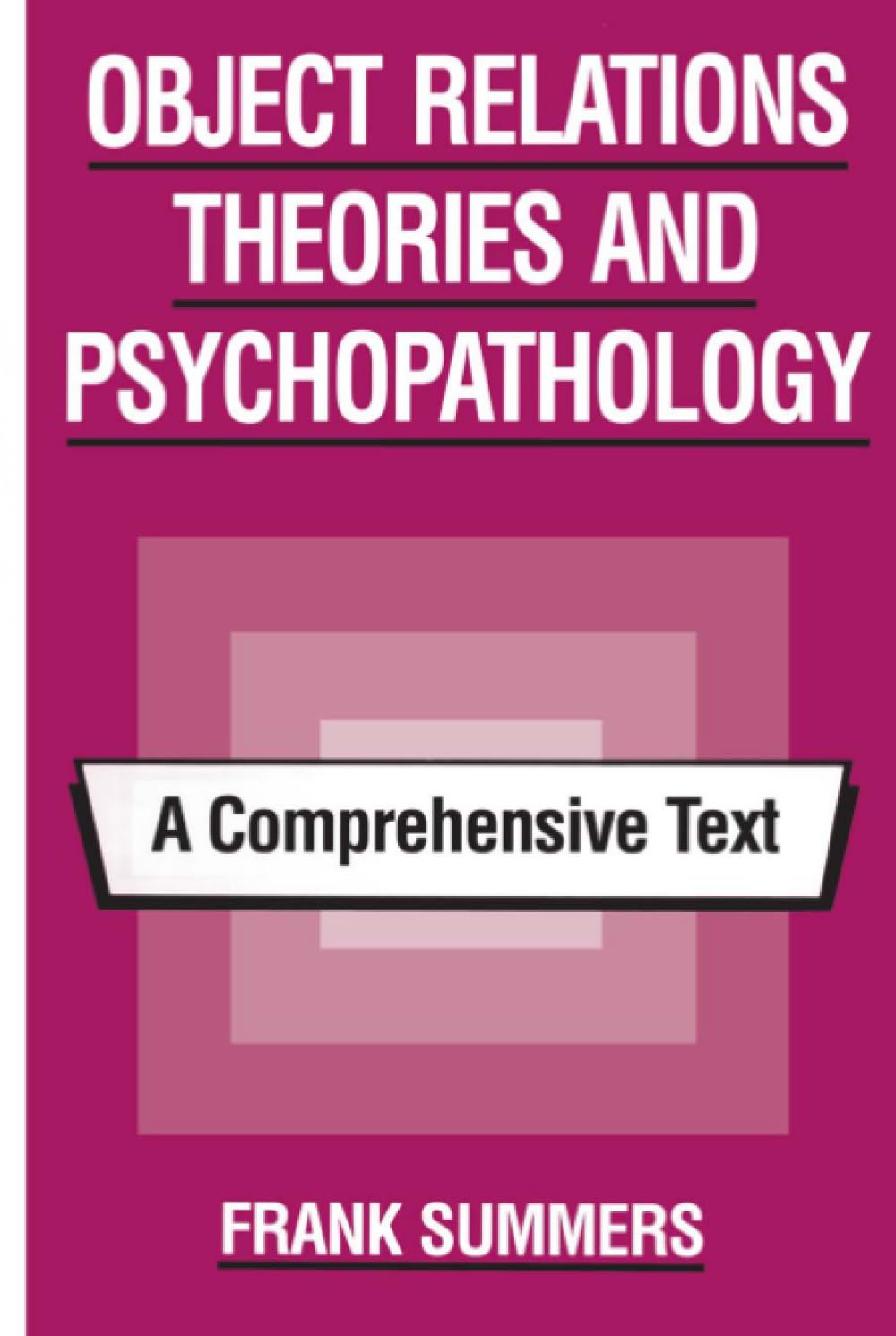
Title
Object Relations Theories And Psychopathology: A Comprehensive Text
Sold by Ergodebooks, an authorized reseller.
Returns accepted within 30 days | support@ergodebooks.com
Shipping Information
- Free Standard Shipping — United States only
- Processing Time: 3–5 business days
- Estimated Delivery: 6–10 business days after dispatch
- Double-boxed, fully insured & discreetly packaged
- Tracking number sent via email once dispatched
Returns & Refund
Returns accepted within 30 days of delivery.
Damaged or Defective Item
Free return shipping + replacement or full refund
Wrong Item Received
Free return shipping + replacement or full refund
Change of Mind
Return shipping at customer's expense · 25% restocking fee applies
Payment Option

In Object Relations Theories And Psychopathology: A Comprehensive Text, Frank Summers Provides Thorough, Lucid, And Critically Informed Accounts Of The Work Of Major Object Relations Theorists: Fairbairn, Guntrip, Klein, Winnicott, Kernberg, And Kohut. His Expositions Achieve Distinction On Two Counts. First, The Work Of Each Object Relations Theorist Is Presented As A Comprehensive Whole, With Separate Sections Expounding The Theorist'S Ideas And Assumptions About Metapsychology, Development, Psychopathology, And Treatment, With A Critical Evaluation Of The Strengths And Limitations Of The Theory In Question. Second, The Emphasis In Each Chapter Is On Issues Of Clinical Understanding And Technique. Making Extensive Use Of Case Material Provided By Each Of The Theorists, He Shows How Each Object Relations Theory Yields Specific Clinical Approaches To A Variety Of Syndromes, And How These Approaches Entail Specific Modifications In Clinical Technique.Beyond His Detailed Attention To The Theoretical And Technical Differences Among Object Relations Theories, Summers' Penultimate Chapter Discusses The Similarities And Differences Of Object Relations And Interpersonal Theories. And His Concluding Chapter Outlines A Pragmatic Object Relations Approach To Development, Psychopathology, And Technique That Combines Elements Of All Object Relations Theories Without Opting For Any Single Theory.Object Relations Theories And Psychopathology Is That Rare Event In Psychoanalytic Publishing: A Substantial, Readable Text That Surveys A Broad Expanse Of Theoretical And Clinical Landscape With Erudition, Sympathy, And Critical Perspective. It Will Be Essential Reading For All Analysts, Psychologists, Psychiatrists, And Social Workers Who Wish To Familiarize Themselves With Object Relations Theories In General, Sharpen Their Understanding Of The Work Of Specific Object Relations Theorists, Or Enhance Their Ability To Employ These Theories In Their Clinical Work.
⚠️ WARNING (California Proposition 65):
This product may contain chemicals known to the State of California to cause cancer, birth defects, or other reproductive harm.
For more information, please visit www.P65Warnings.ca.gov.
- Q: What is the main focus of 'Object Relations Theories and Psychopathology'? A: The book provides a comprehensive overview of major object relations theorists and their contributions to understanding psychopathology, development, and clinical techniques.
- Q: Who is the author of this book? A: The author is Frank Summers, who critically examines the work of several key theorists in the field of object relations.
- Q: What topics are covered in the book? A: The book covers metapsychology, development, psychopathology, treatment approaches, and comparative analyses of object relations and interpersonal theories.
- Q: How many pages does the book contain? A: The book contains 411 pages, providing an in-depth exploration of its subjects.
- Q: What is the binding type of the book? A: The book is available in hardcover binding, ensuring durability and a professional appearance.
- Q: Is the book suitable for professionals in mental health? A: Yes, it is essential reading for analysts, psychologists, psychiatrists, and social workers looking to deepen their understanding of object relations theories.
- Q: When was the book published? A: The book was published on April 1, 1994.
- Q: Does the book include case studies? A: Yes, it makes extensive use of case material to illustrate how each theory applies to clinical practice.
- Q: What is the significance of the concluding chapter? A: The concluding chapter outlines a pragmatic approach that integrates elements from various object relations theories without adhering to a single one.
- Q: Can this book help in understanding clinical techniques? A: Yes, it emphasizes clinical understanding and technique, making it a valuable resource for practitioners.