If you have any questions, you are always welcome to contact us. We'll get back to you as soon as possible, withing 24 hours on weekdays.
Customer service
All questions about your order, return and delivery must be sent to our customer service team by e-mail at yourstore@yourdomain.com
Sale & Press
If you are interested in selling our products, need more information about our brand or wish to make a collaboration, please contact us at press@yourdomain.com
Help
If you have any questions, you are always welcome to contact us. We'll get back to you as soon as possible, withing 24 hours on weekdays.
Customer service
All questions about your order, return and delivery must be sent to our customer service team by e-mail at yourstore@yourdomain.com
Sale & Press
If you are interested in selling our products, need more information about our brand or wish to make a collaboration, please contact us at press@yourdomain.com
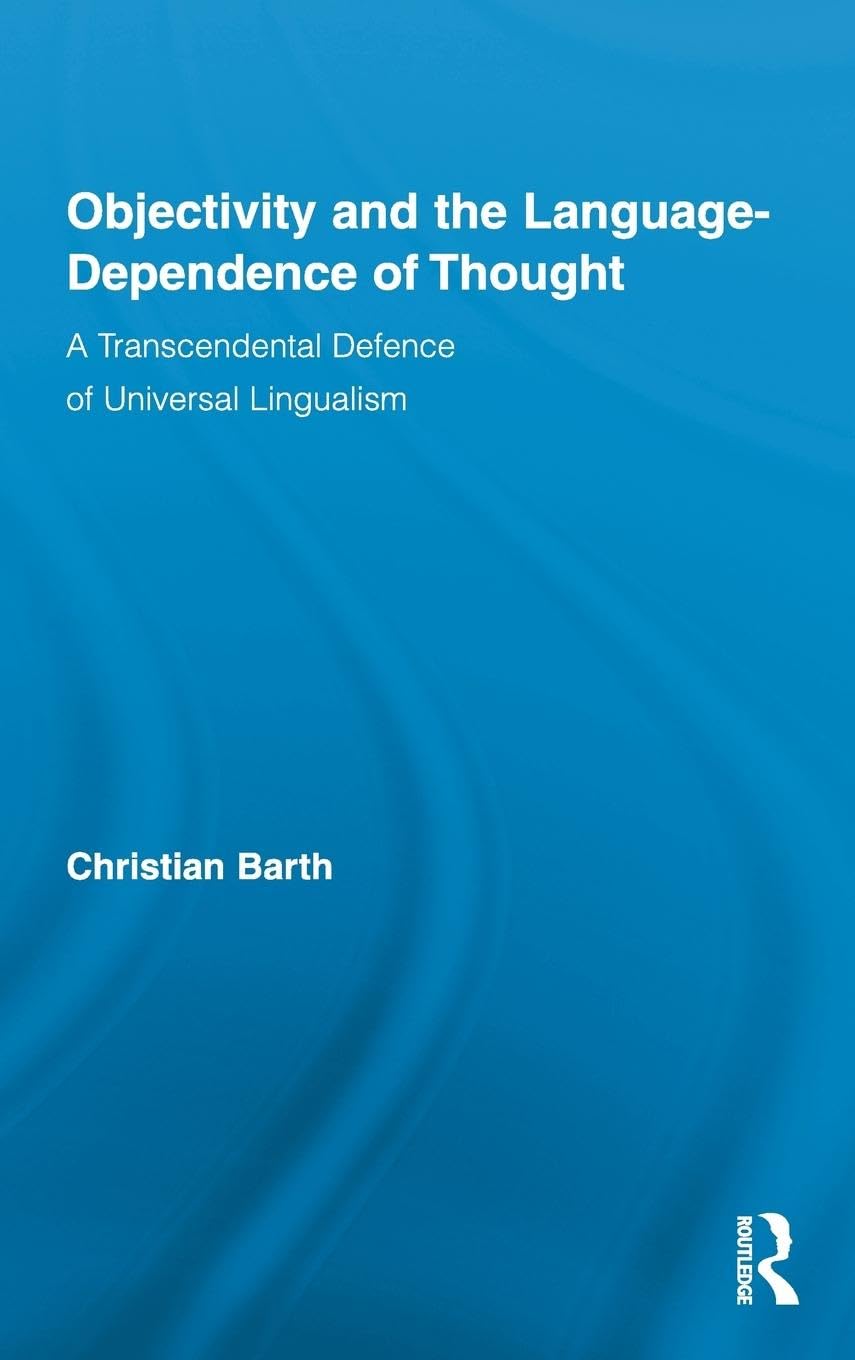
Does thought depend on language? Primarily as a consequence of the cognitive turn in empirical disciplines like psychology and ethology, many current empirical researchers and empirically minded philosophers tend to answer this question in the negative. This book rejects this mainstream view and develops a philosophical argument in favor of a universal dependence of language on thought. In doing so, it comprises insights of two primary representatives of 20th century and contemporary philosophy, namely Donald Davidson and Robert Brandom.Barth offers an introduction to the debate concerning the languagedependence of thought and lays the methodological foundation for the subsequent argument in favor of a universal dependence of thought on language, presenting an account and defense of the transcendental method in reference to the writings of Peter F. Strawson. He then offers a transcendental argument in favor of a universal languagedependence of thought, beginning with a reevaluation of a basic idea for an argument originally presented by Donald Davidson. Later, two main objections to the conclusion of this transcendental argument are addressed and rejected using Robert Brandoms inferentialist and normativist account of thought and language. In the course of doing so, the recent debate on Brandoms work is addressed extensively, and main objections to Brandoms work are presented and answered.
⚠️ WARNING (California Proposition 65):
This product may contain chemicals known to the State of California to cause cancer,
birth defects, or other reproductive harm.
For MAP (Minimum Advertised Price) violations and Intellectual Property (IP) or Trademark concerns, please contact:
support@ergodebooks.com
⚠️ California Proposition 65 Warning: Some products sold on this website may expose you to chemicals known to the State of California to cause cancer, birth defects, or other reproductive harm. For more information, visit www.P65Warnings.ca.gov.