
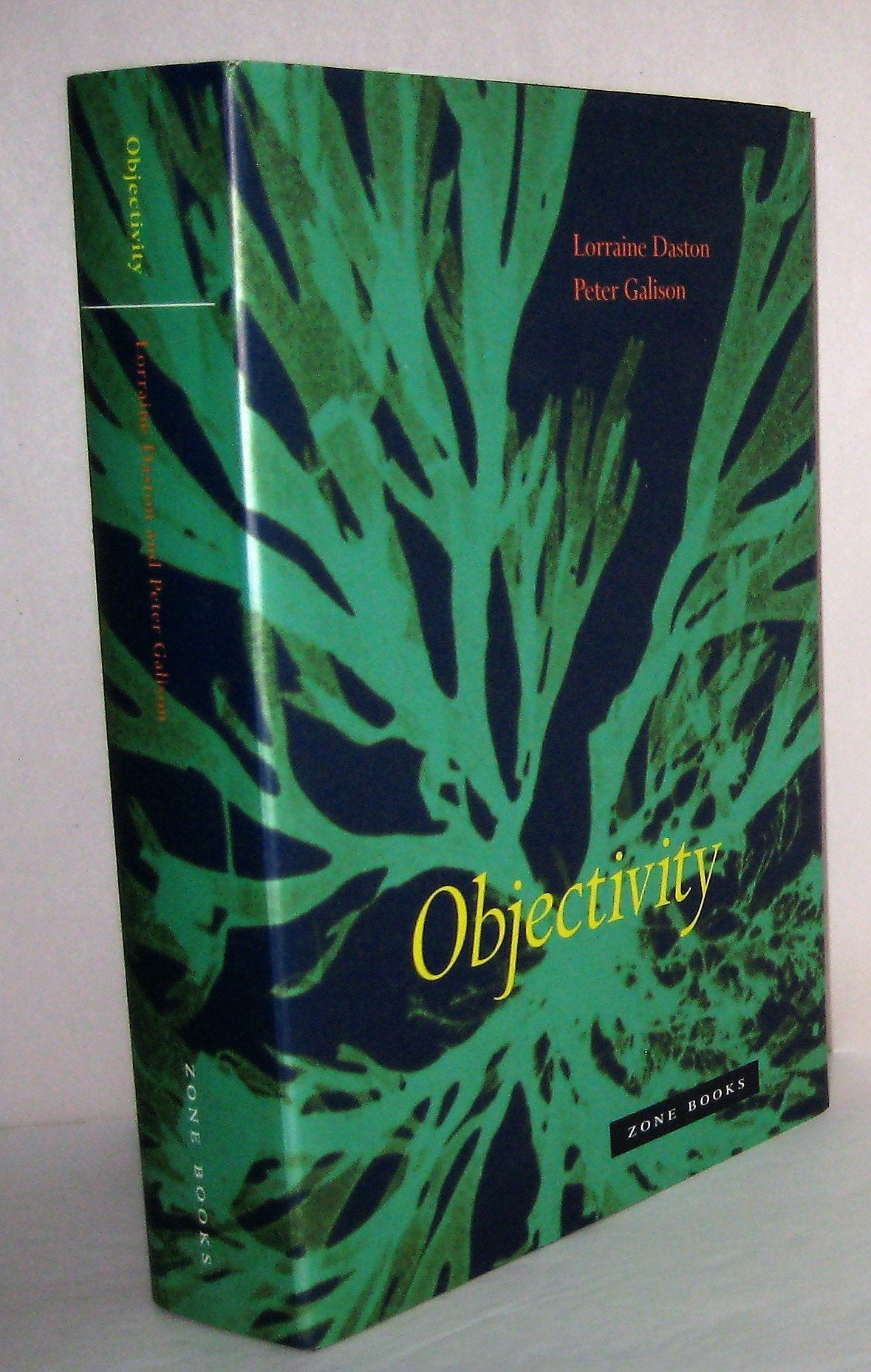
Title
Objectivity,New
Sold by Ergodebooks, an authorized reseller.
Returns accepted within 30 days | support@ergodebooks.com
Shipping Information
- Free Standard Shipping — United States only
- Processing Time: 3–5 business days
- Estimated Delivery: 6–10 business days after dispatch
- Double-boxed, fully insured & discreetly packaged
- Tracking number sent via email once dispatched
Returns & Refund
Returns accepted within 30 days of delivery.
Damaged or Defective Item
Free return shipping + replacement or full refund
Wrong Item Received
Free return shipping + replacement or full refund
Change of Mind
Return shipping at customer's expense · 25% restocking fee applies
Payment Option

Objectivity has a history, and it is full of surprises. In Objectivity, Lorraine Daston and Peter Galison chart the emergence of objectivity in the midnineteenthcentury sciences and show how the concept differs from alternatives, truthtonature and trained judgment. This is a story of lofty epistemic ideals fused with workaday practices in the making of scientific images.From the eighteenth through the early twentyfirst centuries, the images that reveal the deepest commitments of the empirical sciences from anatomy to crystallography are those featured in scientific atlases: the compendia that teach practitioners of a discipline what is worth looking at and how to look at it. Atlas images define the working objects of the sciences of the eye: snowflakes, galaxies, skeletons, even elementary particles.Galison and Daston use atlas images to uncover a hidden history of scientific objectivity and its rivals. Whether an atlas maker idealizes an image to capture the essentials in the name of truthtonature or refuses to erase even the most incidental detail in the name of objectivity or highlights patterns in the name of trained judgment is a decision enforced by an ethos as well as by an epistemology.As Daston and Galison argue, atlases shape the subjects as well as the objects of science. To pursue objectivity or truthtonature or trained judgment is simultaneously to cultivate a distinctive scientific self wherein knowing and knower converge. Moreover, the very point at which they visibly converge is in the very act of seeing not as a separate individual but as a member of a particular scientific community. Embedded in the atlas image, therefore, are the traces of consequential choices about knowledge, persona, and collective sight. Objectivity is a book addressed to any one interested in the elusive and crucial notion of objectivity and in what it means to peer into the world scientifically.
⚠️ WARNING (California Proposition 65):
This product may contain chemicals known to the State of California to cause cancer, birth defects, or other reproductive harm.
For more information, please visit www.P65Warnings.ca.gov.
- Q: What is the main focus of the book 'Objectivity'? A: The book 'Objectivity' by Lorraine Daston and Peter Galison explores the emergence of objectivity in the sciences during the mid-nineteenth century, contrasting it with concepts like truth-to-nature and trained judgment.
- Q: Who are the authors of 'Objectivity'? A: 'Objectivity' is authored by Lorraine Daston and Peter Galison, both of whom are respected scholars in the field of history and philosophy of science.
- Q: What topics does 'Objectivity' cover in relation to scientific images? A: 'Objectivity' discusses how atlas images from various scientific disciplines illustrate the principles of objectivity and the choices made by atlas makers that reflect their epistemic ideals.
- Q: How many pages does 'Objectivity' have? A: 'Objectivity' contains a total of 504 pages, providing an in-depth exploration of its themes.
- Q: In what condition is the used copy of 'Objectivity'? A: The used copy of 'Objectivity' is in good condition, indicating that it has been previously owned but remains functional and readable.
- Q: What is the binding type of 'Objectivity'? A: 'Objectivity' is available in hardcover binding, which typically offers durability and a premium feel compared to paperback editions.
- Q: When was 'Objectivity' published? A: 'Objectivity' was published on March 1, 2007.
- Q: What genre does 'Objectivity' belong to? A: 'Objectivity' is categorized under the genre of history.
- Q: Is there any specific audience for 'Objectivity'? A: 'Objectivity' is aimed at readers interested in the philosophical and historical aspects of scientific practices and the concept of objectivity.
- Q: What can readers expect to learn from 'Objectivity'? A: Readers can expect to gain insight into the historical development of scientific objectivity, its implications, and the ethical considerations involved in the presentation of scientific images.