
Title
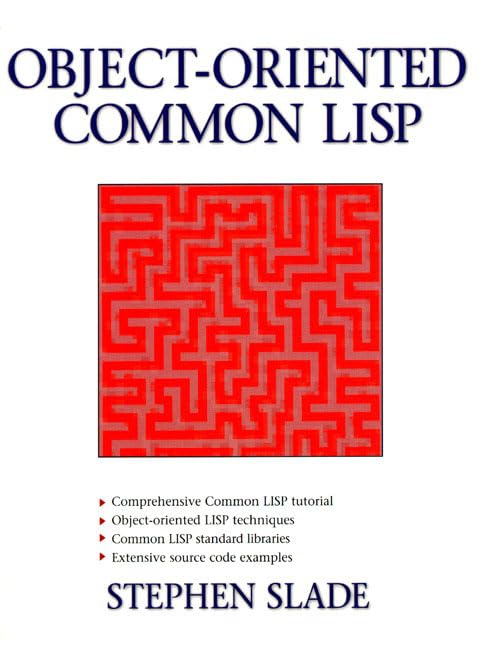
ObjectOriented Common Lisp,Used
Sold by Ergodebooks, an authorized reseller.
Returns accepted within 30 days | support@ergodebooks.com
Shipping Information
- Free Standard Shipping — United States only
- Processing Time: 3–5 business days
- Estimated Delivery: 6–10 business days after dispatch
- Double-boxed, fully insured & discreetly packaged
- Tracking number sent via email once dispatched
Returns & Refund
Returns accepted within 30 days of delivery.
Damaged or Defective Item
Free return shipping + replacement or full refund
Wrong Item Received
Free return shipping + replacement or full refund
Change of Mind
Return shipping at customer's expense · 25% restocking fee applies
Payment Option

LISP, which stands for LISt Processing, was developed in the late 1950s by John McCarthy as a language for manipulating symbols. This book presents the Common LISP Language, a version of LISP, and details a range of applications for it, including data structures, computer systems, and compiler design.This book presents a tutorial introduction to Common LISP, coverign lists and trees, recursion, local vs. global reference, characters and strings, streams, LAMDA and LABELS, control, debugging, macros, structures, classes and objects, vectors and arrays, and efficiency and compilation.For programmers interested in a language with simple syntax, extensive adaptability and advanced memory management.
⚠️ WARNING (California Proposition 65):
This product may contain chemicals known to the State of California to cause cancer, birth defects, or other reproductive harm.
For more information, please visit www.P65Warnings.ca.gov.
- Q: What is the main focus of 'Object-Oriented Common Lisp'? A: 'Object-Oriented Common Lisp' primarily focuses on teaching the Common LISP programming language, including its syntax and various applications in data structures, computer systems, and compiler design.
- Q: Who is the author of this book? A: The author of 'Object-Oriented Common Lisp' is Stephen Slade.
- Q: How many pages does the book have? A: 'Object-Oriented Common Lisp' contains a total of 774 pages.
- Q: What topics are covered in the book? A: The book covers a range of topics, including lists and trees, recursion, local vs. global reference, characters and strings, streams, LAMDA and LABELS, control, debugging, macros, structures, classes and objects, vectors and arrays, as well as efficiency and compilation.
- Q: What is the publication date of 'Object-Oriented Common Lisp'? A: 'Object-Oriented Common Lisp' was published on January 1, 1997.
- Q: What type of binding does this book have? A: 'Object-Oriented Common Lisp' is available in paperback binding.
- Q: Is this book suitable for beginners? A: Yes, 'Object-Oriented Common Lisp' provides a tutorial introduction to Common LISP, making it suitable for beginners as well as experienced programmers.
- Q: What programming concepts does the book emphasize? A: The book emphasizes key programming concepts such as object-oriented design, data structures, and memory management in the context of Common LISP.
- Q: Can this book help with understanding advanced LISP features? A: Absolutely, 'Object-Oriented Common Lisp' covers advanced topics such as macros, classes, and objects, which are essential for a deeper understanding of LISP.
- Q: Is 'Object-Oriented Common Lisp' applicable for modern programming needs? A: While the book focuses on Common LISP, the concepts of object-oriented design and memory management it teaches are relevant to modern programming practices.