
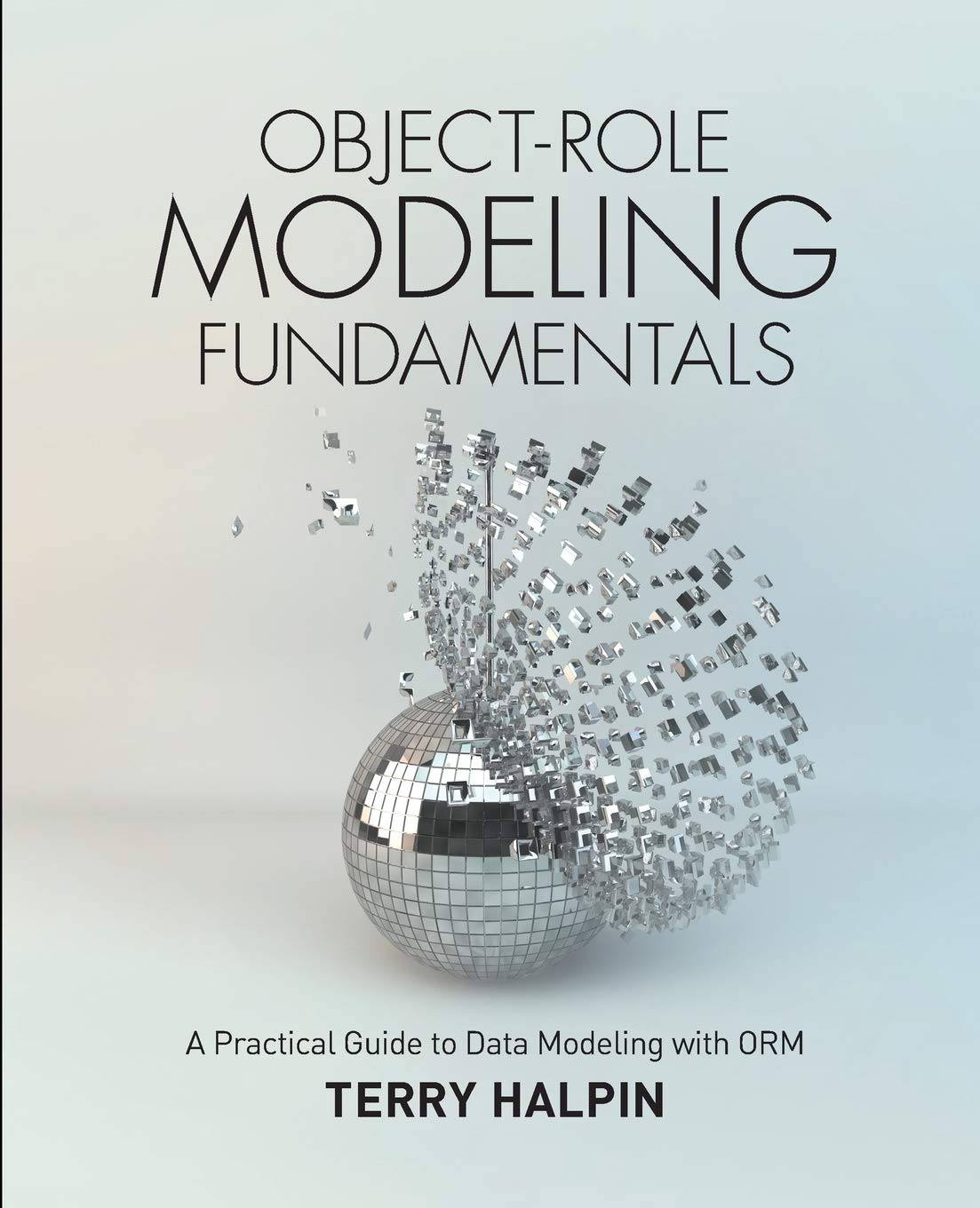
Title
ObjectRole Modeling Fundamentals: A Practical Guide to Data Modeling with ORM,Used
Sold by Ergodebooks, an authorized reseller.
Returns accepted within 30 days | support@ergodebooks.com
Shipping Information
- Free Standard Shipping — United States only
- Processing Time: 3–5 business days
- Estimated Delivery: 6–10 business days after dispatch
- Double-boxed, fully insured & discreetly packaged
- Tracking number sent via email once dispatched
Returns & Refund
Returns accepted within 30 days of delivery.
Damaged or Defective Item
Free return shipping + replacement or full refund
Wrong Item Received
Free return shipping + replacement or full refund
Change of Mind
Return shipping at customer's expense · 25% restocking fee applies
Payment Option

ObjectRole Modeling (ORM) is a factbased approach to data modeling that expresses the information requirements of any business domain simply in terms of objects that play roles in relationships. All facts of interest are treated as instances of attributefree structures known as fact types, where the relationship may be unary (e.g. Person smokes), binary (e.g. Person was born on Date), ternary (e.g. Customer bought Product on Date), or longer. Fact types facilitate natural expression, are easy to populate with examples for validation purposes, and have greater semantic stability than attributebased structures such as those used in Entity Relationship Modeling (ER) or the Unified Modeling Language (UML).All relevant facts, constraints and derivation rules are expressed in controlled natural language sentences that are intelligible to users in the business domain being modeled. This allows ORM data models to be validated by business domain experts who are unfamiliar with ORM's graphical notation. For the data modeler, ORM's graphical notation covers a much wider range of constraints than can be expressed in industrial ER or UML class diagrams, and thus allows rich visualization of the underlying semantics.Suitable for both novices and experienced practitioners, this book covers the fundamentals of the ORM approach. Written in easytounderstand language, it shows how to design an ORM model, illustrating each step with simple examples. Each chapter ends with a practical lab that discusses how to use the freeware NORMA tool to enter ORM models and use it to automatically generate verbalizations of the model and map it to a relational database.
⚠️ WARNING (California Proposition 65):
This product may contain chemicals known to the State of California to cause cancer, birth defects, or other reproductive harm.
For more information, please visit www.P65Warnings.ca.gov.