
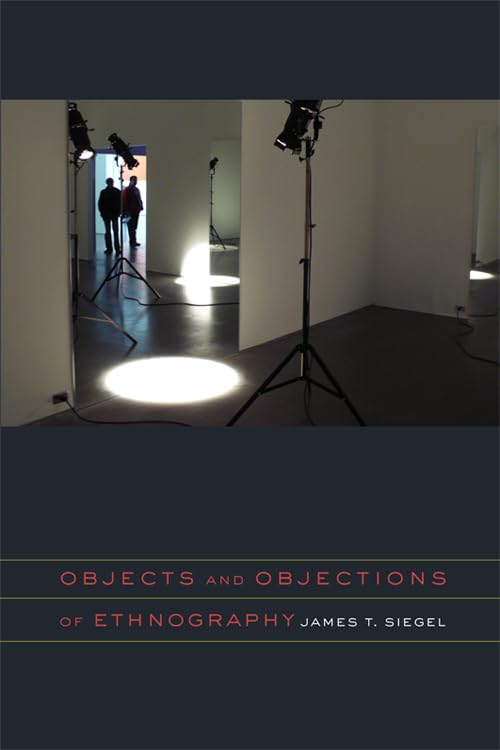
Title
Objects And Objections Of Ethnography
Sold by Ergodebooks, an authorized reseller.
Returns accepted within 30 days | support@ergodebooks.com
Shipping Information
- Free Standard Shipping — United States only
- Processing Time: 3–5 business days
- Estimated Delivery: 6–10 business days after dispatch
- Double-boxed, fully insured & discreetly packaged
- Tracking number sent via email once dispatched
Returns & Refund
Returns accepted within 30 days of delivery.
Damaged or Defective Item
Free return shipping + replacement or full refund
Wrong Item Received
Free return shipping + replacement or full refund
Change of Mind
Return shipping at customer's expense · 25% restocking fee applies
Payment Option

The Essays In This Volume, In All Their Astonishing Richness And Diversity, Focus On The Question Of The Other. Brimming With Whole Flotillas Of New Ideas, They Delineate Subtle And Various Ways In Which That Question Can Be Made The Basis Of An Ethnographic Project.In Them, The Author Responds To The Invitations Extended By A Specific Location Rather Than Pursuing A Codified Method. And They Examine Many Different Socialities In Many Different Locationsamong Them The Cornell University Campus In The Late Seventies, The Former Muse De Lhomme And The Quai Branly Museum In Paris, Theindonesian Province Of Aceh In The Wake Of The Tsunami Of 2004, And Contemporary Indonesia, In The Liminal Figures Of The Jew And The Chinese. The Author Meticulously Traces How The Social And Cultural Responses In Each Location Are Astonishingly Differentin The Form, Say, Of Gorges, Faces, Garbage, And Fetishes.Regrettably, These Days Anthropologists Have A Tendency To Look For Similarities Rather Than Differences, To Show How One Phenomenon Is Just Like Another. This Book Stands Determinedly Against This Trend, Both In Its Ethnographic Examinations And In How It Takes Up Such Figures As Kant, Derrida, Bataille, Simmel, And Leiris So As To Illuminate Not Only The Objects Of Ethnography But Also Differences Among The Perspectivesthese Thinkers Represent.This Book Will Put The Methods And Objects Of Anthropology In An Entirely New Light. In Addition, It Will Speak To The Concerns Of Historians, Political Scientists, And Scholars Of Area Studies, Literature, And Art.
⚠️ WARNING (California Proposition 65):
This product may contain chemicals known to the State of California to cause cancer, birth defects, or other reproductive harm.
For more information, please visit www.P65Warnings.ca.gov.
- Q: What is the page count of 'Objects and Objections of Ethnography'? A: The book contains one hundred eighty-eight pages. This makes it a concise yet rich exploration of ethnographic themes.
- Q: What is the binding type of this book? A: The book is available in paperback binding. This type of binding is flexible and lightweight, making it easy to handle.
- Q: What are the dimensions of 'Objects and Objections of Ethnography'? A: The dimensions are eight point nine inches in length, six inches in height, and zero point six inches in width. These dimensions make it portable and easy to store.
- Q: Who is the author of this book? A: The author is James T. Siegel. He brings a wealth of knowledge and experience to the discussions presented in the essays.
- Q: What topics does this book cover? A: The book explores themes related to ethnography, cultural differences, and social responses. It delves into various locations and their unique socialities.
- Q: Is this book suitable for beginners in ethnographic studies? A: Yes, it is suitable for beginners. The essays are accessible and provide foundational insights into ethnographic methods and perspectives.
- Q: How can I apply the concepts from this book? A: You can apply the concepts by utilizing the diverse ethnographic methods and perspectives in your own research or studies. The book encourages readers to focus on differences rather than similarities.
- Q: What age group is this book appropriate for? A: The book is appropriate for adults and advanced students. It covers complex themes that may not be suitable for younger audiences.
- Q: How should I store this book to keep it in good condition? A: Store the book in a cool, dry place away from direct sunlight. This will help preserve the binding and pages over time.
- Q: Can I return the book if I'm not satisfied? A: Yes, you can return the book under the guaranteed returns policy. Ensure it is in mint condition for a hassle-free return process.
- Q: What if the book arrives damaged? A: If the book arrives damaged, contact customer service for a replacement. Ensure you provide details of the damage to expedite the process.
- Q: Is there any specific way to clean this book? A: To clean the book, gently wipe the cover with a soft, dry cloth. Avoid using liquids as they can damage the pages.
- Q: How does this book differ from other ethnography texts? A: This book stands out by emphasizing the uniqueness of different cultures and socialities rather than drawing parallels. It challenges conventional approaches in anthropology.
- Q: What kind of illustrations are included in the book? A: The book includes two black and white illustrations. These visuals complement the text and enhance the reader’s understanding.
- Q: What is the publication date of this book? A: The publication date is not specified in the details. However, it is published by Fordham University Press, a reputable academic publisher.
- Q: Can this book be used in academic settings? A: Yes, it can be used in academic settings. It is relevant for courses in ethnic studies, anthropology, and cultural studies.