
Title
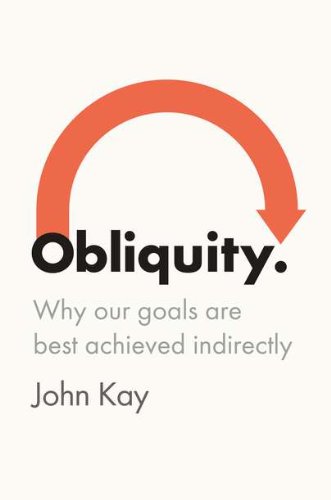
Obliquity: Why Our Goals Are Best Achieved Indirectly,Used
Sold by Ergodebooks, an authorized reseller.
Returns accepted within 30 days | support@ergodebooks.com
Shipping Information
- Free Standard Shipping — United States only
- Processing Time: 3–5 business days
- Estimated Delivery: 6–10 business days after dispatch
- Double-boxed, fully insured & discreetly packaged
- Tracking number sent via email once dispatched
Returns & Refund
Returns accepted within 30 days of delivery.
Damaged or Defective Item
Free return shipping + replacement or full refund
Wrong Item Received
Free return shipping + replacement or full refund
Change of Mind
Return shipping at customer's expense · 25% restocking fee applies
Payment Option

A leading economist charts the indirect road to happiness and wealth.Using dozens of practical examples from the worlds of business, politics, science, sports, literature, even parenting, esteemed economist John Kay proves a notion that feels at once paradoxical and deeply commonsensical: The best way to achieve any complex or broadly defined goalfrom happiness to wealth to profit to preventing forest firesis the indirect way. As Kay points out, we rarely know enough about the intricacies of important problems to tackle them headon. And our unpredictable interactions with other people and the world at large mean that the path to our goalsand sometimes the goals themselveswill inevitably change. We can learn about our objectives and how to achieve them only through a gradual process of risk taking and discoverywhat Kay calls obliquity.Kay traces this pathway to satisfaction as it manifests itself in nearly every aspect of life. The wealthiest peoplefrom Andrew Carnegie to Bill Gatesachieved their riches through a passion for their work, not because they set materialistic goals. Research has shown that companies whose goal (as declared in mission statements) is excellent products or service are more profitable than companies whose stated goal is increasing profits. In the personal realm, a large body of evidence shows that parenthood is on a daily basis far more frustrating than happy making. Yet parents are statistically happier than nonparents. Though their shortterm pleasure is often thwarted by the demands of childrearing, the subtleobliquerewards of parenthood ultimately make them happier.Once he establishes the ubiquity of obliquity, Kay offers a wealth of practical guidance for avoiding the traps laid by the direct approach to complex problems. Directness blinds us to new information that contradicts our presumptions, fools us into confusing logic with truth, cuts us off from our intuition (which is the subconscious expression of our experience), shunts us away from alternative solutions that may be better than the one were set on, and more. Kay also shows us how to acknowledge our limitations, redefine our goals to fit our skills, open our minds to new data and solutions, and otherwise live life with obliquity.This bracing manifesto will convince readersor confirm their convictionthat the best route to satisfaction and success does not run through the bottom line.
⚠️ WARNING (California Proposition 65):
This product may contain chemicals known to the State of California to cause cancer, birth defects, or other reproductive harm.
For more information, please visit www.P65Warnings.ca.gov.
- Q: How many pages does the book have? A: The book has two hundred twenty-four pages. It provides ample content on the themes of obliquity and indirect goal achievement.
- Q: What are the dimensions of this book? A: The book measures five point seventy-five inches in length, one point twenty-six inches in width, and eight point five inches in height. These dimensions make it easy to handle and read.
- Q: What binding does the book use? A: This book is bound in hardcover. The hardcover binding ensures durability and a premium feel for readers.
- Q: Who is the author of this book? A: The author of the book is John Kay. He is a renowned economist known for his insights on indirect approaches to achieving goals.
- Q: What genre does this book belong to? A: This book is categorized under personal transformation. It delves into economic principles and personal development.
- Q: Is this book suitable for young readers? A: Yes, this book is suitable for young readers. It offers valuable insights into goal-setting and personal growth, making it accessible to a broad audience.
- Q: How can I apply the concepts from this book? A: You can apply the concepts by focusing on indirect methods to achieve your goals. These methods involve adapting your approach based on experiences and feedback.
- Q: Is there a recommended age for reading this book? A: The book is recommended for readers aged fifteen and above. It discusses complex ideas that may require a certain level of maturity to fully grasp.
- Q: What practical advice does this book offer? A: The book offers practical guidance on redefining goals and embracing flexibility. It encourages readers to acknowledge limitations and adapt their strategies.
- Q: How should I store this book? A: Store this book in a cool, dry place, away from direct sunlight. Proper storage will help maintain its condition over time.
- Q: Can I clean the book if it gets dirty? A: Yes, you can clean the book by gently wiping it with a soft, dry cloth. Avoid using water or cleaning solutions to prevent damage.
- Q: What if the book arrives damaged? A: If the book arrives damaged, you should contact customer support for assistance. They typically offer solutions like exchanges or refunds.
- Q: Is there a warranty on this book? A: No, there is no warranty on books. However, many retailers have return policies for damaged items.
- Q: How do I return the book if I'm not satisfied? A: To return the book, follow the retailer's return policy. Generally, you'll need to keep the original packaging and receipt.
- Q: Are there any special instructions for handling the book? A: Handle the book with clean hands to avoid smudges. Avoid bending the spine to preserve its structure.
- Q: What topics does the book cover? A: The book covers topics such as indirect goal achievement, personal fulfillment, and economic principles. It uses real-life examples to illustrate these themes.