
Title
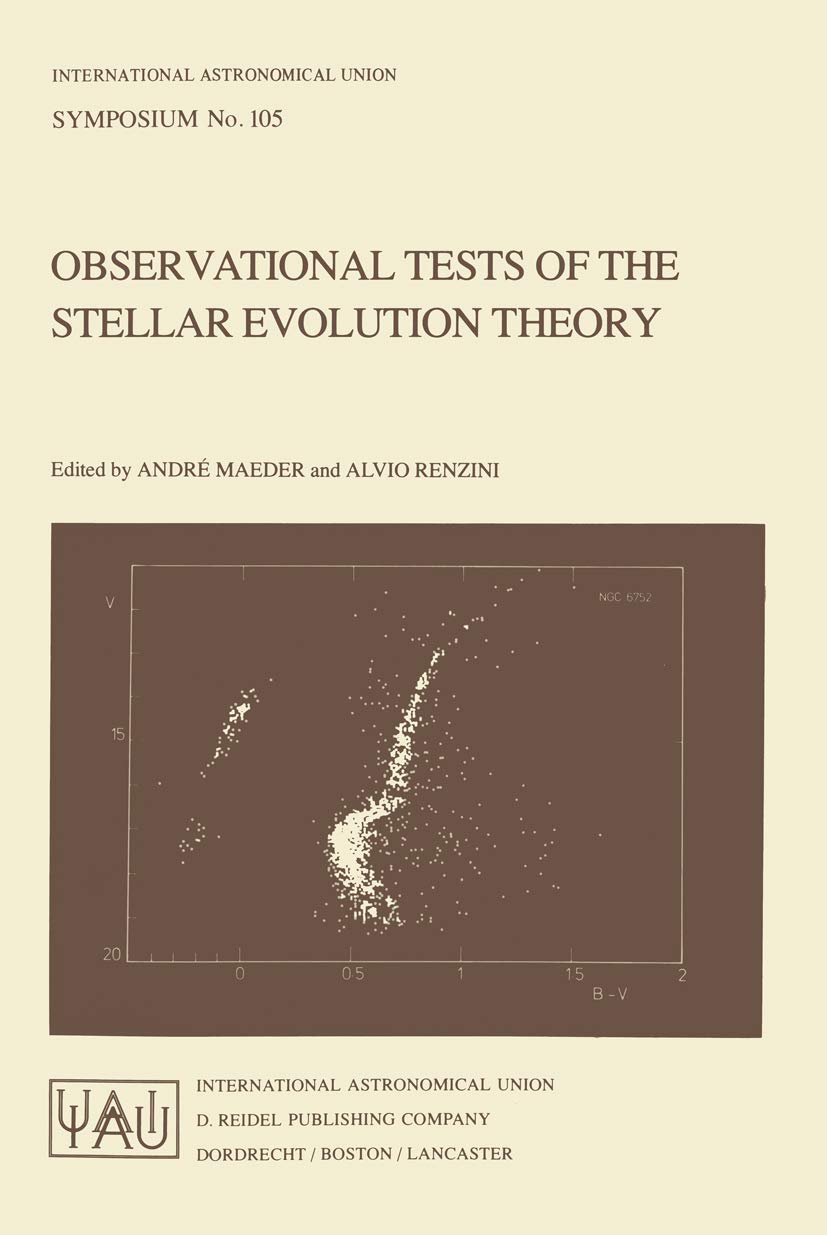
Observational Tests Of The Stellar Evolution Theory (International Astronomical Union Symposia, 105),Used
Sold by Ergodebooks, an authorized reseller.
Returns accepted within 30 days | support@ergodebooks.com
Shipping Information
- Free Standard Shipping — United States only
- Processing Time: 3–5 business days
- Estimated Delivery: 6–10 business days after dispatch
- Double-boxed, fully insured & discreetly packaged
- Tracking number sent via email once dispatched
Returns & Refund
Returns accepted within 30 days of delivery.
Damaged or Defective Item
Free return shipping + replacement or full refund
Wrong Item Received
Free return shipping + replacement or full refund
Change of Mind
Return shipping at customer's expense · 25% restocking fee applies
Payment Option

Review This book can be highly recommended to advanced students and to professional astronomers. It should be required reading for all investigators in the theory of stellar evolution.' Journal of the Royal Astronomical Society of Canada, 79:6 (1985) Product Description 'If simple perfect laws uniquely rule the universe, should not pure thought be capable of uncovering this perfect set of laws without having to lean on the crutches of tediously assembled observations? True, the laws to be discovered may be perfect, but the human brain is not. Left on its own, it is prone to stray, as many past examples sadly prove. In fact, we have missed few chances to err until new data freshly gleaned from nature set us right again for the next steps. Thus pillars rather than crutches are the observations on which we base our theories; and for the theory of stellar evolution these pillars must be there before we can get far on the right track. ' These words written by Martin Schwarzschi1d in his famous book en titled 'Structure and Evolution of the Stars'(1958) remind us how necessary and fruitful is the interplay of stellar evolution theory and observations. Clearly, observations are the great censor by their possibility of confirming or contradicting theoretical constructions. In addition, they have a driving role: new and sometimes unexpected facts may give rise to progressive ideas and stimulate further theoretical developments. In turn, theory, in its major role of sifting out and placing the facts in a logical sequence based on physical laws, must also be predictive and indicate new and pertinent observations to be undertaken.
⚠️ WARNING (California Proposition 65):
This product may contain chemicals known to the State of California to cause cancer, birth defects, or other reproductive harm.
For more information, please visit www.P65Warnings.ca.gov.