If you have any questions, you are always welcome to contact us. We'll get back to you as soon as possible, withing 24 hours on weekdays.
Customer service
All questions about your order, return and delivery must be sent to our customer service team by e-mail at yourstore@yourdomain.com
Sale & Press
If you are interested in selling our products, need more information about our brand or wish to make a collaboration, please contact us at press@yourdomain.com
Help
If you have any questions, you are always welcome to contact us. We'll get back to you as soon as possible, withing 24 hours on weekdays.
Customer service
All questions about your order, return and delivery must be sent to our customer service team by e-mail at yourstore@yourdomain.com
Sale & Press
If you are interested in selling our products, need more information about our brand or wish to make a collaboration, please contact us at press@yourdomain.com
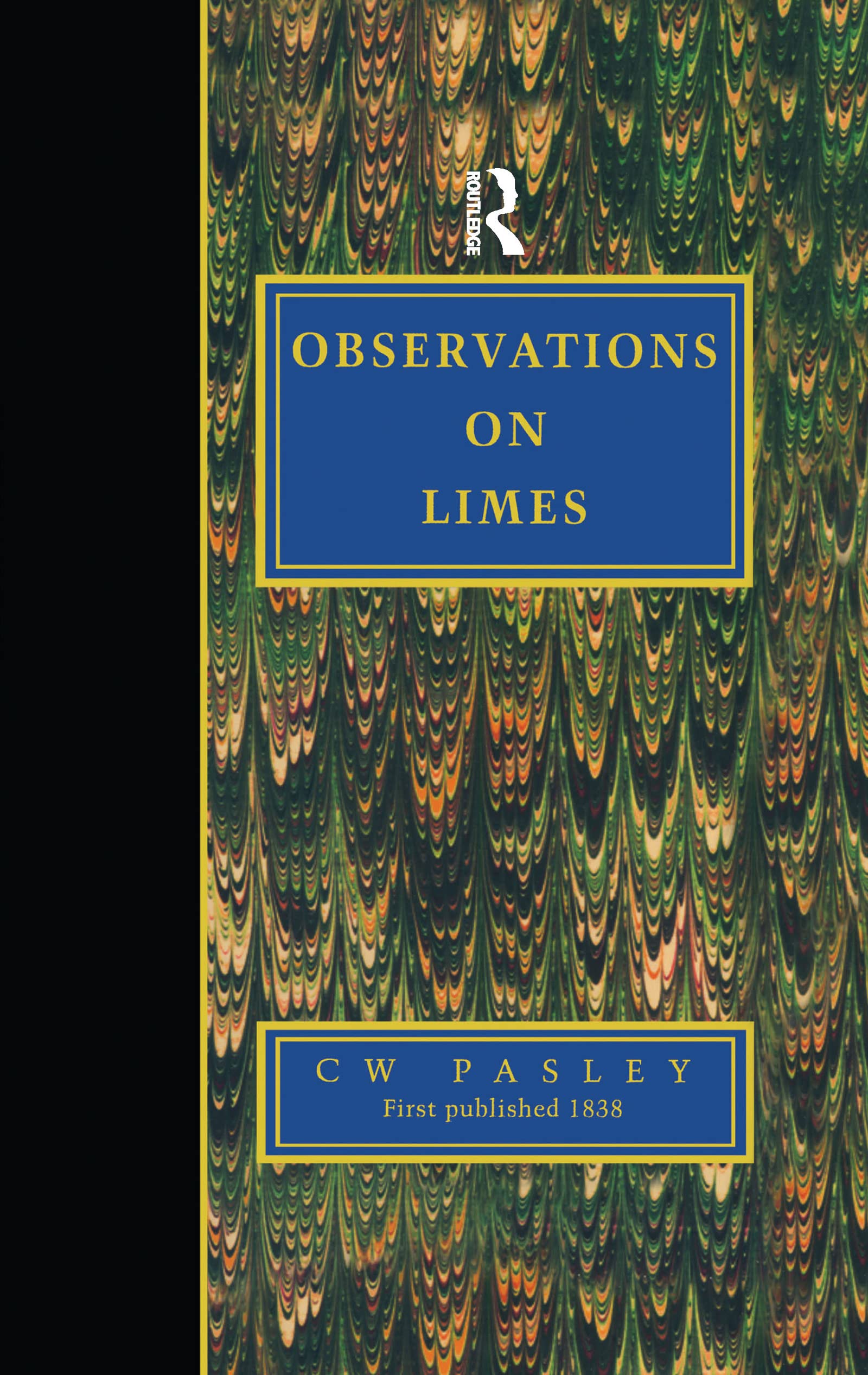
This volume represents a small part of the book Sir Charles Pasley wrote in 1838 which detailed his own experiments in the development of artificial cement for military uses. Whilst much of the first part of Pasley's work is of limited use to those involved with the care of historic buildings today, the section that Donhead has chosen to reprint provides a fascinating insight into the developments using lime during the eighteenth and early nineteenth centuries. Michael Wingate's excellent introduction to this edition offers a helpful present day perspective of the work undertaken on lime in that period, and shows how relevant such research is to conservation practitioners and others currently specifying or directly working with lime. Pasley has summarized and explained the work and experiments of the most important authors of the period including Smeaton (1791), Parker (1796), Vicat (1818 and 1828), Treussart (1829), and Godwin (1836). Pasley's text reveals the contrast between those, like Dr Higgins, who set out to achieve exceptional performance from the simplest of limes, and others such as John Smeaton, who understood how strength for the toughest conditions could be achieved from impure limes.
⚠️ WARNING (California Proposition 65):
This product may contain chemicals known to the State of California to cause cancer,
birth defects, or other reproductive harm.
For MAP (Minimum Advertised Price) violations and Intellectual Property (IP) or Trademark concerns, please contact:
support@ergodebooks.com
⚠️ California Proposition 65 Warning: Some products sold on this website may expose you to chemicals known to the State of California to cause cancer, birth defects, or other reproductive harm. For more information, visit www.P65Warnings.ca.gov.