
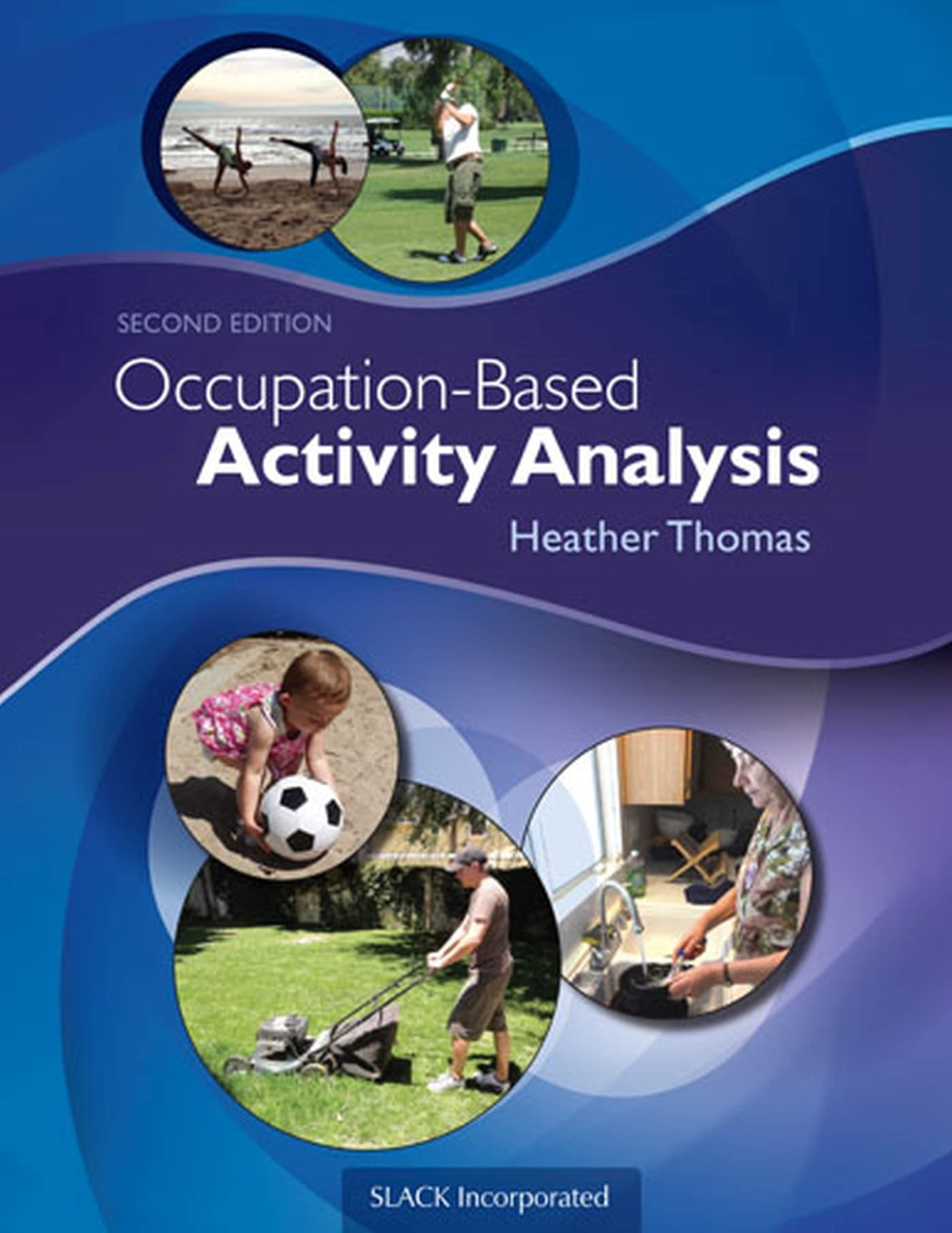
Title
Occupationbased Activity Analysis
Sold by Ergodebooks, an authorized reseller.
Returns accepted within 30 days | support@ergodebooks.com
Shipping Information
- Free Standard Shipping — United States only
- Processing Time: 3–5 business days
- Estimated Delivery: 6–10 business days after dispatch
- Double-boxed, fully insured & discreetly packaged
- Tracking number sent via email once dispatched
Returns & Refund
Returns accepted within 30 days of delivery.
Damaged or Defective Item
Free return shipping + replacement or full refund
Wrong Item Received
Free return shipping + replacement or full refund
Change of Mind
Return shipping at customer's expense · 25% restocking fee applies
Payment Option

Occupational Therapists Use Occupations And Activities As Not Just A Goal, But Also As A Treatment Medium, Therefore, They Must Understand Both The Uniqueness Of A Clients Occupations And How An Activity Can Be Used Therapeutically. To Analyze The Complexity Of An Occupation Takes Much More Depth Of Understanding Of The Person Engaging In It, His Or Her Environment, And The Uniqueness Of The Occupation A Person Has Chosen.The New Second Edition Of Occupationbased Activity Analysis Continues The Tradition Of Teaching Students And Clinicians The Process Of Conducting Activity Analyses And Occupationbased Activity Analyses.Dr. Heather Thomas Has Updated Occupationbased Activity Analysis, Second Edition To Reflect The Significant Changes Made To The Activity Analysis Process And Terminology In The Occupational Therapy Practice Framework, Third Edition. As In An Activity Analysis, Occupationbased Activity Analysis Looks At What Is Required For Full Participation, Yet Goes Beyond Analyzing The Activity; It Looks At What It Means For The Person Engaging In It And How And Where It Is Performed By That Person.Inside Occupationbased Activity Analysis, Second Edition, Each Chapter Is Dedicated To A Component Of The Activity Analysis Process And Corresponding Section Of The Framework. Chapters Have Been Restructured Based On A Greater Emphasis On Occupationbased Activity Analysis. From Start To Finish, Readers Are Guided Through Identifying The Occupation, Sequence And Timing, Objects And Properties, Space And Social Demands, Body Functions, And Structures And Performance Skills Required.New In The Second Edition: Chapters Throughout The Text Have Been Updated To Reflect The Changes In The Framework A New Chapter To Reflect The New Addition To The Activity Demands Section Of The Framework Changes In Terminology And Definitions In The Areas Of Occupation, Performance Skills, And Body Functions Additional Activities Provided At The End Of Each Chapter Appendices And Forms Have Been Updated To Reflect The Changes In The Framework Images Have Been Updated With Greater Clarity And Resolution Updated And New Instructor Materials For Faculty To Use In The Classroominstructors In Educational Settings Can Visit Www.Efacultylounge.Com For Additional Materials To Be Used For Teaching In The Classroom.As A Foundational Skill, Activity Analysis And Occupationbased Activity Analysis Is Utilized Throughout Students Careers And Into Their Lives As Practitioners, Making Occupationbased Activity Analysis, Second Edition The Perfect Textbook For The Occupational Therapy Or Occupational Therapy Assistant Student, Faculty, Or Clinician.
⚠️ WARNING (California Proposition 65):
This product may contain chemicals known to the State of California to cause cancer, birth defects, or other reproductive harm.
For more information, please visit www.P65Warnings.ca.gov.
- Q: What are the dimensions of the book? A: The book measures eight and a half inches in length, eleven inches in height, and zero point seventy-one inches in width.
- Q: How many pages does the book have? A: The book contains two hundred fifty-six pages, providing comprehensive coverage of the subject matter.
- Q: What type of binding does the book have? A: The book is published in paperback binding, making it lightweight and easy to handle.
- Q: Who is the author of the book? A: The author of the book is Heather Thomas, who has updated the content for the second edition.
- Q: What is the main focus of the book? A: The book focuses on activity analysis and occupation-based activity analysis in the field of occupational therapy.
- Q: How do I use this book for my studies? A: You can use this book as a textbook for understanding the process of conducting activity analyses in occupational therapy.
- Q: Is this book suitable for beginners in occupational therapy? A: Yes, this book is suitable for both students and clinicians, making it a great resource for beginners.
- Q: Can this book help me with practical applications in therapy? A: Yes, the book provides insights into using activities therapeutically, enhancing your practical applications in therapy.
- Q: How should I store the book? A: Store the book in a cool, dry place to maintain its condition and prevent damage.
- Q: What is the best way to care for this book? A: To care for the book, avoid exposing it to moisture and direct sunlight, and handle it with clean hands.
- Q: What if the book arrives damaged? A: If the book arrives damaged, you should contact the seller for their return policy and replacement options.
- Q: Is this book appropriate for use in educational settings? A: Yes, the book is designed for educational settings and includes updated instructor materials for faculty.
- Q: How does this book compare to previous editions? A: This second edition includes updates to reflect changes in the Occupational Therapy Practice Framework, enhancing its relevance.
- Q: Can I find additional resources for teaching from this book? A: Yes, instructors can visit www.efacultylounge.com for additional teaching materials related to the book.
- Q: Does this book include any activities for practice? A: Yes, the book includes additional activities at the end of each chapter to enhance learning and application.
- Q: What topics are covered in this book? A: The book covers components of the activity analysis process, including occupation identification and performance skills.