If you have any questions, you are always welcome to contact us. We'll get back to you as soon as possible, withing 24 hours on weekdays.
Customer service
All questions about your order, return and delivery must be sent to our customer service team by e-mail at yourstore@yourdomain.com
Sale & Press
If you are interested in selling our products, need more information about our brand or wish to make a collaboration, please contact us at press@yourdomain.com
Help
If you have any questions, you are always welcome to contact us. We'll get back to you as soon as possible, withing 24 hours on weekdays.
Customer service
All questions about your order, return and delivery must be sent to our customer service team by e-mail at yourstore@yourdomain.com
Sale & Press
If you are interested in selling our products, need more information about our brand or wish to make a collaboration, please contact us at press@yourdomain.com
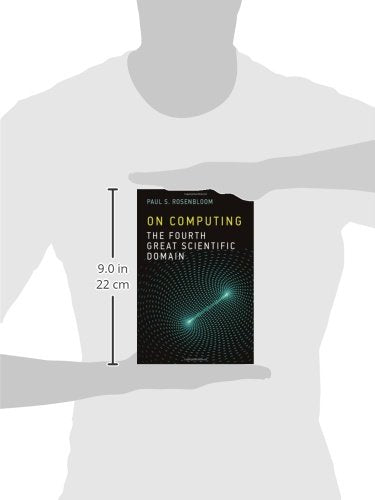
Computing is not simply about hardware or software, or calculation or applications. Computing, writes Paul Rosenbloom, is an exciting and diverse, yet remarkably coherent, scientific enterprise that is highly multidisciplinary yet maintains a unique core of its own. In On Computing, Rosenbloom proposes that computing is a great scientific domain on a par with the physical, life, and social sciences.Rosenbloom introduces a relational approach for understanding computing, conceptualizing it in terms of forms of interaction and implementation, to reveal the hidden structures and connections among its disciplines. He argues for the continuing vitality of computing, surveying the leading edge in computing's combination with other domains, from biocomputing and braincomputer interfaces to crowdsourcing and virtual humans to robots and the intermingling of the real and the virtual. He explores forms of higher order coherence, or macrostructures, over complex computing topics and organizations. Finally, he examines the very notion of a great scientific domain in philosophical terms, honing his argument that computing should be considered the fourth great scientific domain.With On Computing, Rosenbloom, a key architect of the founding of University of Southern California's Institute for Creative Technologies and former Deputy Director of USC's Information Sciences Institute, offers a broader perspective on what computing is and what it can become.
⚠️ WARNING (California Proposition 65):
This product may contain chemicals known to the State of California to cause cancer,
birth defects, or other reproductive harm.
For MAP (Minimum Advertised Price) violations and Intellectual Property (IP) or Trademark concerns, please contact:
support@ergodebooks.com
⚠️ California Proposition 65 Warning: Some products sold on this website may expose you to chemicals known to the State of California to cause cancer, birth defects, or other reproductive harm. For more information, visit www.P65Warnings.ca.gov.