
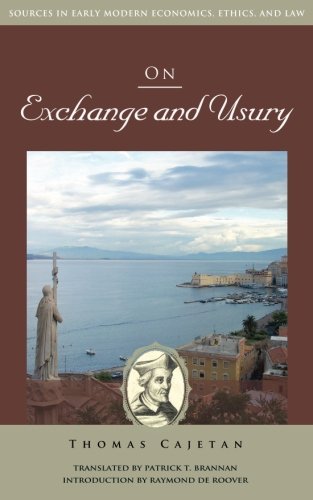
Title
On Exchange and Usury (Sources in Early Modern Economics, Ethics, and Law),Used
Sold by Ergodebooks, an authorized reseller.
Returns accepted within 30 days | support@ergodebooks.com
Shipping Information
- Free Standard Shipping — United States only
- Processing Time: 3–5 business days
- Estimated Delivery: 6–10 business days after dispatch
- Double-boxed, fully insured & discreetly packaged
- Tracking number sent via email once dispatched
Returns & Refund
Returns accepted within 30 days of delivery.
Damaged or Defective Item
Free return shipping + replacement or full refund
Wrong Item Received
Free return shipping + replacement or full refund
Change of Mind
Return shipping at customer's expense · 25% restocking fee applies
Payment Option

The two treatises in this volume provide insight into the banking industry of the early modern eraand the church? surrounding debatesfrom the perspective of one of the most significant theologians of the period. In the first treatise, Cajetan carefully argues for a use of bills of exchange on the money market (real exchange) that does not run afoul of the church? condemnation of usury. In the second treatise, Cajetan handles several questions on the nature of usury and outlines the obligations of those who are involved in certain lending practices.
⚠️ WARNING (California Proposition 65):
This product may contain chemicals known to the State of California to cause cancer, birth defects, or other reproductive harm.
For more information, please visit www.P65Warnings.ca.gov.
- Q: What is the page count of the book? A: The book contains one hundred forty-four pages. This length provides a concise exploration of early modern economics and ethics.
- Q: What are the dimensions of this book? A: The book measures five inches in length, eight inches in height, and point thirty-three inches in width. These dimensions make it portable and easy to handle.
- Q: What type of binding does this book have? A: This book is published in paperback format. This type of binding allows for easier reading and flexibility.
- Q: How do I read this book? A: To read this book, simply open it and start from the first page. The treatises are structured for easy comprehension of complex topics.
- Q: Is this book suitable for beginners in economics? A: Yes, this book is suitable for beginners. It introduces fundamental concepts of early modern economics in an accessible manner.
- Q: What age group is this book intended for? A: This book is intended for adults and students studying ethics and economics. The content is complex and may be challenging for younger readers.
- Q: How do I keep this book in good condition? A: To keep this book in good condition, store it in a dry place away from direct sunlight. Avoid bending or creasing the cover.
- Q: Can I lend this book to others? A: Yes, you can lend this book to others. Just ensure that it is returned in good condition for continued use.
- Q: Is this book durable enough for regular use? A: Yes, the paperback binding is durable for regular use. However, handle it with care to avoid wear and tear.
- Q: What should I do if the book arrives damaged? A: If the book arrives damaged, contact the seller immediately for a return or exchange. Most sellers provide a return policy for such issues.
- Q: Does this book come with a warranty? A: No, this book does not come with a warranty. It is a printed publication without electronic components.
- Q: Can I return the book if I don't like it? A: Yes, you can typically return the book if you are not satisfied. Check the specific return policy of the seller.
- Q: How does this book compare to other works on economics? A: This book offers a unique perspective on early modern economics compared to more contemporary texts. It focuses on the intersection of theology and economic practices.
- Q: Is this book appropriate for academic study? A: Yes, this book is appropriate for academic study. It provides valuable insights into historical economic practices and ethical considerations.
- Q: What themes does this book explore? A: This book explores themes of usury, banking practices, and ethical considerations in economics during the early modern era.