If you have any questions, you are always welcome to contact us. We'll get back to you as soon as possible, withing 24 hours on weekdays.
Customer service
All questions about your order, return and delivery must be sent to our customer service team by e-mail at yourstore@yourdomain.com
Sale & Press
If you are interested in selling our products, need more information about our brand or wish to make a collaboration, please contact us at press@yourdomain.com
Help
If you have any questions, you are always welcome to contact us. We'll get back to you as soon as possible, withing 24 hours on weekdays.
Customer service
All questions about your order, return and delivery must be sent to our customer service team by e-mail at yourstore@yourdomain.com
Sale & Press
If you are interested in selling our products, need more information about our brand or wish to make a collaboration, please contact us at press@yourdomain.com
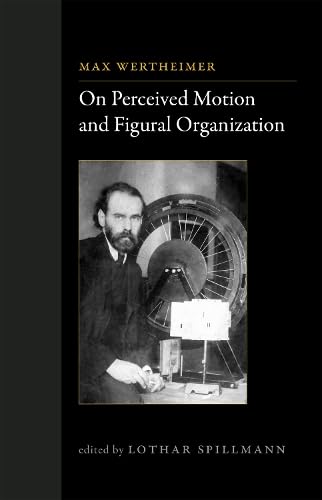
Two seminal articles by a founder of the Gestalt school of psychology, newly translated and accompanied by essays that connect his work to current research.There are few articles in science that remain relevant over a span of 100 years; Max Wertheimer's pioneering experimental studies on apparent motion and figural organization are notable exceptions. Wertheimer's 1912 account of motion perception started a revolution and established the Gestalt school of psychology. It also paved the way for further investigations of apparent motion perception, including subsequent research by Oliver Braddick, Stuart Anstis, Vilaynur Ramachandran, and others. Wertheimer's 1923 article on figural organization (known as the 'dot study' for its numerous examples of dot patterns) helped define grouping as a principle of figureground perception. This book provides contemporary readers and researchers with Wertheimer's two pivotal articles, newly translated into English and each accompanied by a synopsis, and two essays on apparent motion and figural organization that describe the longterm impact of Wertheimer's work.The translation of the original German into readable English prose allows Englishlanguage readers for the first time to appreciate Wertheimer's visionary ideas. The accompanying essays tie Wertheimer's phenomenological descriptions to the underlying neuronal mechanisms, bridging the years between the articles' first publication and modern research.
⚠️ WARNING (California Proposition 65):
This product may contain chemicals known to the State of California to cause cancer,
birth defects, or other reproductive harm.
For MAP (Minimum Advertised Price) violations and Intellectual Property (IP) or Trademark concerns, please contact:
support@ergodebooks.com
⚠️ California Proposition 65 Warning: Some products sold on this website may expose you to chemicals known to the State of California to cause cancer, birth defects, or other reproductive harm. For more information, visit www.P65Warnings.ca.gov.