
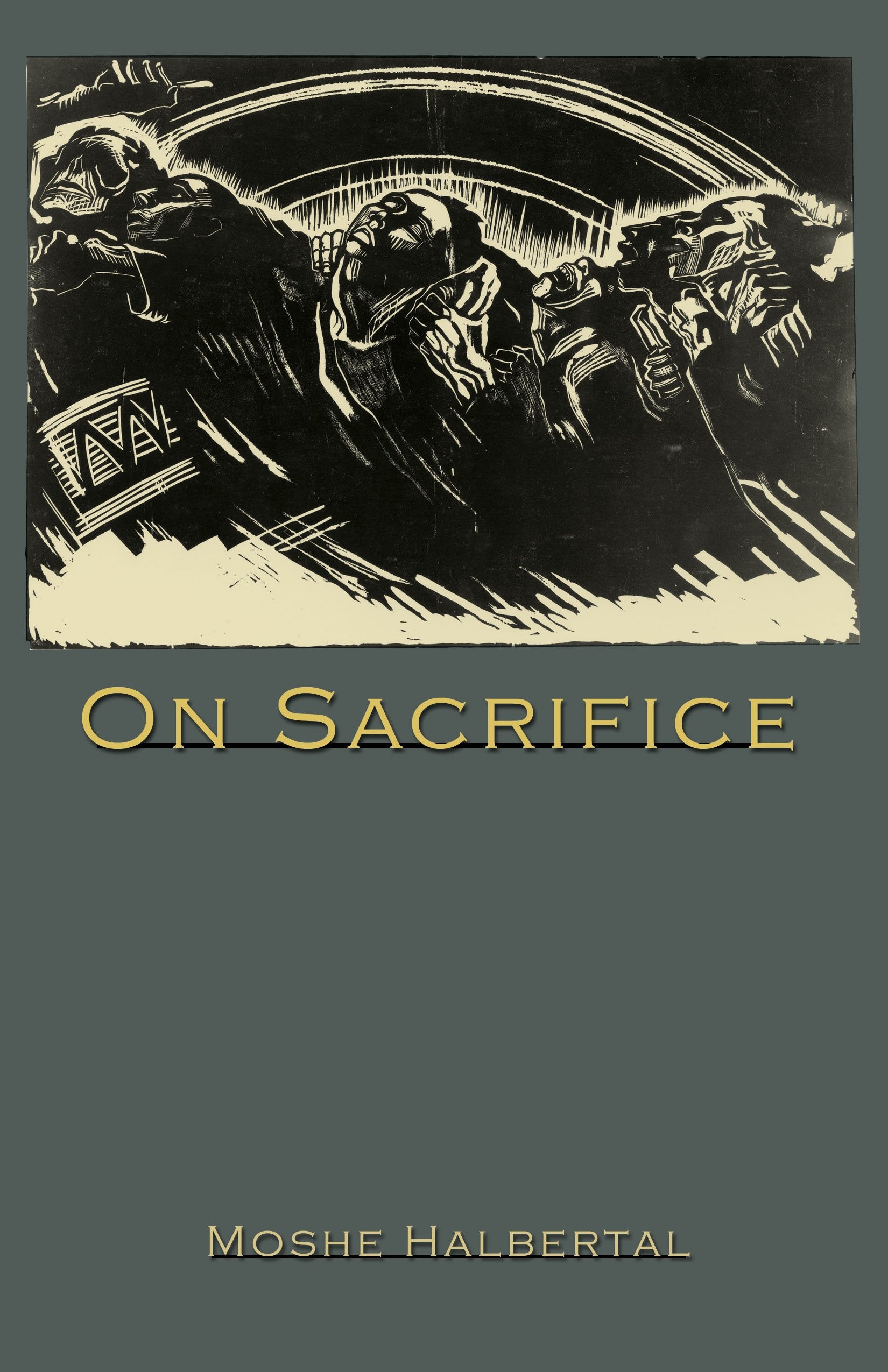
Title
On Sacrifice,Used
Sold by Ergodebooks, an authorized reseller.
Returns accepted within 30 days | support@ergodebooks.com
Shipping Information
- Free Standard Shipping — United States only
- Processing Time: 3–5 business days
- Estimated Delivery: 6–10 business days after dispatch
- Double-boxed, fully insured & discreetly packaged
- Tracking number sent via email once dispatched
Returns & Refund
Returns accepted within 30 days of delivery.
Damaged or Defective Item
Free return shipping + replacement or full refund
Wrong Item Received
Free return shipping + replacement or full refund
Change of Mind
Return shipping at customer's expense · 25% restocking fee applies
Payment Option

The idea and practice of sacrifice play a profound role in religion, ethics, and politics. In this brief book, philosopher Moshe Halbertal explores the meaning and implications of sacrifice, developing a theory of sacrifice as an offering and examining the relationship between sacrifice, ritual, violence, and love. On Sacrifice also looks at the place of selfsacrifice within ethical life and at the complex role of sacrifice as both a noble and destructive political ideal. In the religious domain, Halbertal argues, sacrifice is an offering, a gift given in the context of a hierarchical relationship. As such it is vulnerable to rejection, a trauma at the root of both ritual and violence. An offering is also an ambiguous gesture torn between a genuine expression of gratitude and love and an instrument of exchange, a tension that haunts the practice of sacrifice. In the moral and political domains, sacrifice is tied to the idea of selftranscendence, in which an individualsacrifices his or her selfinterest for the sake of higher values and commitments. While selfsacrifice has great potential moral value, it can also be used to justify the most brutal acts. Halbertal attempts to unravel the relationship between selfsacrifice and violence, arguing that misguided selfsacrifice is far more problematic than exaggerated selflove. In his exploration of the positive and negative dimensions of selfsacrifice, Halbertal also addresses the role of past sacrifice in obligating future generations and in creating a bond for political associations, and considers the function of the modern state as a sacrificial community.
⚠️ WARNING (California Proposition 65):
This product may contain chemicals known to the State of California to cause cancer, birth defects, or other reproductive harm.
For more information, please visit www.P65Warnings.ca.gov.
- Q: What is the main theme of 'On Sacrifice' by Moshe Halbertal? A: The main theme of 'On Sacrifice' is the exploration of the concept and implications of sacrifice in various domains, including religion, ethics, and politics.
- Q: Who is the author of 'On Sacrifice'? A: 'On Sacrifice' is written by philosopher Moshe Halbertal.
- Q: How many pages are in 'On Sacrifice'? A: 'On Sacrifice' contains 152 pages.
- Q: What is the publication date of 'On Sacrifice'? A: 'On Sacrifice' was published on February 26, 2012.
- Q: What type of binding does 'On Sacrifice' have? A: 'On Sacrifice' is available in hardcover binding.
- Q: What are the key topics discussed in 'On Sacrifice'? A: Key topics in 'On Sacrifice' include the meaning of sacrifice, self-sacrifice, the relationship between sacrifice and violence, and the role of sacrifice in ethical and political life.
- Q: Is 'On Sacrifice' suitable for readers interested in philosophy? A: Yes, 'On Sacrifice' is suitable for readers interested in philosophy, particularly those exploring ethical and political implications of sacrifice.
- Q: What is the condition of the item 'On Sacrifice' being sold? A: The item 'On Sacrifice' is in very good condition.
- Q: What edition of 'On Sacrifice' is available? A: 'On Sacrifice' is available in its first edition.
- Q: Does 'On Sacrifice' address the concept of self-sacrifice? A: Yes, 'On Sacrifice' examines self-sacrifice and its complex relationship with violence and moral values.