
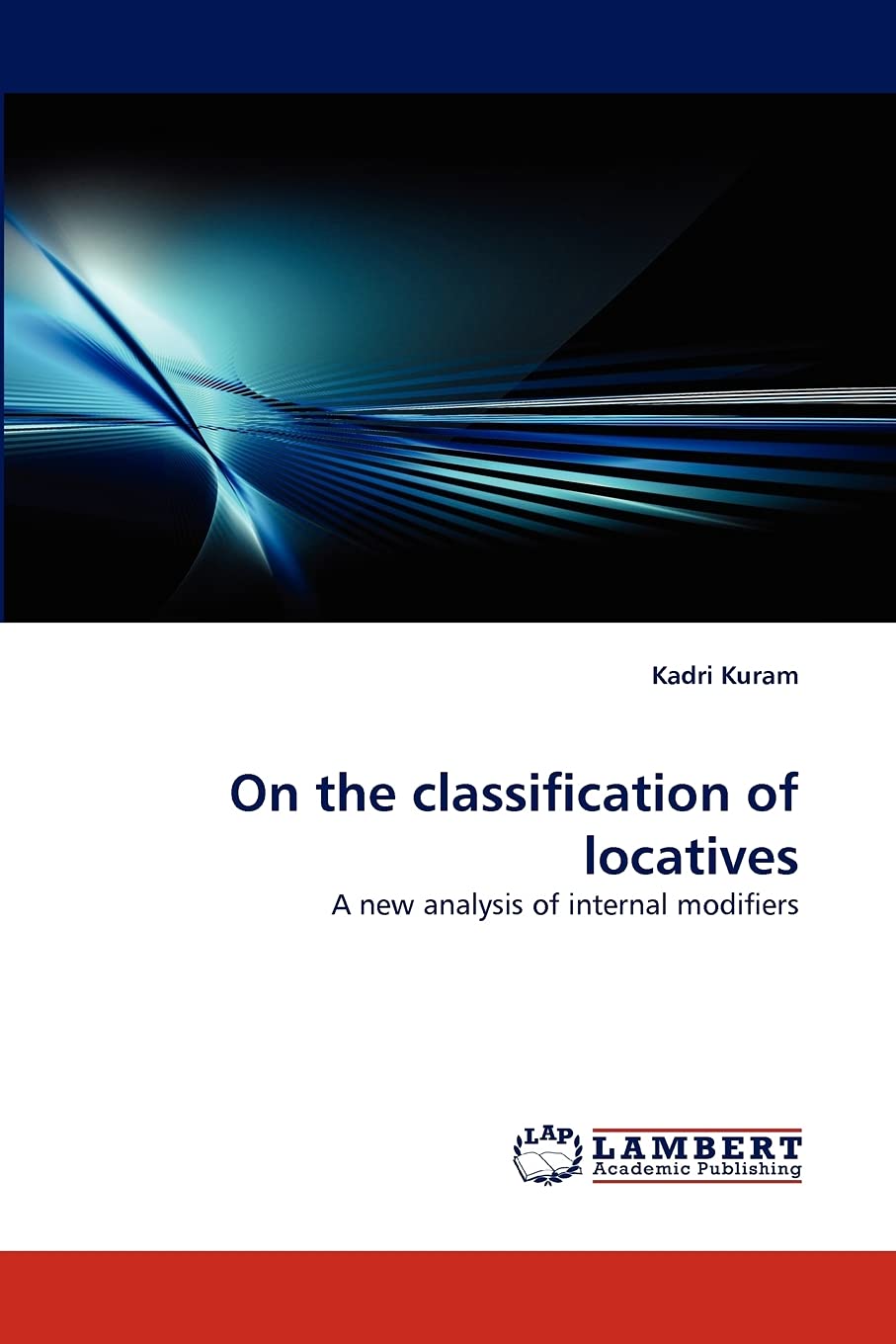
Title
On the classification of locatives: A new analysis of internal modifiers,Used
Sold by Ergodebooks, an authorized reseller.
Returns accepted within 30 days | support@ergodebooks.com
Shipping Information
- Free Standard Shipping — United States only
- Processing Time: 3–5 business days
- Estimated Delivery: 6–10 business days after dispatch
- Double-boxed, fully insured & discreetly packaged
- Tracking number sent via email once dispatched
Returns & Refund
Returns accepted within 30 days of delivery.
Damaged or Defective Item
Free return shipping + replacement or full refund
Wrong Item Received
Free return shipping + replacement or full refund
Change of Mind
Return shipping at customer's expense · 25% restocking fee applies
Payment Option

No verb in human language necessitates the event it denotes to take place in a specific geographical area. Therefore, the lexical items and phrases denoting location are dubbed adjuncts. However, it seems that there is more to them than merely adjuncts. Recently, a German researcher, Claudia Maienborn, offered the following tripartite classification of locatives: Frame Setting Modifiers, External Modifiers and Internal Modifiers. Maienborn asserts that the three different types of locatives have three different underlying positions. Maienborn seems to have adequate grounds for such a classification. This book is a modest attempt to test her thesis against Turkish, an Altaic language. It covers but is not limited to tests, though. After a discussion of the tests, the fourth section offers a new analysis of internal modifiers. It argues that they should be better analyzed as small clauses. This analysis is promising since it reduces the number of classes Universal Grammar has to assume and nicely explains some peculiar properties of internal modifiers also referred to by Maienborn. The book should be helpful for scholars who are interested in Turkish syntax.
⚠️ WARNING (California Proposition 65):
This product may contain chemicals known to the State of California to cause cancer, birth defects, or other reproductive harm.
For more information, please visit www.P65Warnings.ca.gov.