If you have any questions, you are always welcome to contact us. We'll get back to you as soon as possible, withing 24 hours on weekdays.
Customer service
All questions about your order, return and delivery must be sent to our customer service team by e-mail at yourstore@yourdomain.com
Sale & Press
If you are interested in selling our products, need more information about our brand or wish to make a collaboration, please contact us at press@yourdomain.com
Help
If you have any questions, you are always welcome to contact us. We'll get back to you as soon as possible, withing 24 hours on weekdays.
Customer service
All questions about your order, return and delivery must be sent to our customer service team by e-mail at yourstore@yourdomain.com
Sale & Press
If you are interested in selling our products, need more information about our brand or wish to make a collaboration, please contact us at press@yourdomain.com
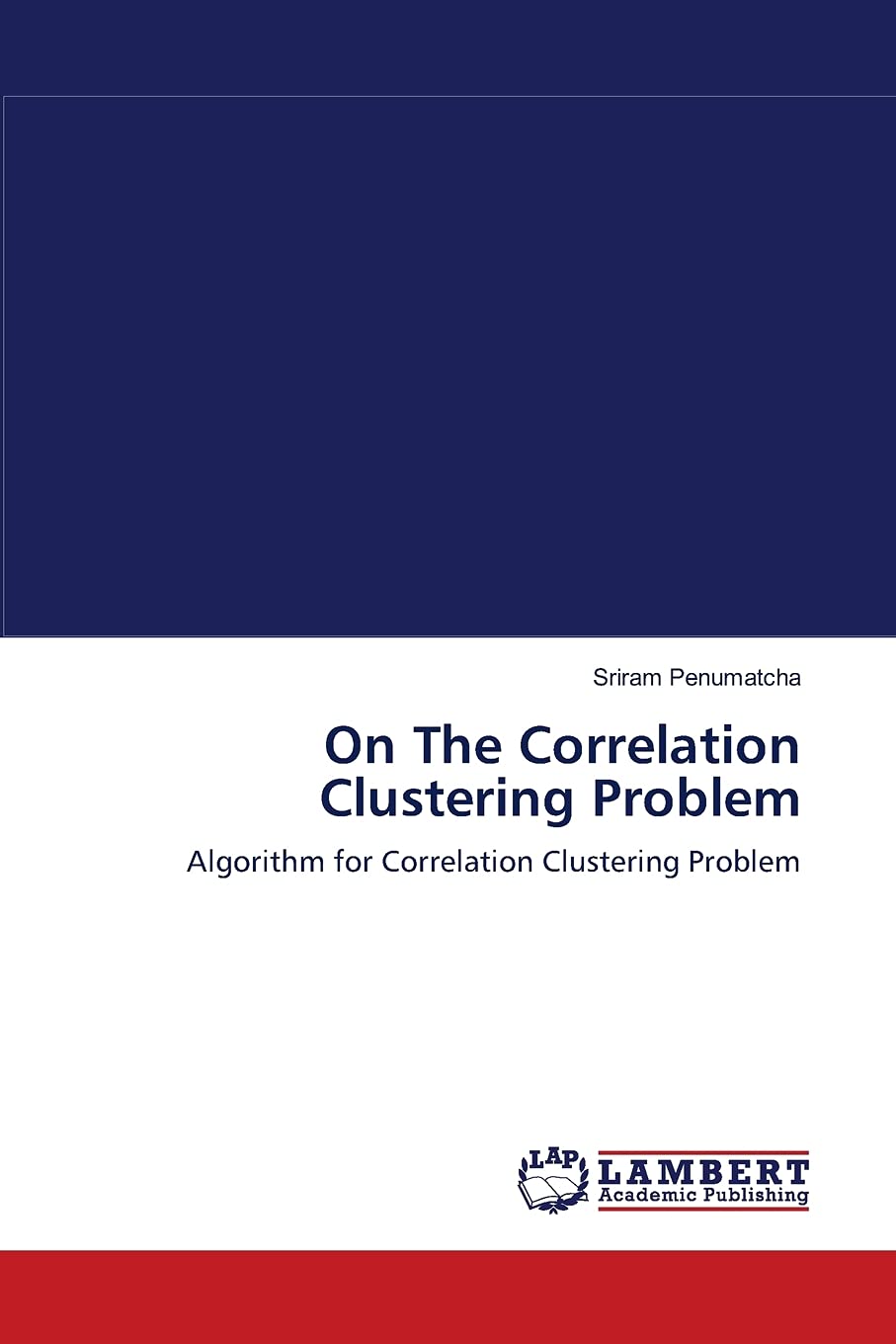
We consider the correlation clustering problem which was initially introduced by Bansal, Blum, Chawla et al. Given a complete graph G on n vertices, with weights of +1 or 1 defined on the edges, we want to find a partition which maximizes the sum of the number of edges with positive weights inside the clusters plus the number of edges with negative weights between different clusters. In this thesis we present a deterministic polynomial time approximation scheme for finding such a partition. Our approach is different from the one given by Bansal, Blum, Chawla et al. as it relies on the Szemeredi's Regularity Lemma. We start by introducing the problem, then we introduce the concepts of regularity lemma and give a proof of Szemeredi's Regularity Lemma. Then we present the algorithm and the proof of the correctness of the algorithm.
⚠️ WARNING (California Proposition 65):
This product may contain chemicals known to the State of California to cause cancer,
birth defects, or other reproductive harm.
For MAP (Minimum Advertised Price) violations and Intellectual Property (IP) or Trademark concerns, please contact:
support@ergodebooks.com
⚠️ California Proposition 65 Warning: Some products sold on this website may expose you to chemicals known to the State of California to cause cancer, birth defects, or other reproductive harm. For more information, visit www.P65Warnings.ca.gov.