
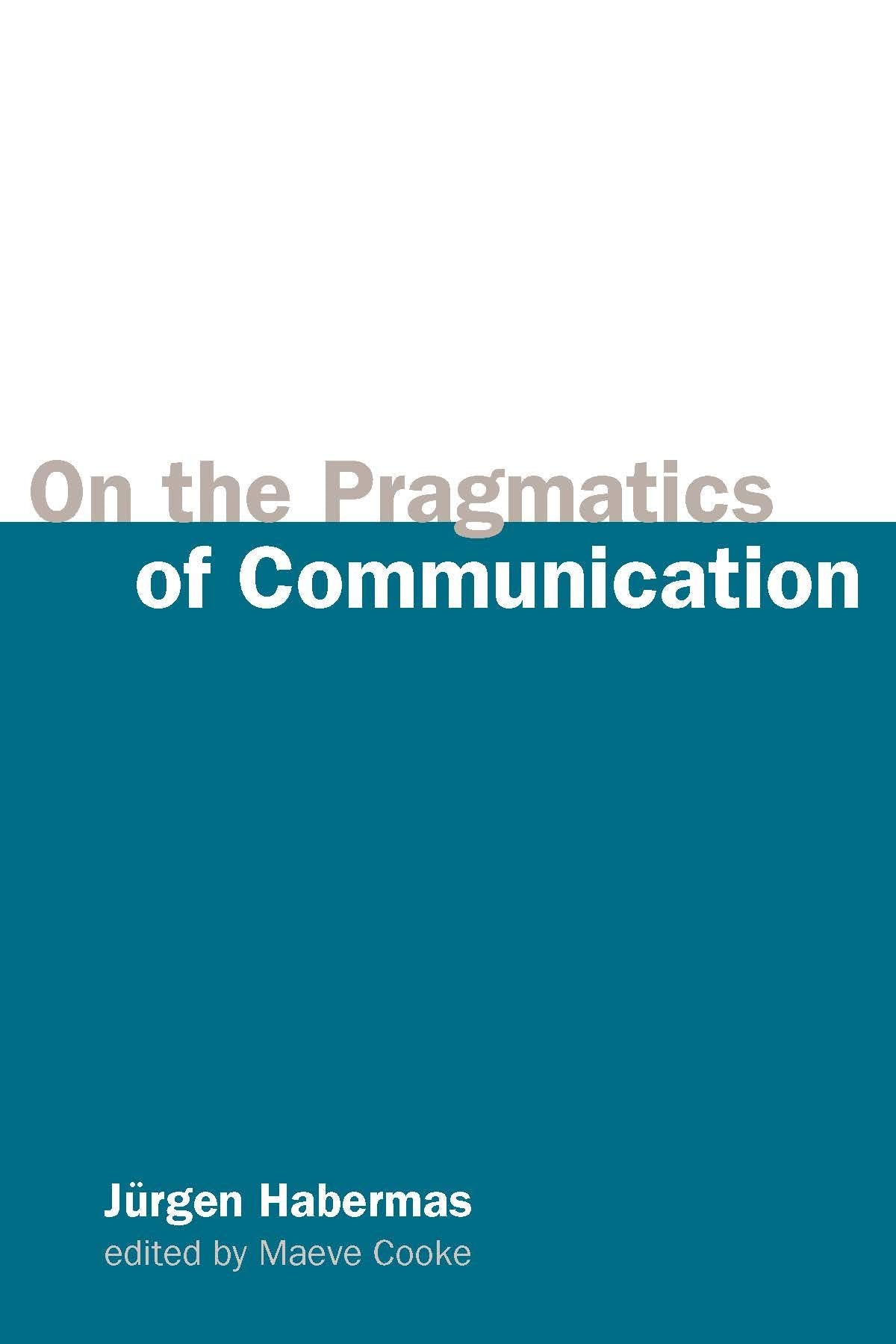
Title
On the Pragmatics of Communication (Studies in Contemporary German Social Thought),Used
Sold by Ergodebooks, an authorized reseller.
Returns accepted within 30 days | support@ergodebooks.com
Shipping Information
- Free Standard Shipping — United States only
- Processing Time: 3–5 business days
- Estimated Delivery: 6–10 business days after dispatch
- Double-boxed, fully insured & discreetly packaged
- Tracking number sent via email once dispatched
Returns & Refund
Returns accepted within 30 days of delivery.
Damaged or Defective Item
Free return shipping + replacement or full refund
Wrong Item Received
Free return shipping + replacement or full refund
Change of Mind
Return shipping at customer's expense · 25% restocking fee applies
Payment Option

Jrgen Habermas's program in formal pragmatics fulfills two main functions. First, it serves as the theoretical underpinning for his theory of communicative action, a crucial element in his theory of society. Second, it contributes to ongoing philosophical discussion of problems concerning meaning, truth, rationality, and action. By the "pragmatic" dimensions of language, Habermas means those pertaining specifically to the employment of sentences in utterances. He makes clear that "formal" is to be understood in a tolerant sense to refer to the rational reconstruction of general intuitions or competences. Formal pragmatics, then, aims at a systematic reconstruction of the intuitive linguistic knowledge of competent subjects as it is used in everyday communicative practices. His program may thus be distinguished from empirical pragmatics for example, sociolinguistics which looks primarily at particular situations of use.This anthology brings together for the first time, in revised or new translation, ten essays that present the main concerns of Habermas's program in formal pragmatics. Its aim is to convey a sense of the overall purpose of his linguistic investigations while introducing the reader to their specific details, in particular to his theories of meaning, truth, rationality, and action.
⚠️ WARNING (California Proposition 65):
This product may contain chemicals known to the State of California to cause cancer, birth defects, or other reproductive harm.
For more information, please visit www.P65Warnings.ca.gov.
- Q: What is the main focus of 'On the Pragmatics of Communication'? A: The book explores Jürgen Habermas's program in formal pragmatics, which serves as a theoretical foundation for his theory of communicative action and addresses issues of meaning, truth, rationality, and action.
- Q: Who is the author of this book? A: The author of 'On the Pragmatics of Communication' is Jürgen Habermas, a prominent philosopher and sociologist.
- Q: What type of binding does this book have? A: This book is available in a hardcover binding, providing durability and a premium feel.
- Q: How many pages are in 'On the Pragmatics of Communication'? A: The book contains 454 pages, offering an extensive exploration of its topics.
- Q: When was this book published? A: This book was published on October 26, 1998.
- Q: Is this book suitable for beginners in pragmatics? A: While the book provides valuable insights, it is geared towards readers with a foundational understanding of philosophy and linguistics due to its complex themes.
- Q: What are some key themes discussed in the book? A: Key themes include the rational reconstruction of linguistic knowledge, the distinction between formal and empirical pragmatics, and the theories of meaning, truth, rationality, and action.
- Q: Is there any special edition of this book? A: This book is categorized as an 'Edition Unstated', meaning it is not a specific special edition but may contain revised translations of selected essays.
- Q: Can you provide a summary of the essays included in the anthology? A: The anthology includes ten essays that highlight the main concerns of Habermas's formal pragmatics, aiming to present both the overall purpose and specific details of his linguistic investigations.
- Q: What kind of readers would benefit from this book? A: Readers interested in contemporary philosophy, linguistics, and social theory, particularly those studying Jürgen Habermas’s work, will find this book beneficial.