
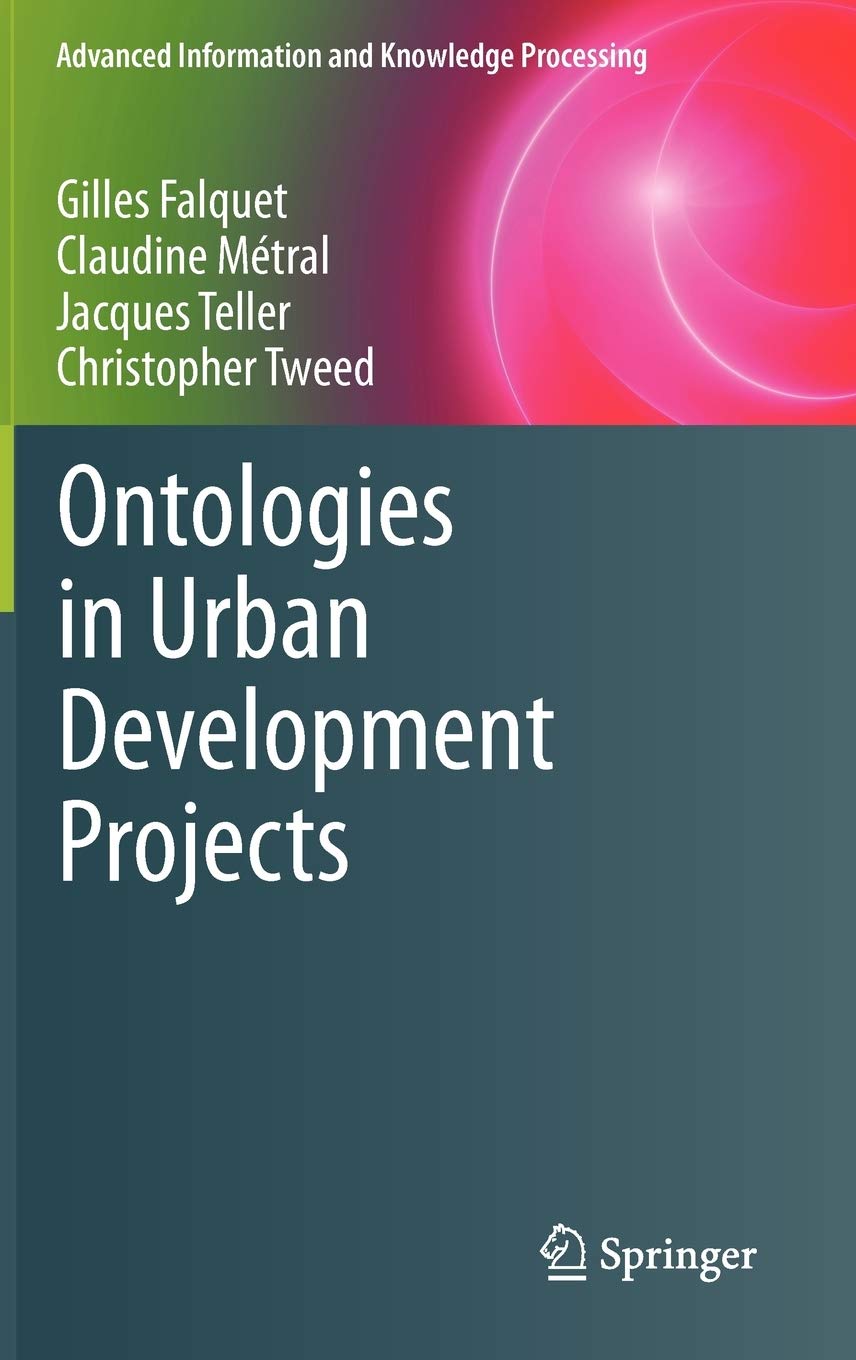
Title
Ontologies in Urban Development Projects (Advanced Information and Knowledge Processing),Used
Sold by Ergodebooks, an authorized reseller.
Returns accepted within 30 days | support@ergodebooks.com
Shipping Information
- Free Standard Shipping — United States only
- Processing Time: 3–5 business days
- Estimated Delivery: 6–10 business days after dispatch
- Double-boxed, fully insured & discreetly packaged
- Tracking number sent via email once dispatched
Returns & Refund
Returns accepted within 30 days of delivery.
Damaged or Defective Item
Free return shipping + replacement or full refund
Wrong Item Received
Free return shipping + replacement or full refund
Change of Mind
Return shipping at customer's expense · 25% restocking fee applies
Payment Option

Ontologies are increasingly recognized as essential tools in information science. Although the concepts are well understood theoretically , the practical implementation of ontologies remains challenging. In this book, researchers in computer science, information systems, ontology engineering, urban planning and design, civil and building engineering, and architecture present an interdisciplinary study of ontology engineering and its application in urban development projects. The first part of the book introduces the general notion of ontology, describing variations in abstraction level, coverage, and formality. It also discusses the use of ontologies to achieve interoperability, and to represent multiple points of view and multilingualism. This is illustrated with examples from the urban domain. The second part is specific to urban development. It covers spatial and geographical knowledge representation, the creation of urban ontologies from various knowledge sources, the interconnection of urban models and the interaction between standards and domain models. The third part presents case studies of the development of ontologies for urban mobility, urban morphological processes, road systems, and cultural heritage. Other cases report on the use of ontologies to solve urban development problems, in construction business models, building regulations and urban regeneration. It concludes with a discussion of key challenges for the future deployment of ontologies in this domain. This book bridges the gap between urban practitioners and computer scientists. As the essence of most urban projects lies in making connections between worldviews, ontology development has an important role to play, in promoting interoperability between data sources, both formal (urban databases, Building Integrated Models, Geographical Information Systems etc.) and less formal (thesauri, text records, web sources etc.). This volume offers a comprehensive introduction to ontology engineeringfor urban development. It is essential reading for practitioners and ontology designers working in urban development.
⚠️ WARNING (California Proposition 65):
This product may contain chemicals known to the State of California to cause cancer, birth defects, or other reproductive harm.
For more information, please visit www.P65Warnings.ca.gov.