
Title
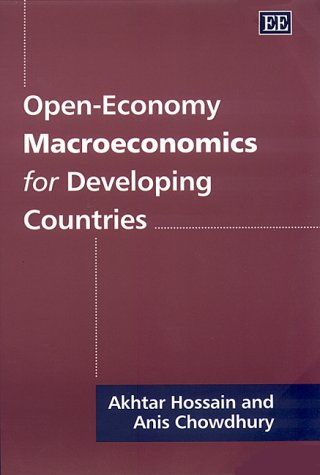
OpenEconomy Macroeconomics for Developing Countries,Used
Sold by Ergodebooks, an authorized reseller.
Returns accepted within 30 days | support@ergodebooks.com
Shipping Information
- Free Standard Shipping — United States only
- Processing Time: 3–5 business days
- Estimated Delivery: 6–10 business days after dispatch
- Double-boxed, fully insured & discreetly packaged
- Tracking number sent via email once dispatched
Returns & Refund
Returns accepted within 30 days of delivery.
Damaged or Defective Item
Free return shipping + replacement or full refund
Wrong Item Received
Free return shipping + replacement or full refund
Change of Mind
Return shipping at customer's expense · 25% restocking fee applies
Payment Option

OpenEconomy Macroeconomics for Developing Countries focuses on fiscal, monetary and exchange rate issues of importance to less developed economies. The book argues that the dichotomy between the shortterm macroeconomic stabilization goal and the longterm economic growth objective commonly found in developing countries' policy framework is inappropriate. The authors report empirical evidence to support the proposition that macroeconomic stability is a prerequisite for sustained economic growth and the root of macroeconomic instability in developing countries lies in the government budget deficits.The book discusses the stabilization tools available to deal with capital flows, supply shocks and the effects of financial deregulation. It opens with a discussion of macroeconomic policy problems for open developing economies and an historical overview of the international institutions such as IMF, GATT and UNCTAD. The authors then provide a comprehensive review of macroeconomic models which are popularly used to analyse policy dilemmas related to internal and external balances of open economies.Having reviewed the institutional and theoretical framework, the authors assess the macroeconomic impact of financial deregulation, capital flows and foreign investment. They address the debt crisis, financial instability, capital flight, currency substitution and exchange rate arrangements. The authors also consider more general issues such as the political economy of macroeconomic management and the institutional framework that may enhance credibility and effectiveness of macroeconomic policy. In conclusion, they stress that the openness of an economy itself acts as a constraint on macroeconomic mismanagement and hence may enhance economic growth.This comprehensive book will be an important addition to the literature, and will be of use to advanced undergraduates and graduates of development economics, development studies and financial and monetary economics.
⚠️ WARNING (California Proposition 65):
This product may contain chemicals known to the State of California to cause cancer, birth defects, or other reproductive harm.
For more information, please visit www.P65Warnings.ca.gov.