
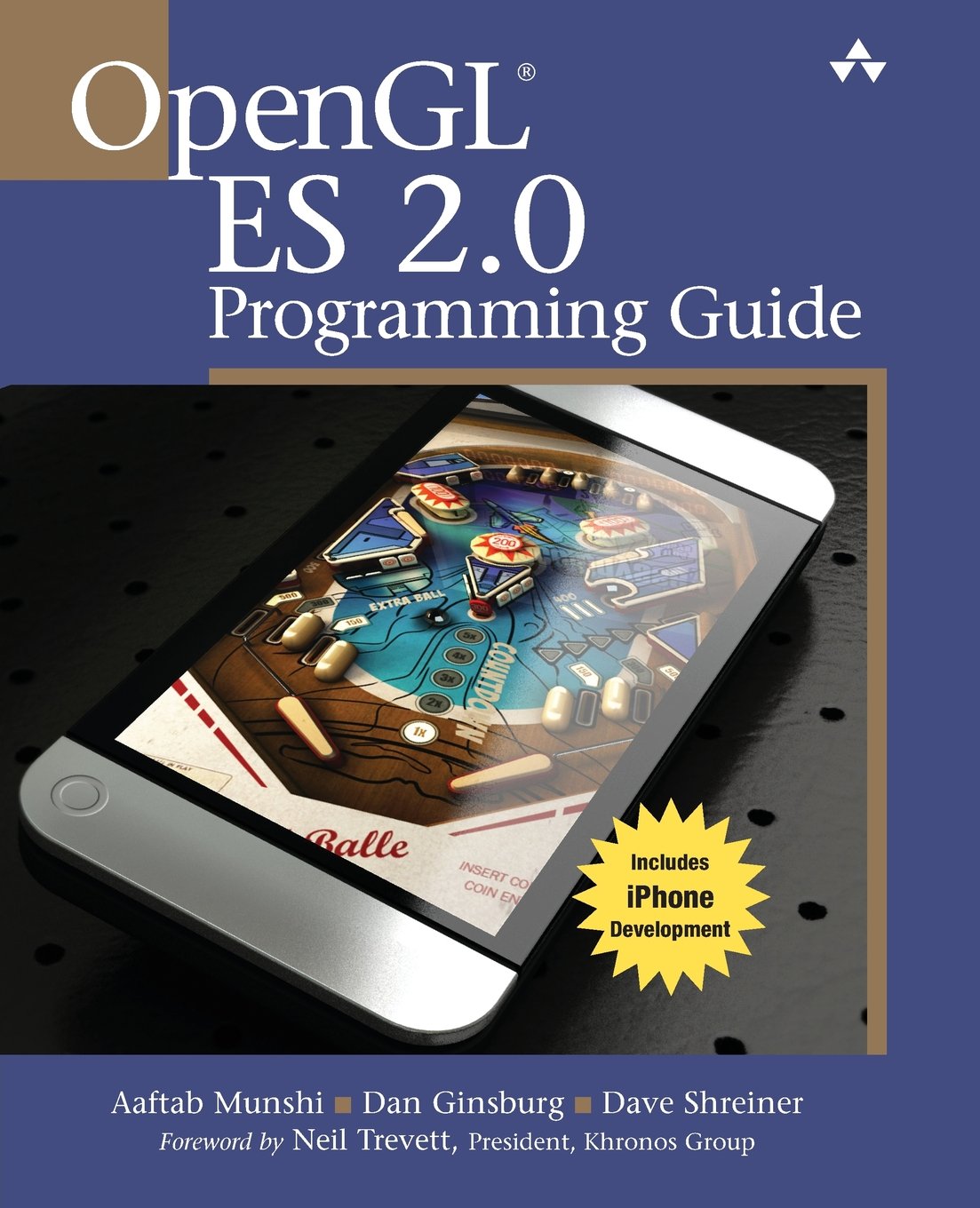
Title
OpenGL ES 2.0 Programming Guide,Used
Sold by Ergodebooks, an authorized reseller.
Returns accepted within 30 days | support@ergodebooks.com
Shipping Information
- Free Standard Shipping — United States only
- Processing Time: 3–5 business days
- Estimated Delivery: 6–10 business days after dispatch
- Double-boxed, fully insured & discreetly packaged
- Tracking number sent via email once dispatched
Returns & Refund
Returns accepted within 30 days of delivery.
Damaged or Defective Item
Free return shipping + replacement or full refund
Wrong Item Received
Free return shipping + replacement or full refund
Change of Mind
Return shipping at customer's expense · 25% restocking fee applies
Payment Option

OpenGL ES 2.0 is the industry&;s leading software interface and graphics library for rendering sophisticated 3D graphics on handheld and embedded devices. With OpenGL ES 2.0, the full programmability of shaders is now available on small and portable devices&;including cell phones, PDAs, consoles, appliances, and vehicles. However, OpenGL ES differs significantly from OpenGL. Graphics programmers and mobile developers have had very little information about it&;until now.In the OpenGL ES 2.0 Programming Guide, three leading authorities on the Open GL ES 2.0 interface&;including the specification&;s editor&;provide starttofinish guidance for maximizing the interface&;s value in a wide range of highperformance applications. The authors cover the entire API, including Khronosratified extensions. Using detailed Cbased code examples, they demonstrate how to set up and program every aspect of the graphics pipeline. You&;ll move from introductory techniques all the way to advanced perpixel lighting, particle systems, and performance optimization.Coverage includes:Shaders in depth: creating shader objects, compiling shaders, checking for compile errors, attaching shader objects to program objects, and linking final program objects The OpenGL ES Shading Language: variables, types, constructors, structures, arrays, attributes, uniforms, varyings, precision qualifiers, and invariance Inputting geometry into the graphics pipeline, and assembling geometry into primitives Vertex shaders, their special variables, and their use in pervertex lighting, skinning, and other applications Using fragment shaders&;including examples of multitexturing, fog, alpha test, and user clip planes Fragment operations: scissor test, stencil test, depth test, multisampling, blending, and dithering Advanced rendering: perpixel lighting with normal maps, environment mapping, particle systems, image postprocessing, and projective texturing Realworld programming challenges: platform diversity, C++ portability, OpenKODE, and platformspecific shader binaries
⚠️ WARNING (California Proposition 65):
This product may contain chemicals known to the State of California to cause cancer, birth defects, or other reproductive harm.
For more information, please visit www.P65Warnings.ca.gov.
- Q: What is the main focus of the OpenGL ES 2.0 Programming Guide? A: The OpenGL ES 2.0 Programming Guide primarily focuses on providing comprehensive guidance for using the OpenGL ES 2.0 interface, which is essential for rendering advanced 3D graphics on portable devices.
- Q: Who are the authors of this book? A: The book is authored by Aaftab Munshi, along with leading experts in the field of OpenGL ES, who provide in-depth knowledge and practical examples.
- Q: What topics are covered in the OpenGL ES 2.0 Programming Guide? A: It covers a wide range of topics including shader creation, the OpenGL ES Shading Language, inputting geometry, and advanced rendering techniques such as per-pixel lighting and particle systems.
- Q: Is this book suitable for beginners? A: Yes, the guide starts with introductory techniques and progresses to advanced topics, making it suitable for both beginners and experienced developers.
- Q: What is the publication date of the OpenGL ES 2.0 Programming Guide? A: The book was published on July 24, 2008.
- Q: What is the binding type of this book? A: The OpenGL ES 2.0 Programming Guide is available in paperback binding.
- Q: How many pages does the book contain? A: The book contains a total of 450 pages.
- Q: Does this book include practical examples? A: Yes, the book includes detailed C-based code examples that illustrate how to program various aspects of the graphics pipeline.
- Q: What is the condition of the book? A: The book is in new condition.
- Q: Is this book applicable for mobile app development? A: Yes, the OpenGL ES 2.0 Programming Guide is particularly relevant for mobile developers as it focuses on rendering graphics for handheld and embedded devices.