If you have any questions, you are always welcome to contact us. We'll get back to you as soon as possible, withing 24 hours on weekdays.
Customer service
All questions about your order, return and delivery must be sent to our customer service team by e-mail at yourstore@yourdomain.com
Sale & Press
If you are interested in selling our products, need more information about our brand or wish to make a collaboration, please contact us at press@yourdomain.com
Help
If you have any questions, you are always welcome to contact us. We'll get back to you as soon as possible, withing 24 hours on weekdays.
Customer service
All questions about your order, return and delivery must be sent to our customer service team by e-mail at yourstore@yourdomain.com
Sale & Press
If you are interested in selling our products, need more information about our brand or wish to make a collaboration, please contact us at press@yourdomain.com
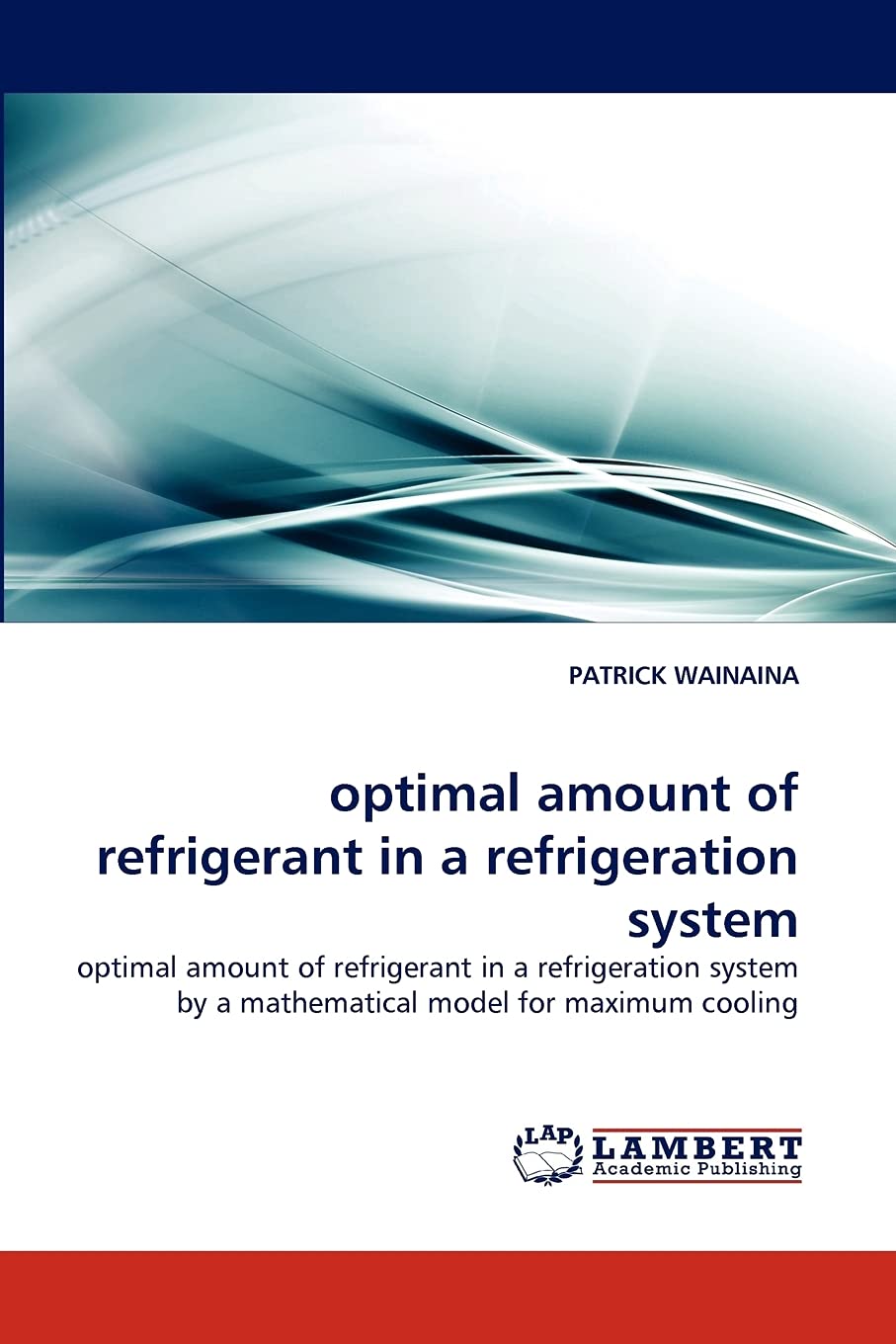
Determination of the optimal amount of refrigerant in field assembled refrigeration systems by use of a sight glass installed in liquid line is often misleading and unreliable. This is attributed to interferences to laminar flow of the refrigerant in the sight glass by ice formation in the expansion valve, vaporization of the liquid in pipes and foreign particles. Due to these interferences refrigeration systems may be overcharged or undercharged with the refrigerant. Measurement of temperatures and pressures at the inlet and exit of an evaporator may provide an accurate and reliable criterion of establishing the optimal amount of refrigerant in a refrigeration system. Using Rayleigh's method of dimensional analysis, a mathematical model that expresses the evaporator cooling rate for field assembled refrigeration systems in terms of physical properties of the evaporator and the thermodynamic properties of refrigerant R134 a was developed. The model expresses the optimal amount of refrigerant in a refrigeration system corresponding to the maximum cooling rate.
⚠️ WARNING (California Proposition 65):
This product may contain chemicals known to the State of California to cause cancer,
birth defects, or other reproductive harm.
For MAP (Minimum Advertised Price) violations and Intellectual Property (IP) or Trademark concerns, please contact:
support@ergodebooks.com
⚠️ California Proposition 65 Warning: Some products sold on this website may expose you to chemicals known to the State of California to cause cancer, birth defects, or other reproductive harm. For more information, visit www.P65Warnings.ca.gov.