If you have any questions, you are always welcome to contact us. We'll get back to you as soon as possible, withing 24 hours on weekdays.
Customer service
All questions about your order, return and delivery must be sent to our customer service team by e-mail at yourstore@yourdomain.com
Sale & Press
If you are interested in selling our products, need more information about our brand or wish to make a collaboration, please contact us at press@yourdomain.com
Help
If you have any questions, you are always welcome to contact us. We'll get back to you as soon as possible, withing 24 hours on weekdays.
Customer service
All questions about your order, return and delivery must be sent to our customer service team by e-mail at yourstore@yourdomain.com
Sale & Press
If you are interested in selling our products, need more information about our brand or wish to make a collaboration, please contact us at press@yourdomain.com
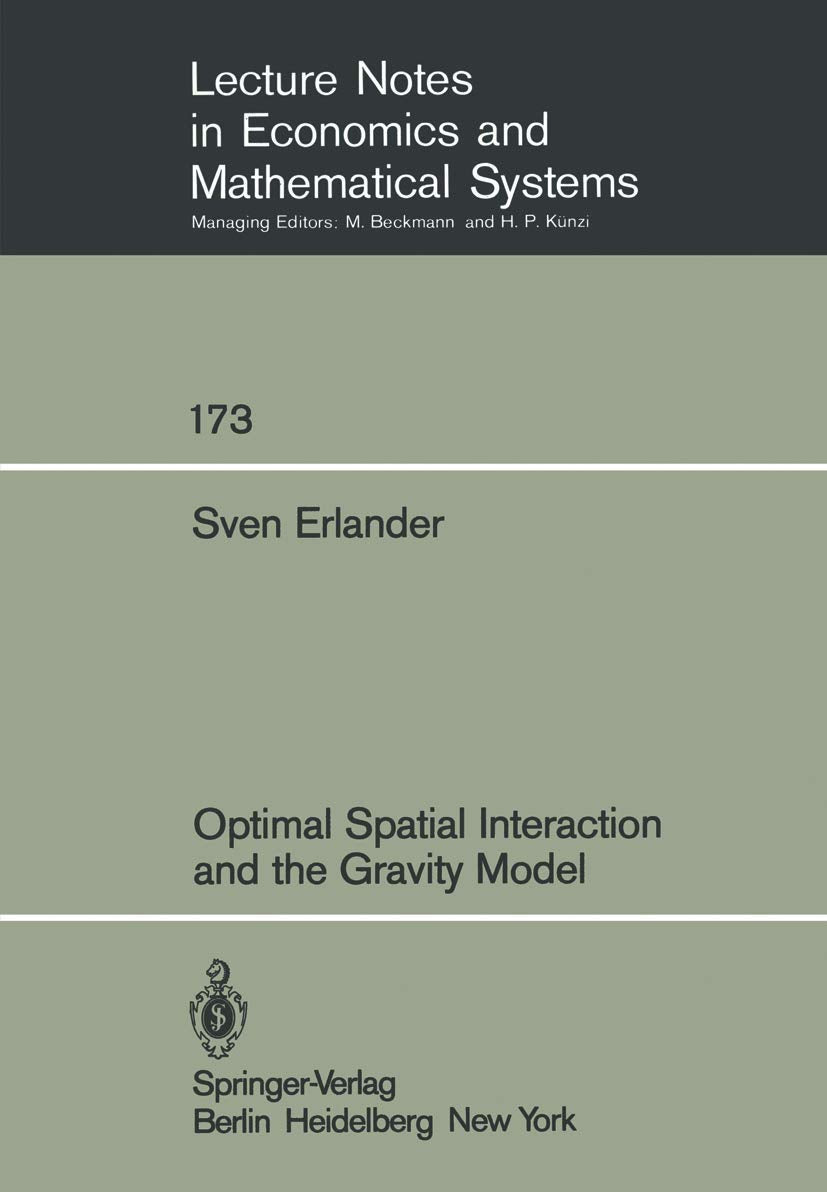
This book has grown out of a desire to explore the possibilities of using optimizing models in transportation planning. This approach has been followed throughout. Models which combine descriptive and optimizing elements are not treated. The gravity model is here studied as the solution to an optimizing model. In spite of this approach, much of the material shoula be of general interest. Algorithms are not discussed. The author has benefited from discussions with many colleagues. M. Florian suggested the term "interacti vi ty". N. F. Stewart and P. Smeds gave many valu able comments on a first draft. M. Beckmann made me think once more about the final chapters. R. Grubbstrem and K. Jornsten helped clarifYing some things in the same chapters. Remaining insufficiencies are due to the author. Gun Mannervik typed with great patience. Linkoping in October 1979 Sven Erlander ABSTRACT The book proposes extended use of optimizing models in transportation plann ing. An entropy constrained linear program for the trip distribution problem is formulated and shown to have the ordinarJ doubly constrained gravity model as its solution. Entropy is here used as a measure of interactivity, which is constrained to be at a prescribed level. In this way the variation present in the reference trip matrix is preserved. (The properties of entropy as a dispersion measure are shortly discussed. ) The detailed mathematics of the optimal solutions as well as of sensitivity and duality are given.
⚠️ WARNING (California Proposition 65):
This product may contain chemicals known to the State of California to cause cancer,
birth defects, or other reproductive harm.
For MAP (Minimum Advertised Price) violations and Intellectual Property (IP) or Trademark concerns, please contact:
support@ergodebooks.com
⚠️ California Proposition 65 Warning: Some products sold on this website may expose you to chemicals known to the State of California to cause cancer, birth defects, or other reproductive harm. For more information, visit www.P65Warnings.ca.gov.