
Title
Optimal Traffic Control: Urban Intersections,Used
Sold by Ergodebooks, an authorized reseller.
Returns accepted within 30 days | support@ergodebooks.com
Shipping Information
- Free Standard Shipping — United States only
- Processing Time: 3–5 business days
- Estimated Delivery: 6–10 business days after dispatch
- Double-boxed, fully insured & discreetly packaged
- Tracking number sent via email once dispatched
Returns & Refund
Returns accepted within 30 days of delivery.
Damaged or Defective Item
Free return shipping + replacement or full refund
Wrong Item Received
Free return shipping + replacement or full refund
Change of Mind
Return shipping at customer's expense · 25% restocking fee applies
Payment Option

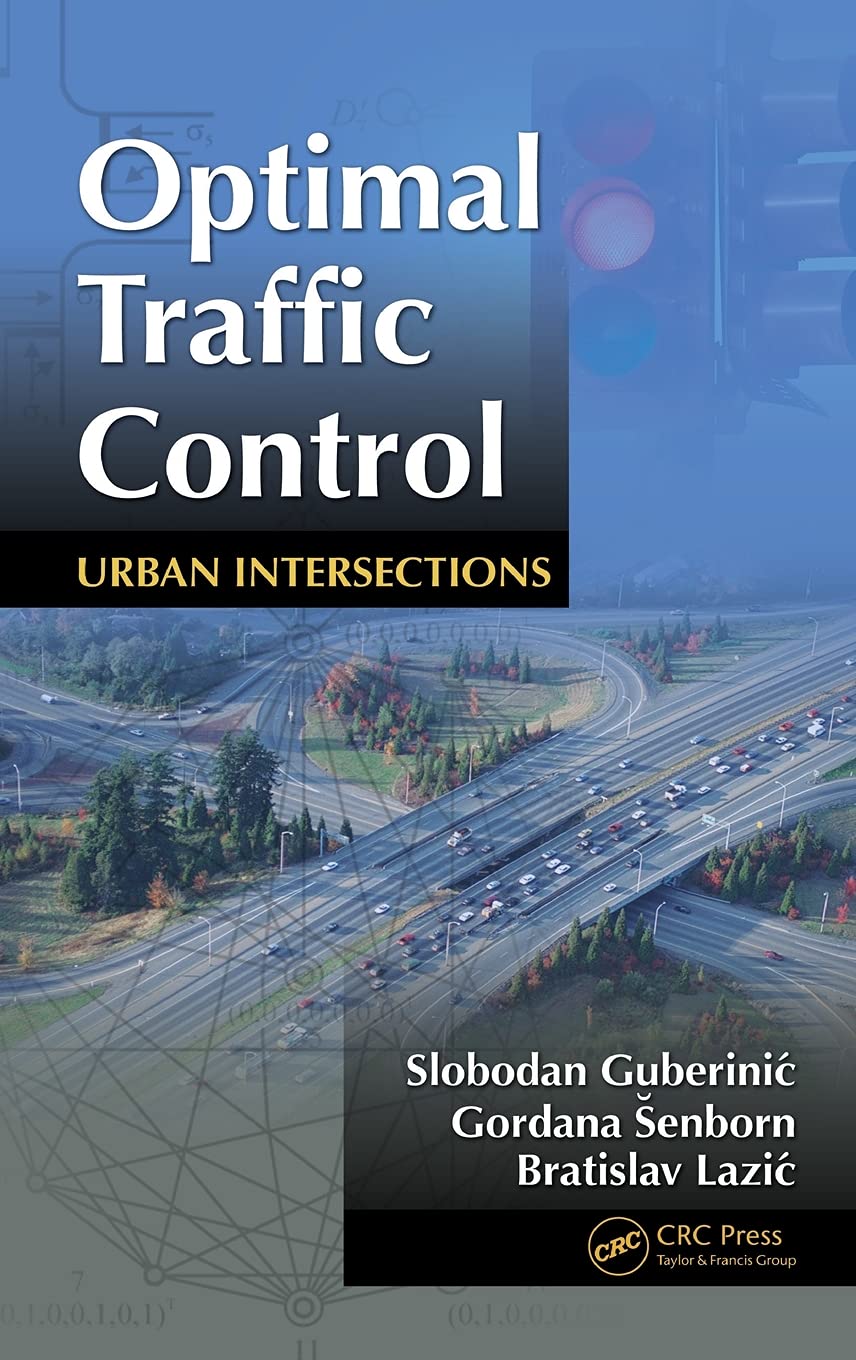
Despite traffic circles, fourway stop signs, lights regulated by timers or sensors, and other methods, the management of urban intersections remains problematic. Consider that transportation systems have all the features of socalled complex systems: the great number of state and control variables, the presence of uncertainty and indeterminism, the complex interactions between subsystems, the necessity to optimize several optimization criteria, and active behavior of the controlled process, to name just a few. Therefore, a mathematical approach to these systems can resolve their complex issues more elegantly than other methods.Addressing both efficiency and traffic safety issues, Optimal Traffic Control: Urban Intersections examines the traffic control optimization problem and presents a novel solution method. Using an approach based on control theory, graph theory, and combinatorial optimization, the authors derive a full mathematical description of the traffic control problem and enumerate all combinatorial aspects. The result is a set of algorithmic solutions to various problems along with computer implementation that you can incorporate into real traffic control systems for immediate results. The book concludes by evaluating how the choice of a complete set of signal groups influences intersection performance.Although modern cities throughout the world have a unique character influenced by culture, geography, and population, most of them share one main feature: busy intersections and the issue of controlling the traffic traveling through them. The development of information technologies, especially computer and telecommunications techniques, has changed the complexity of the problem and influenced the development of new solutions. Clearly stating the issues and presenting a possible solution, this book shows you how to take full advantage of all the capabilities of microprocessorbased traffic signal controllers.
⚠️ WARNING (California Proposition 65):
This product may contain chemicals known to the State of California to cause cancer, birth defects, or other reproductive harm.
For more information, please visit www.P65Warnings.ca.gov.