If you have any questions, you are always welcome to contact us. We'll get back to you as soon as possible, withing 24 hours on weekdays.
Customer service
All questions about your order, return and delivery must be sent to our customer service team by e-mail at yourstore@yourdomain.com
Sale & Press
If you are interested in selling our products, need more information about our brand or wish to make a collaboration, please contact us at press@yourdomain.com
Help
If you have any questions, you are always welcome to contact us. We'll get back to you as soon as possible, withing 24 hours on weekdays.
Customer service
All questions about your order, return and delivery must be sent to our customer service team by e-mail at yourstore@yourdomain.com
Sale & Press
If you are interested in selling our products, need more information about our brand or wish to make a collaboration, please contact us at press@yourdomain.com
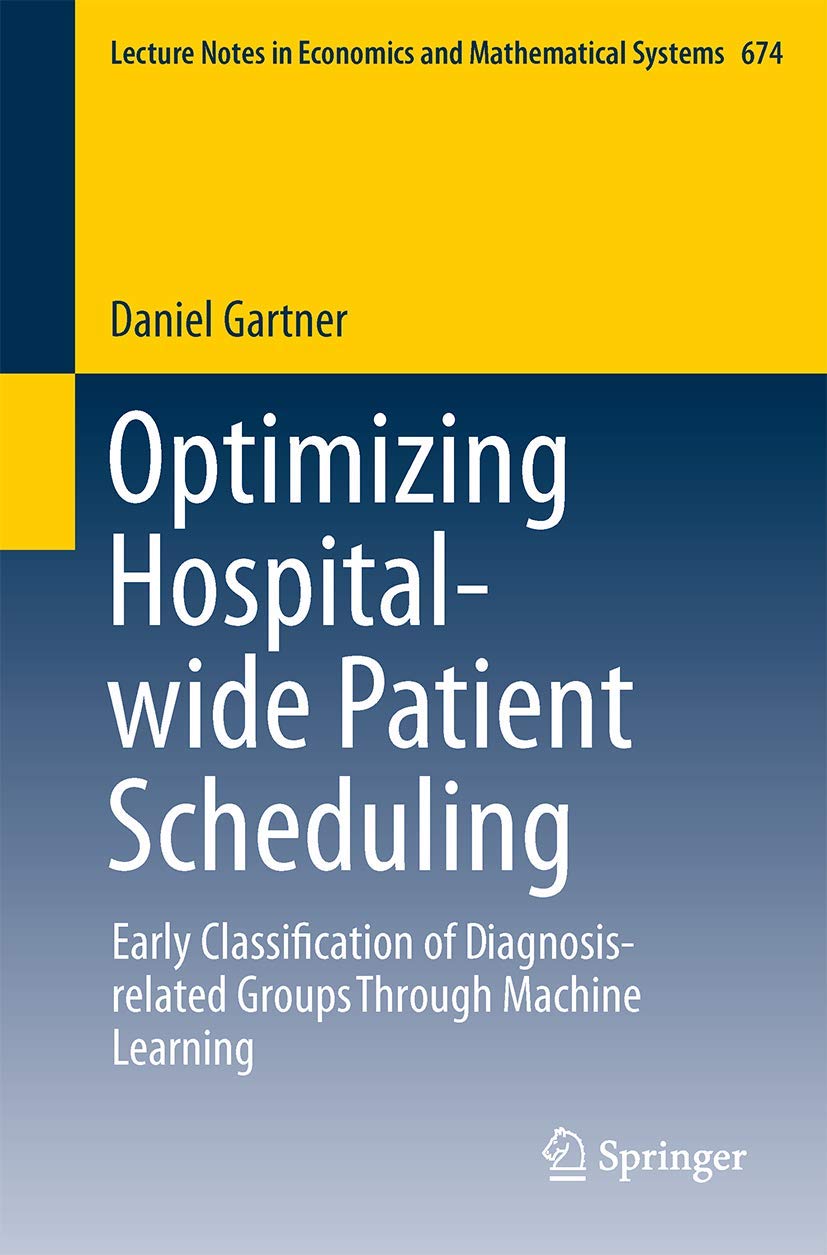
Diagnosisrelated groups (DRGs) are used in hospitals for the reimbursement of inpatient services. The assignment of a patient to a DRG can be distinguished into billing and operationsdriven DRG classification. The topic of this monograph is operationsdriven DRG classification, in which DRGs of inpatients are employed to improve contribution marginbased patient scheduling decisions. In the first part, attribute selection and classification techniques are evaluated in order to increase early DRG classification accuracy. Employing mathematical programming, the hospitalwide flow of elective patients is modelled taking into account DRGs, clinical pathways and scarce hospital resources. The results of the early DRG classification part reveal that a small set of attributes is sufficient in order to substantially improve DRG classification accuracy as compared to the current approach of many hospitals. Moreover, the results of the patient scheduling part reveal that the contribution margin can be increased as compared to current practice.
⚠️ WARNING (California Proposition 65):
This product may contain chemicals known to the State of California to cause cancer,
birth defects, or other reproductive harm.
For MAP (Minimum Advertised Price) violations and Intellectual Property (IP) or Trademark concerns, please contact:
support@ergodebooks.com
⚠️ California Proposition 65 Warning: Some products sold on this website may expose you to chemicals known to the State of California to cause cancer, birth defects, or other reproductive harm. For more information, visit www.P65Warnings.ca.gov.