
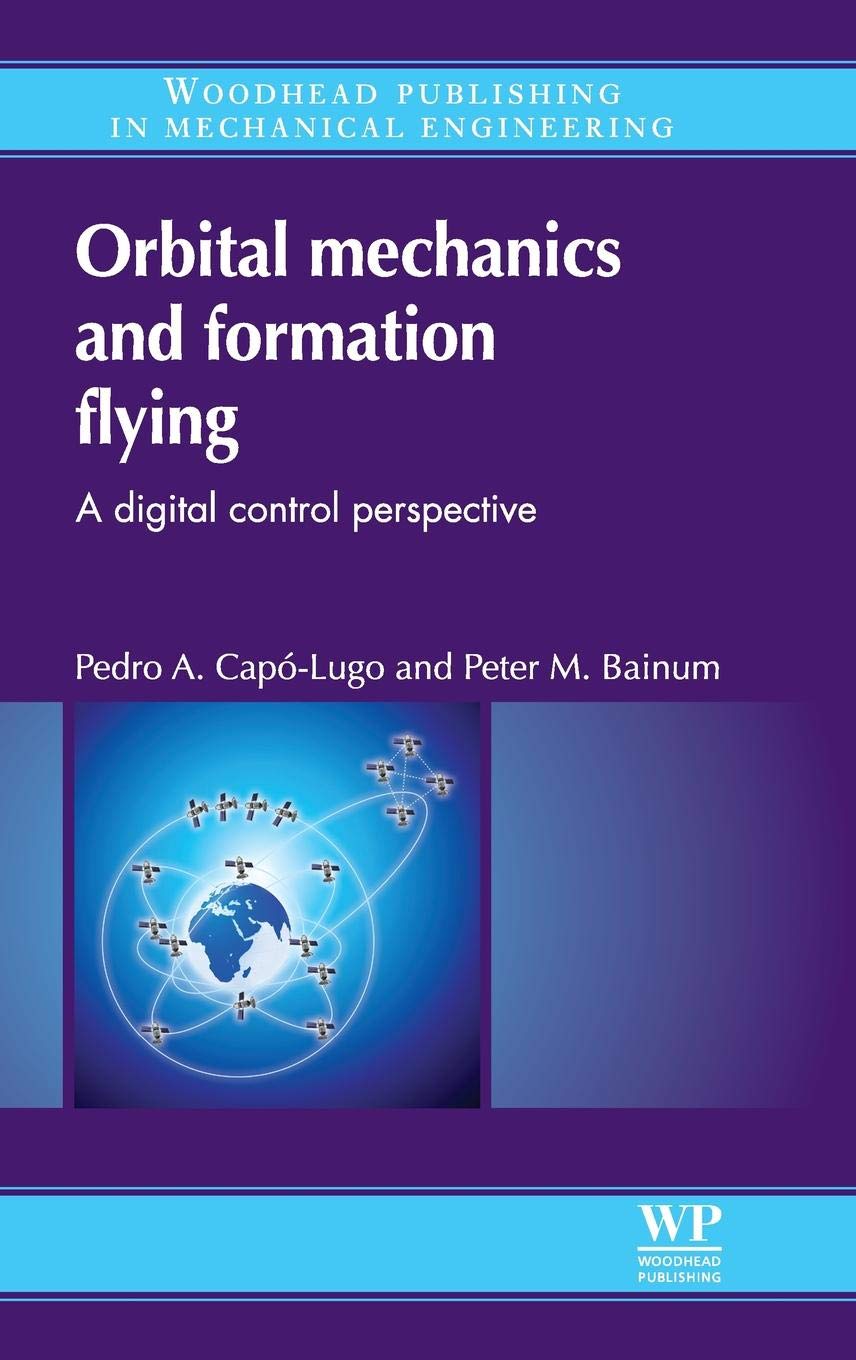
Title
Orbital Mechanics And Formation Flying: A Digital Control Perspective (Woodhead Publishing In Mechanical Engineering),Used
Sold by Ergodebooks, an authorized reseller.
Returns accepted within 30 days | support@ergodebooks.com
Shipping Information
- Free Standard Shipping — United States only
- Processing Time: 3–5 business days
- Estimated Delivery: 6–10 business days after dispatch
- Double-boxed, fully insured & discreetly packaged
- Tracking number sent via email once dispatched
Returns & Refund
Returns accepted within 30 days of delivery.
Damaged or Defective Item
Free return shipping + replacement or full refund
Wrong Item Received
Free return shipping + replacement or full refund
Change of Mind
Return shipping at customer's expense · 25% restocking fee applies
Payment Option

Aimed at students, faculty and professionals in the aerospace field, this book provides practical information on the development, analysis, and control of a single and/or multiple spacecraft in space. This book is divided into two major sections: single and multiple satellite motion. The first section analyses the orbital mechanics, orbital perturbations, and attitude dynamics of a single satellite around the Earth. Using the knowledge of a single satellite motion, the translation of a group of satellites called formation flying or constellation is explained. Formation flying has been one of the main research topics over the last few years and this book explains different control approaches to control the satellite attitude motion and/or to maintain the constellation together. The control schemes are explained in the discrete domain such that it can be easily implemented on the computer on board the satellite. The key objective of this book is to show the reader the practical and the implementation process in the discrete domain. Explains the orbital motion and principal perturbations affecting the satellite Uses the Ares V rocket as an example to explain the attitude motion of a space vehicle Presents the practical approach for different control actuators that can be used in a satellite
⚠️ WARNING (California Proposition 65):
This product may contain chemicals known to the State of California to cause cancer, birth defects, or other reproductive harm.
For more information, please visit www.P65Warnings.ca.gov.