If you have any questions, you are always welcome to contact us. We'll get back to you as soon as possible, withing 24 hours on weekdays.
Customer service
All questions about your order, return and delivery must be sent to our customer service team by e-mail at yourstore@yourdomain.com
Sale & Press
If you are interested in selling our products, need more information about our brand or wish to make a collaboration, please contact us at press@yourdomain.com
Help
If you have any questions, you are always welcome to contact us. We'll get back to you as soon as possible, withing 24 hours on weekdays.
Customer service
All questions about your order, return and delivery must be sent to our customer service team by e-mail at yourstore@yourdomain.com
Sale & Press
If you are interested in selling our products, need more information about our brand or wish to make a collaboration, please contact us at press@yourdomain.com
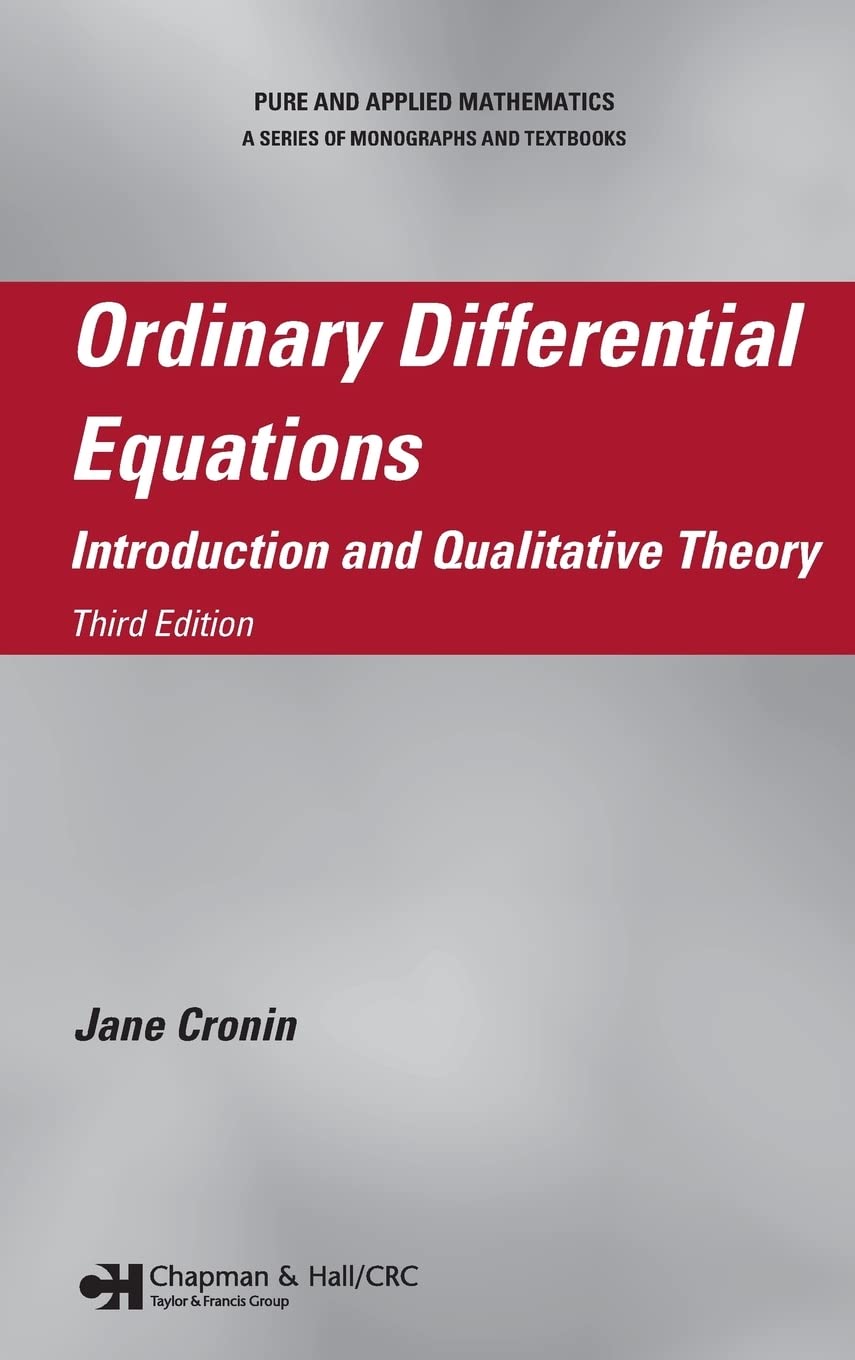
Designed for a rigorous first course in ordinary differential equations, Ordinary Differential Equations: Introduction and Qualitative Theory, Third Edition includes basic material such as the existence and properties of solutions, linear equations, autonomous equations, and stability as well as more advanced topics in periodic solutions of nonlinear equations. Requiring only a background in advanced calculus and linear algebra, the text is appropriate for advanced undergraduate and graduate students in mathematics, engineering, physics, chemistry, or biology.This third edition of a highly acclaimed textbook provides a detailed account of the Bendixson theory of solutions of twodimensional nonlinear autonomous equations, which is a classical subject that has become more prominent in recent biological applications. By using the Poincar method, it gives a unified treatment of the periodic solutions of perturbed equations. This includes the existence and stability of periodic solutions of perturbed nonautonomous and autonomous equations (bifurcation theory). The text shows how topological degree can be applied to extend the results. It also explains that using the averaging method to seek such periodic solutions is a special case of the use of the Poincar method.
⚠️ WARNING (California Proposition 65):
This product may contain chemicals known to the State of California to cause cancer,
birth defects, or other reproductive harm.
For MAP (Minimum Advertised Price) violations and Intellectual Property (IP) or Trademark concerns, please contact:
support@ergodebooks.com
⚠️ California Proposition 65 Warning: Some products sold on this website may expose you to chemicals known to the State of California to cause cancer, birth defects, or other reproductive harm. For more information, visit www.P65Warnings.ca.gov.