If you have any questions, you are always welcome to contact us. We'll get back to you as soon as possible, withing 24 hours on weekdays.
Customer service
All questions about your order, return and delivery must be sent to our customer service team by e-mail at yourstore@yourdomain.com
Sale & Press
If you are interested in selling our products, need more information about our brand or wish to make a collaboration, please contact us at press@yourdomain.com
Help
If you have any questions, you are always welcome to contact us. We'll get back to you as soon as possible, withing 24 hours on weekdays.
Customer service
All questions about your order, return and delivery must be sent to our customer service team by e-mail at yourstore@yourdomain.com
Sale & Press
If you are interested in selling our products, need more information about our brand or wish to make a collaboration, please contact us at press@yourdomain.com
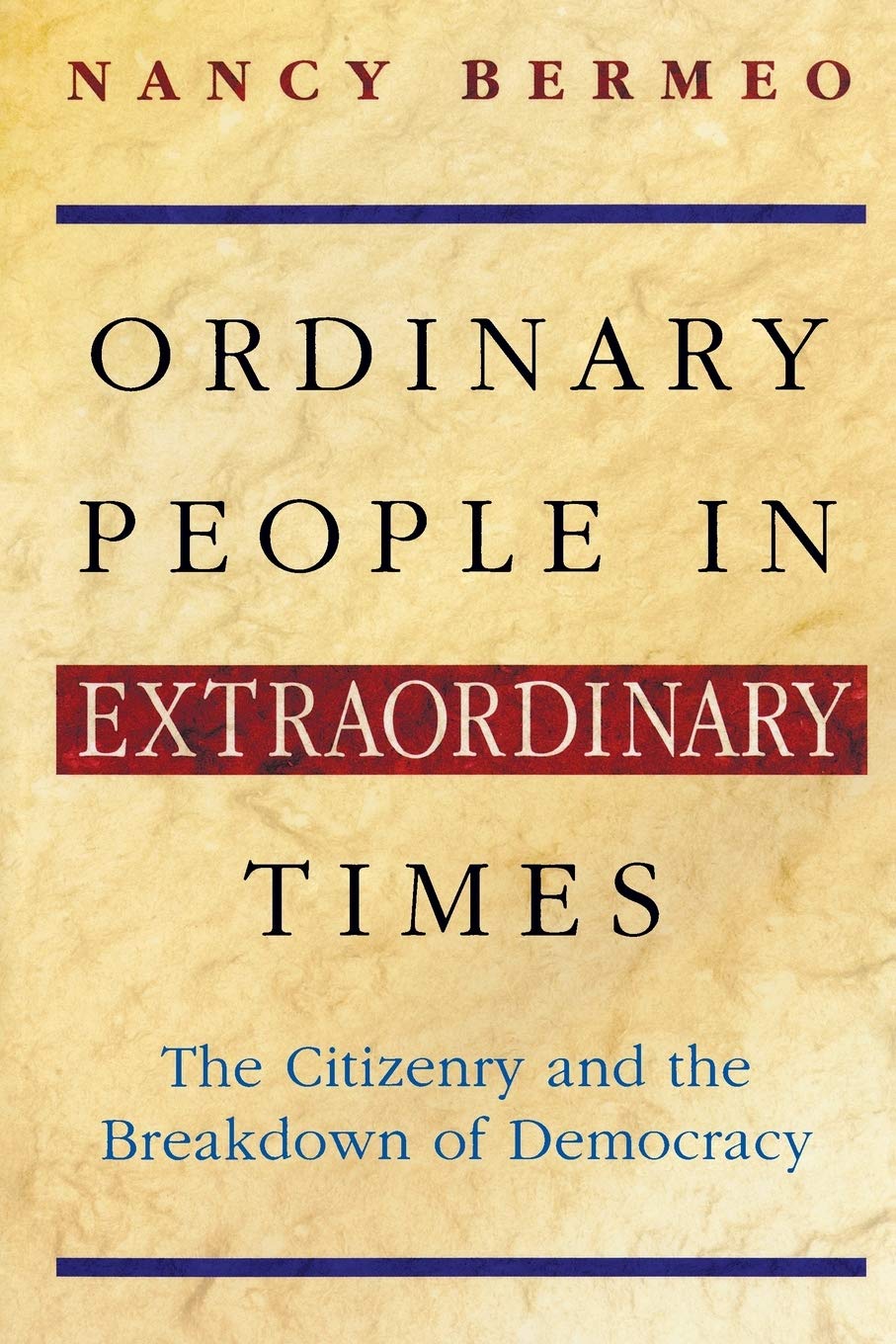
For generations, influential thinkersoften citing the tragic polarization that took place during Germany's Great Depressionhave suspected that people's loyalty to democratic institutions erodes under pressure and that citizens gravitate toward antidemocratic extremes in times of political and economic crisis. But do people really defect from democracy when times get tough? Do ordinary people play a leading role in the collapse of popular government?Based on extensive research, this book overturns the common wisdom. It shows that the German experience was exceptional, that people's affinity for particular political positions are surprisingly stable, and that what is often labeled polarization is the result not of vote switching but of such factors as expansion of the franchise, elite defections, and the mobilization of new voters. Democratic collapses are caused less by changes in popular preferences than by the actions of political elites who polarize themselves and mistake the actions of a few for the preferences of the many. These conclusions are drawn from the study of twenty cases, including every democracy that collapsed in the aftermath of the Russian Revolution in interwar Europe, every South American democracy that fell to the Right after the Cuban Revolution, and three democracies that avoided breakdown despite serious economic and political challenges.Unique in its historical and regional scope, this book offers unsettling but important lessons about civil society and regime changeand about the paths to democratic consolidation today.
⚠️ WARNING (California Proposition 65):
This product may contain chemicals known to the State of California to cause cancer,
birth defects, or other reproductive harm.
For MAP (Minimum Advertised Price) violations and Intellectual Property (IP) or Trademark concerns, please contact:
support@ergodebooks.com
⚠️ California Proposition 65 Warning: Some products sold on this website may expose you to chemicals known to the State of California to cause cancer, birth defects, or other reproductive harm. For more information, visit www.P65Warnings.ca.gov.