
Title

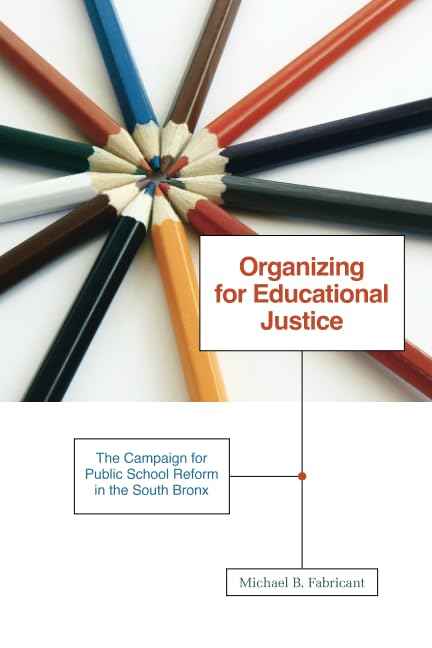
Organizing for Educational Justice: The Campaign for Public School Reform in the South Bronx,Used
Sold by Ergodebooks, an authorized reseller.
Returns accepted within 30 days | support@ergodebooks.com
Shipping Information
- Free Standard Shipping — United States only
- Processing Time: 3–5 business days
- Estimated Delivery: 6–10 business days after dispatch
- Double-boxed, fully insured & discreetly packaged
- Tracking number sent via email once dispatched
Returns & Refund
Returns accepted within 30 days of delivery.
Damaged or Defective Item
Free return shipping + replacement or full refund
Wrong Item Received
Free return shipping + replacement or full refund
Change of Mind
Return shipping at customer's expense · 25% restocking fee applies
Payment Option

Since the 1980s, strategies for improving public education in America have focused on either competition through voucher programs and charter schools or standardization as enacted into federal law through No Child Left Behind. These reforms, however, have failed to narrow the performance gap between poor urban students and other children. In response, parents have begun to organize local campaigns to strengthen the public schools in their communities. One of the most original, successful, and influential of these parentled campaigns has been the Community Collaborative to Improve District 9 (CC9), a consortium of six neighborhoodbased groups in the Bronx.In Organizing for Educational Justice, Michael B. Fabricant tells the story of CC9 from its origins in 1995 as a small group of concerned parents to the citywide application of its reform agendaconcentrating on targeted investment in the development of teacher capacityten years later. Drawing on indepth interviews with participants, analysis of qualitative data, and access to meetings and archives, Fabricant evaluates CC9s innovative approach to organizing and collaboration with other stakeholders, including the United Federation of Teachers, the NYC Department of Education, neighborhood nonprofits, and city colleges and universities.Situating this case within a wider exploration of parent participation in educational reform, Fabricant explains why CC9 succeeded and other parentled movements did not. He also examines the ways in which the movement effectively empowered parents by rigorously ensuring a democratic process in making decisions and, more broadly, an inclusive organizational culture. As urban parents across America search for ways to hold public schools accountable for their failures, this book shows how the success of the CC9 experience can be replicated elsewhere around the country.
⚠️ WARNING (California Proposition 65):
This product may contain chemicals known to the State of California to cause cancer, birth defects, or other reproductive harm.
For more information, please visit www.P65Warnings.ca.gov.